
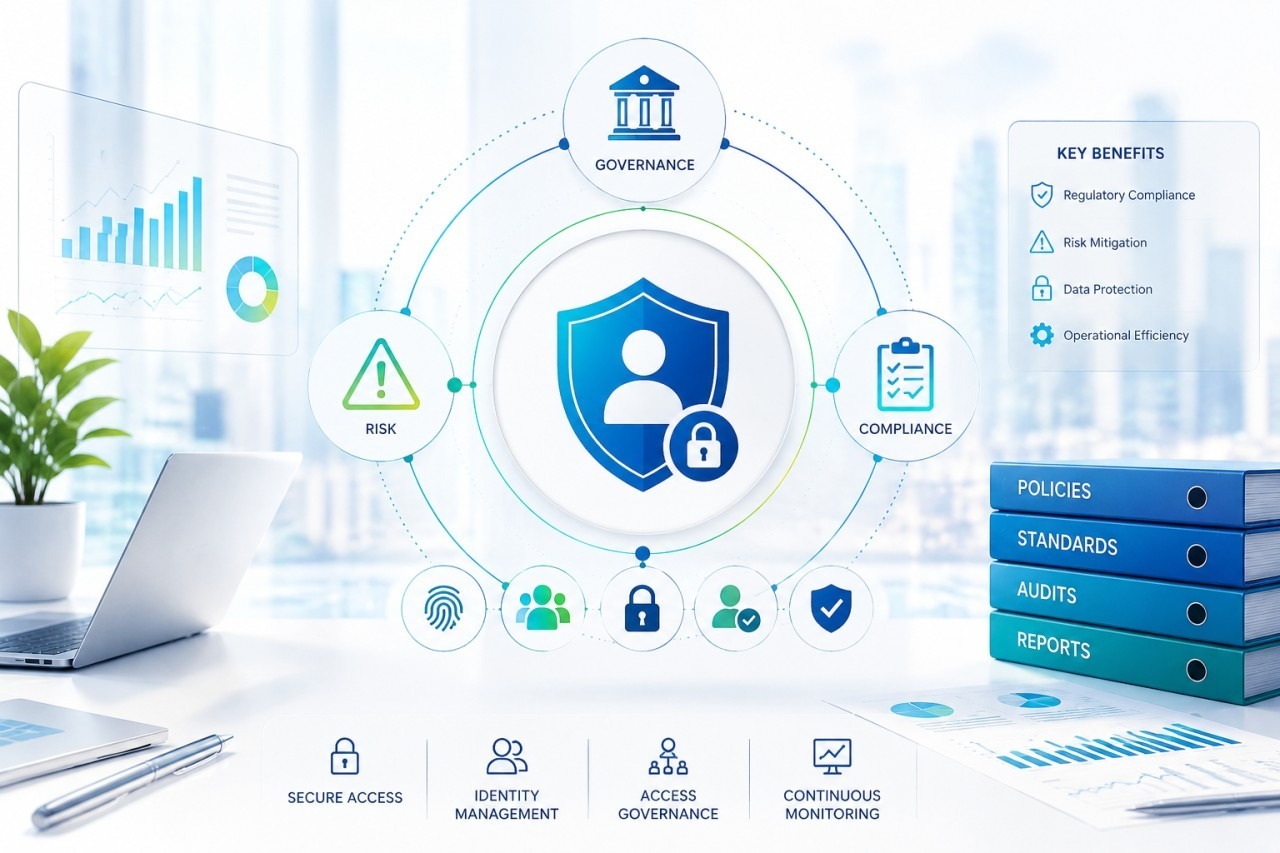
The financial services industry has never faced a more complex security and compliance landscape. Banks, credit unions, insurance firms, and fintech companies are dealing with an expanding attack surface driven by cloud adoption, remote workforces, open banking APIs, and increasingly sophisticated cyber threats. At the same time, regulators across the globe are tightening requirements, issuing new frameworks, and raising the stakes for non-compliance.
For most financial institutions, the traditional approach to Governance, Risk, and Compliance was built on spreadsheets, manual audits, and siloed compliance teams. That model does not scale anymore. When a single phishing attack can expose millions of customer records, or a misconfigured access privilege can open the door to insider fraud, the old ways of managing GRC are simply too slow and too fragile.
What has changed everything is identity. Every transaction, every login, every privileged action inside a financial system is tied to an identity. Managing those identities, controlling what they can access, and proving that access is appropriate is now the core of GRC in financial services. Identity and Access Management has evolved from an IT utility into a strategic compliance engine.
This guide covers everything banking CIOs, CISOs, compliance officers, and identity architects need to know about GRC in financial services, and how modern IAM platforms, Identity Governance, Privileged Access Management, and Zero Trust Security work together to keep institutions secure, compliant, and audit-ready.
What Is Governance, Risk, and Compliance (GRC)?
What Is GRC in Financial Services?
GRC in financial services is a unified framework that aligns an organization’s governance policies, risk management practices, and regulatory compliance obligations. For banks and financial institutions, GRC ensures that enterprise-wide security controls, access policies, and operational processes meet both internal standards and external regulatory requirements while reducing financial, legal, and reputational risk.
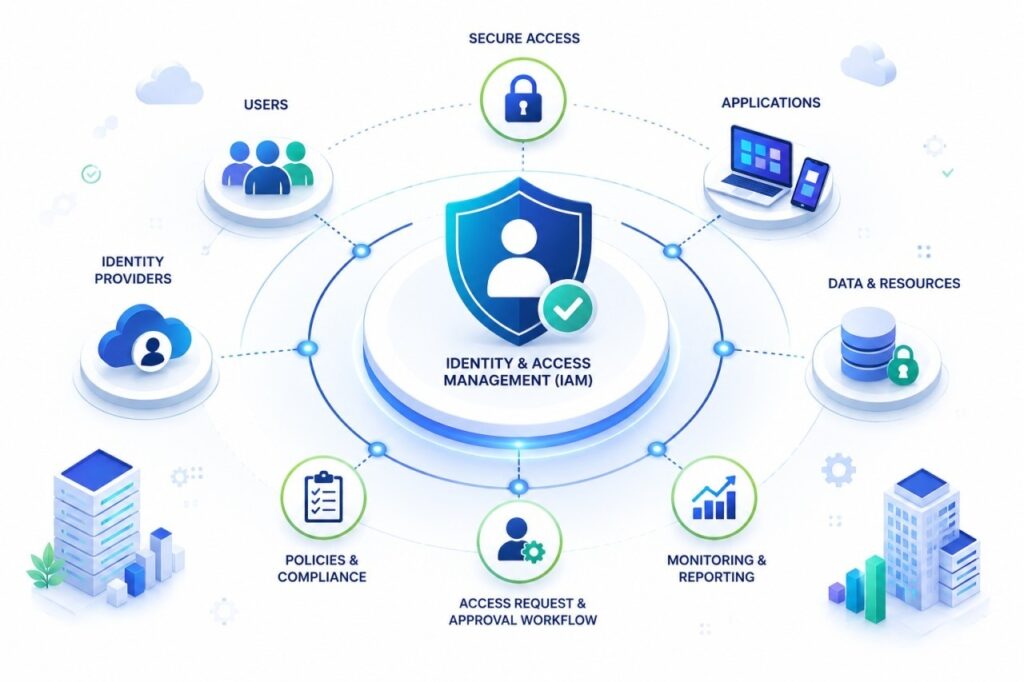
Governance Explained
Governance refers to the policies, processes, and decision-making structures that guide how an organization operates. In financial services, governance defines who is accountable for risk decisions, how access policies are created and enforced, and how leadership receives visibility into security posture and compliance status. Strong governance ensures that every business unit follows a consistent set of rules and that those rules are actually enforced at the system level, not just written in a policy document.
Risk Management Explained
Risk management is the process of identifying, assessing, and responding to threats that could harm the organization. In banking, risks span credit exposure, operational failures, cybersecurity incidents, third-party vulnerabilities, and regulatory violations. Effective risk management requires real-time insight into where risks exist, how severe they are, and what controls are in place to mitigate them. Identity analytics and access governance tools play a significant role here by flagging anomalous behavior, excessive privileges, and access policy violations before they become incidents.
Compliance Explained
Compliance is the practice of meeting the requirements set by external regulations and internal policies. For financial institutions, this means adhering to a complex web of mandates including SOX, PCI DSS, GLBA, GDPR, DORA, Basel III, FFIEC guidelines, and more. Compliance is not a one-time checkbox exercise. It requires continuous monitoring, documentation, audit trail maintenance, and evidence collection to demonstrate that controls are working as intended.
Why GRC Matters in Financial Services
Financial institutions operate under some of the most demanding regulatory environments of any industry. A compliance failure does not just result in a fine. It can trigger regulatory investigations, reputational damage, loss of customer trust, and in severe cases, loss of operating licenses. At the same time, the cyber threat landscape facing banking and financial services is relentless. According to industry research, financial services organizations face significantly more cyberattacks per year than the cross-industry average, with insider threats and credential-based attacks ranking among the top causes of data breaches.
A mature GRC strategy connects the dots between security, compliance, and business operations. When GRC is done well, it reduces audit costs, speeds up regulatory responses, improves security posture, and gives leadership the confidence to pursue digital transformation without accepting unacceptable risk.
Why Financial Institutions Need a Strong GRC Strategy

Regulatory Pressure
Regulators are not slowing down. The European Union introduced DORA (Digital Operational Resilience Act) to mandate operational resilience for financial entities. GDPR continues to evolve in enforcement scope. PCI DSS v4.0 introduced stricter authentication and access management requirements. FFIEC guidelines require financial institutions to demonstrate continuous risk assessment. Keeping up with this pace of regulatory change without automation is nearly impossible.
Increasing Cyber Threats
Ransomware targeting financial institutions has grown year over year. Credential stuffing attacks exploit stolen usernames and passwords to gain unauthorized access. Supply chain compromises expose banks through third-party software vulnerabilities. The 2023 IBM Cost of a Data Breach Report highlighted that financial services consistently rank among the most expensive industries for breach costs, often exceeding $5.9 million per incident.
Insider Risks
Not every threat comes from outside the organization. Employees, contractors, and service providers with excessive access privileges represent a significant and often underestimated risk. Insider threats whether intentional fraud, negligent misuse, or compromised credentials account for a growing proportion of financial data breaches. Detecting and controlling insider risk requires continuous monitoring of access behavior, automated detection of anomalies, and strict enforcement of least-privilege principles.
Third-Party Risks
Modern banks rely on hundreds of third-party vendors, cloud providers, and API partners. Each of these relationships creates potential access pathways into core financial systems. Managing vendor identities, enforcing access policies for third-party users, and continuously monitoring third-party access activity are critical components of a mature GRC program.
Cloud Adoption
The shift to cloud infrastructure has fundamentally changed the attack surface. Legacy perimeter security models do not translate effectively to cloud environments where resources, APIs, and services are distributed across multiple providers. Cloud-native IAM solutions that integrate with platforms like Microsoft Azure, AWS, and Google Cloud are essential for maintaining governance and compliance in hybrid environments.
Digital Banking
Mobile banking, open banking APIs, real-time payments, and digital lending platforms have created new identity challenges. Customer identities, partner identities, and machine identities all need to be managed, governed, and secured. Financial institutions must balance frictionless customer experiences with strong authentication and regulatory compliance.
Customer Trust
In a survey by Edelman, financial services ranked lower in customer trust compared to other industries, partly due to high-profile data breaches and privacy violations. Demonstrating robust GRC practices and investing in security is not just a compliance obligation. It is a customer retention strategy.
Business Continuity
Operational resilience requires that critical systems remain available even during cyberattacks, system failures, or large-scale disruptions. GRC frameworks that incorporate Business Continuity Planning (BCP), Disaster Recovery (DR), and Access Management ensure that the right people can access the right systems under any circumstances, including crisis scenarios.
Understanding IAM in Financial Services

What Is IAM?
Identity and Access Management (IAM) is the discipline of managing digital identities and controlling which users can access which systems, applications, and data. In financial services, IAM covers employees, contractors, customers, partners, and machine identities across on-premises, cloud, and hybrid environments.
IAM Components
A complete IAM architecture for financial services typically includes:
- Identity Governance and Administration (IGA)
- Privileged Access Management (PAM)
- Access Management and Single Sign-On (SSO)
- Multi-Factor Authentication (MFA) and Adaptive Authentication
- Directory Services (Active Directory, LDAP)
- Identity Analytics and Risk Intelligence
- User Provisioning and Deprovisioning
- Role Management and Access Certification
Identity Lifecycle Management
Identity Lifecycle Management refers to the end-to-end management of a user’s digital identity from onboarding through offboarding. In banking, this means automatically provisioning access when a new employee joins, updating access when roles change, and immediately revoking access when an employee leaves or a contractor’s engagement ends. Failures in lifecycle management are a leading cause of orphaned accounts, excessive access, and compliance violations.
Identity Governance
Identity Governance refers to the policies, processes, and technology that ensure access rights are appropriate, authorized, and continuously reviewed. It connects IAM operations to compliance requirements by making access decisions auditable, defensible, and aligned with regulatory standards.
Access Management
Access Management controls how users authenticate and what resources they can reach. It includes Single Sign-On (SSO) for seamless user experiences, federation for cross-domain access, and session management for monitoring active connections. In financial services, access management must be tightly integrated with risk-based controls that can step up authentication requirements when unusual behavior is detected.
Authentication
Modern financial institutions have moved well beyond usernames and passwords. Multi-Factor Authentication (MFA), Passwordless Authentication, Adaptive Authentication, and Risk-Based Authentication are now standard expectations for both employees and customers. Regulators including PCI DSS, FFIEC, and DORA explicitly require strong authentication for access to sensitive financial systems.
Authorization
Authorization determines what actions an authenticated user is permitted to perform. Role-Based Access Control (RBAC) assigns permissions based on job function. Attribute-Based Access Control (ABAC) applies more granular policies based on user attributes, resource context, and environmental factors. In practice, most financial institutions use a hybrid approach.
Identity Analytics
Identity Analytics applies machine learning and behavioral analysis to identity data to detect anomalies, excessive access, toxic role combinations, and signs of account compromise. Platforms like SailPoint, Saviynt, and IBM Security Verify incorporate identity analytics to surface risk scores and trigger automated remediation workflows.
How IAM Helps Manage GRC
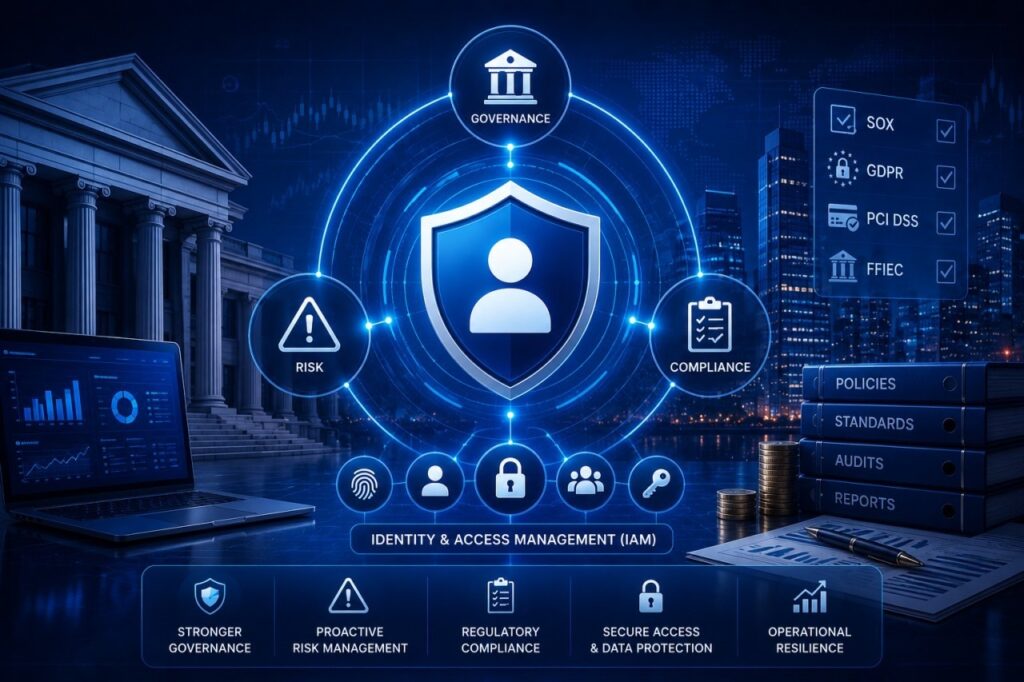
Automated User Provisioning
Manual provisioning is slow, error-prone, and inconsistent. Automated provisioning connects HR systems, Active Directory, and business applications to ensure that users receive the correct access rights automatically, based on their role, department, and employment status. This reduces the time to productivity for new employees while ensuring that access assignments are consistent and auditable.
Automated Deprovisioning
When an employee leaves or a contractor’s engagement ends, their access must be revoked immediately. Automated deprovisioning triggered by HR system updates ensures that no orphaned accounts linger in financial systems. Orphaned accounts are a frequent finding in regulatory audits and a common vector for unauthorized access.
Access Reviews
Regular access reviews or access certifications are a core requirement under SOX, PCI DSS, and other regulations. IAM platforms automate the scheduling, distribution, and tracking of access review campaigns, allowing managers and data owners to review and certify access rights through simple dashboards. Exceptions and revocations are tracked automatically for audit evidence.
Role-Based Access Control (RBAC)
RBAC assigns access permissions based on the user’s job role. In banking, this means a loan officer sees lending systems, a compliance officer sees audit tools, and a help desk analyst has a limited set of support permissions. RBAC simplifies access management at scale and forms the foundation of most financial services access governance programs.
Attribute-Based Access Control (ABAC)
ABAC extends RBAC by adding contextual attributes to access decisions. A trader might be allowed to view trading positions during business hours from a corporate device but denied access from an unmanaged personal device at 2 AM. ABAC enables financial institutions to enforce fine-grained, context-aware access policies that go beyond static role assignments.
Segregation of Duties (SoD)
Segregation of Duties is a foundational control that prevents any single individual from having the ability to execute conflicting high-risk activities. In banking, SoD policies prevent users from both initiating and approving the same financial transaction, or from having access to both trade execution and trade settlement systems. IAM platforms enforce SoD rules at provisioning time and continuously monitor for violations.
Privileged Access Management (PAM)
Privileged accounts, system administrators, database accounts, and service accounts have elevated access to critical financial infrastructure. PAM solutions from providers like CyberArk and Delinea vault privileged credentials, enforce session recording, require just-in-time access approvals, and provide full audit trails of privileged activity. PAM is a critical control for both cybersecurity and regulatory compliance.
Identity Governance
IGA platforms like SailPoint and Saviynt provide a governance layer over IAM operations, connecting access policies to compliance requirements. They automate access certifications, detect policy violations, generate compliance reports, and provide risk-weighted visibility into the access landscape across the entire organization.
Audit Trails
Every access event, provisioning change, authentication attempt, and privileged action must be logged and preserved for regulatory review. IAM platforms integrate with SIEM tools like Splunk and Microsoft Defender to provide centralized, tamper-evident audit trails that satisfy regulators and support forensic investigations.
Compliance Reporting
Compliance teams spend enormous amounts of time manually compiling evidence for audits. Modern IAM platforms automate compliance report generation, mapping access controls to specific regulatory requirements and producing audit-ready documentation on demand. This reduces audit preparation time from weeks to hours.
Risk Reduction
By enforcing least-privilege access, continuously monitoring for anomalies, automating deprovisioning, and detecting SoD violations, IAM directly reduces the probability and impact of both external cyberattacks and insider threats. Risk reduction is not just a security outcome. It translates directly into lower regulatory risk, fewer audit findings, and reduced breach costs.
Key GRC Regulations Affecting Financial Institutions
Regulation Comparison Table
| Regulation | Purpose | IAM’s Role |
|---|---|---|
| SOX (Sarbanes-Oxley) | Financial reporting integrity | Access controls, SoD, audit trails |
| PCI DSS | Payment card data protection | MFA, access restriction, privileged access |
| GLBA | Consumer financial data privacy | Access governance, data protection |
| GDPR | EU personal data protection | Data access controls, consent management |
| CCPA | California consumer privacy | Access governance, data subject rights |
| Basel III | Banking capital adequacy and risk | Operational risk controls, access governance |
| FFIEC Guidelines | US banking examination standards | Authentication, access management |
| PSD2 | Open banking and payment security | Strong authentication, API access governance |
| DORA | Digital operational resilience (EU) | Resilience, third-party access, ICT risk |
| AML / KYC | Anti-money laundering, customer verification | Identity verification, access to AML systems |
| ISO 27001 | Information security management | Comprehensive IAM controls |
| NIST Cybersecurity Framework | US cybersecurity best practices | Identity, access, detect, respond |
SOX
The Sarbanes-Oxley Act requires publicly traded companies including financial institutions to maintain strict internal controls over financial reporting. SOX Section 404 mandates that management assess and report on the effectiveness of internal controls. Access controls, SoD enforcement, and audit trails managed by IAM platforms are central to SOX compliance.
Basel III
The Basel III framework developed by the Basel Committee on Banking Supervision sets international standards for bank capital adequacy, stress testing, and liquidity. From an operational risk perspective, Basel III requires banks to maintain robust controls over IT systems, access management, and data integrity.

PCI DSS
The Payment Card Industry Data Security Standard requires any organization that processes, stores, or transmits payment card data to implement strict access controls. PCI DSS v4.0 requires MFA for all access to the cardholder data environment (CDE), strong password policies, and regular access reviews.
GLBA
The Gramm-Leach-Bliley Act requires US financial institutions to protect consumer financial information. The GLBA Safeguards Rule requires a written information security program that includes access controls, risk assessment, and regular testing.
GDPR
The General Data Protection Regulation applies to financial institutions processing personal data of EU residents. GDPR requires data minimization, purpose limitation, and the ability to respond to data subject access requests. IAM governs who can access personal data and provides the audit trails required to demonstrate compliance.
PSD2
The EU’s Revised Payment Services Directive requires Strong Customer Authentication (SCA) for electronic payments. PSD2 has driven adoption of adaptive authentication and MFA across European banking, and has shaped open banking API security standards globally.
AML and KYC
Anti-Money Laundering and Know Your Customer regulations require financial institutions to verify customer identities and monitor transactions for suspicious activity. Identity Governance tools support AML compliance by ensuring that only authorized analysts have access to sensitive transaction monitoring systems, and that access is reviewed regularly.
DORA
The Digital Operational Resilience Act, effective from January 2025, requires EU financial entities to demonstrate operational resilience against ICT disruptions, including cyberattacks. DORA mandates third-party risk management, ICT incident reporting, and continuous testing of resilience measures. IAM and PAM are critical controls under DORA’s requirements for managing third-party access and privileged users.
ISO 27001
ISO 27001 provides a framework for an Information Security Management System (ISMS). Access control is one of the core domains, requiring financial institutions to implement identity management, authentication, and authorization policies aligned with their risk appetite.
NIST Cybersecurity Framework
The NIST CSF provides a voluntary but widely adopted framework for managing cybersecurity risk. Its Identify, Protect, Detect, Respond, and Recover functions all have strong IAM dependencies. The NIST Special Publication 800-63 series sets detailed guidelines for digital identity, authentication, and federation.
Identity Governance and Administration (IGA)

What Is IGA?
Identity Governance and Administration (IGA) is a subset of IAM focused specifically on the governance layer: ensuring access rights are appropriate, aligned with policy, and continuously managed throughout the identity lifecycle. IGA platforms like SailPoint IdentityNow, Saviynt, and One Identity Manager provide the automation and visibility needed to manage access governance at enterprise scale.
Access Certification
Access certification is the process of reviewing and confirming that users’ access rights are still appropriate for their current role. IGA platforms automate certification campaigns by routing access reviews to the appropriate approvers, tracking completion, and automatically revoking access where certification is not granted. This satisfies audit requirements under SOX, PCI DSS, and FFIEC while dramatically reducing the manual burden on compliance teams.
User Access Reviews
User Access Reviews are a specific type of access certification focused on reviewing individual user accounts and their associated permissions. In financial services, access reviews are typically performed quarterly or annually, depending on the sensitivity of the systems involved. Automated reviews through IGA platforms ensure consistency, completeness, and audit documentation.
Policy Enforcement
IGA platforms enforce access policies at provisioning time and continuously check for policy violations. If a user’s role assignment would create an SoD conflict, the IGA platform blocks the assignment and triggers a review workflow. Policy enforcement in IGA ensures that the access landscape remains compliant even as users change roles and responsibilities.
Compliance Automation
Compliance automation reduces the time and effort required to demonstrate regulatory compliance. IGA platforms map access controls to regulatory frameworks, automatically generate evidence packages for audits, and provide real-time compliance dashboards that show current control status. Financial institutions using compliance automation report significant reductions in audit preparation time and fewer findings.
Identity Lifecycle
IGA manages the complete identity lifecycle including joiner, mover, and leaver processes. Automated workflows triggered by HR events ensure that new employees receive appropriate access on day one, that access is updated when employees change roles, and that access is revoked the moment an employee departs. This lifecycle automation is essential for maintaining compliance and reducing risk from orphaned accounts.
Risk Intelligence
Advanced IGA platforms incorporate risk intelligence engines that score users and access rights based on sensitivity, usage patterns, and behavioral analytics. High-risk users or access combinations trigger automated reviews or additional authentication requirements. This risk-aware governance model helps financial institutions prioritize compliance efforts on the highest-risk areas.
Segregation of Duties (SoD): Preventing Fraud Through IAM
What Is SoD?
Segregation of Duties (SoD) is a fundamental internal control that divides critical business processes among multiple individuals to prevent any single person from having complete control over a high-risk transaction. In financial services, SoD is a core requirement under SOX, Basel III, and virtually every major regulatory framework.
Common SoD Conflicts in Banking
| Conflict Type | Example | Risk |
|---|---|---|
| Initiation and approval | Same user initiates and approves a wire transfer | Unauthorized fund movement |
| Trade and settlement | Trader also controls trade settlement | Front-running, unauthorized positions |
| IT access and financial records | Admin with access to both systems and accounting data | Data manipulation |
| User creation and entitlement | Same admin creates users and assigns privileges | Privilege abuse |
| Purchasing and payment | Same employee creates and pays vendor invoices | Invoice fraud |
Automated SoD Analysis
Manual SoD analysis cannot keep pace with the speed and scale of modern financial operations. IGA platforms with SoD analysis capabilities, including tools like SailPoint, Saviynt, and Oracle Identity Manager, continuously analyze role assignments across connected applications, detect conflicting permissions, and flag violations for review. Role mining tools analyze existing access patterns to build a clean, compliant role model.
Financial Services Use Cases
A regional bank deploying SoD controls through an IGA platform reduced segregation of duties violations by over 80% within six months of implementation. Automated SoD analysis during provisioning prevented 93% of conflicts from ever being granted, shifting the compliance posture from reactive to preventive. Audit findings related to access controls dropped significantly in the following regulatory examination cycle.
Zero Trust and Financial Compliance

Identity-Centric Security
Zero Trust Architecture replaces the assumption that everything inside the network perimeter is safe. Instead, Zero Trust starts from the principle that no user, device, or system should be trusted by default, regardless of where it is located. In financial services, this means every access request must be authenticated, authorized, and continuously validated.
Continuous Verification
Under a Zero Trust model, authentication is not a one-time event at login. Sessions are continuously monitored for changes in user behavior, device posture, and network context. If a user’s behavior deviates from their baseline, the system can step up authentication requirements or terminate the session automatically.
Least Privilege Access
Zero Trust mandates least privilege access, meaning every user, application, and service receives only the minimum access necessary to perform its function. In banking, this prevents privilege accumulation over time, reduces the blast radius of compromised accounts, and directly addresses a common audit finding in SOX and PCI DSS reviews.
Adaptive Authentication
Adaptive Authentication dynamically adjusts authentication requirements based on contextual risk signals. A trader logging in from their usual corporate workstation during business hours might authenticate with a single password and MFA push. The same trader logging in from an overseas IP address at 3 AM would face additional verification challenges. Solutions from Microsoft Entra ID, Okta, and Ping Identity implement adaptive authentication policies that balance security with user experience.
Micro-Segmentation
Micro-segmentation divides the network into small, isolated zones, preventing lateral movement if an account is compromised. In financial services, this means an attacker who compromises a customer service workstation cannot easily pivot to core banking systems or trading platforms. Micro-segmentation combined with identity-based access policies creates a defense-in-depth approach that significantly limits breach impact.
Risk-Based Access
Risk-Based Access Control evaluates real-time risk factors, including user behavior analytics, threat intelligence, and device health, before granting or restricting access. IAM platforms with integrated identity analytics from IBM Security Verify or Saviynt can score access requests in real time and apply dynamic policies based on current risk levels.
Best Practices for Managing GRC with IAM
Enterprise GRC Implementation Checklist
Identity Governance
- Implement an IGA platform aligned with business processes and compliance requirements
- Define and document role taxonomy across all business units
- Establish automated joiner, mover, leaver workflows
- Schedule and automate quarterly or semi-annual access certifications
- Implement SoD policies for all high-risk business processes
Access Management
- Deploy MFA for all employees, contractors, and privileged users
- Implement SSO across all enterprise applications
- Configure risk-based and adaptive authentication policies
- Apply least privilege access principles across all systems
- Establish third-party access governance processes
Privileged Access Management
- Vault all privileged credentials in a PAM solution
- Implement just-in-time access for privileged operations
- Enable full session recording for privileged users
- Review and recertify all privileged accounts quarterly
- Integrate PAM with SIEM for real-time alerting on privileged activity
Compliance Automation
- Map IAM controls to applicable regulatory frameworks
- Automate compliance report generation and evidence collection
- Configure real-time dashboards for compliance status
- Establish automated alert workflows for policy violations
- Conduct regular penetration testing and access control reviews
Monitoring and Analytics
- Integrate IAM with SIEM (Splunk, Microsoft Defender, etc.)
- Enable identity analytics for behavioral anomaly detection
- Establish KPIs and metrics for IAM performance and compliance
- Implement continuous controls monitoring
- Define and test incident response procedures for identity-related incidents
Additional Best Practices
Continuous Monitoring: Real-time visibility into access events, provisioning changes, and authentication failures is essential for both cybersecurity and compliance. Continuous monitoring through integrated IAM and SIEM platforms ensures that anomalies are detected and investigated promptly.
AI-Based Risk Analytics: Modern IAM platforms incorporate machine learning models that analyze access patterns, detect unusual behavior, and predict risk before incidents occur. AI-driven risk analytics from platforms like SailPoint, Saviynt, and IBM Security Verify help compliance teams prioritize remediation efforts on the highest-risk access scenarios.
Compliance Dashboards: Real-time compliance dashboards provide CISOs, compliance officers, and risk managers with instant visibility into the current state of access controls, outstanding certifications, SoD violations, and audit readiness scores.
Third-Party Risk Management: Assign unique identities to all third-party users, enforce just-in-time access, require MFA for all vendor access, and conduct regular access reviews for vendor accounts. Tools like ServiceNow GRC can integrate with IAM platforms to provide unified third-party risk management.
Security Awareness: Technology controls alone are insufficient. Regular training on phishing awareness, password hygiene, and access policy obligations is essential for maintaining a strong human layer of defense.
Common Challenges in Financial GRC
Legacy Systems
Many financial institutions operate core banking systems that are decades old and were never designed with modern identity standards in mind. Integrating these legacy platforms with contemporary IAM solutions requires custom connectors, middleware, and careful planning. Legacy systems often lack API support, making automated provisioning and access governance more complex.
Manual Compliance Processes
Compliance teams in many banks still rely heavily on manual processes for access reviews, evidence collection, and regulatory reporting. Manual processes are slow, error-prone, and difficult to scale. They also create inconsistency in how controls are documented and evidenced, which creates risk during regulatory examinations.
Identity Sprawl
As financial institutions adopt more cloud applications, SaaS platforms, and third-party services, the number of identities that need to be managed grows rapidly. Identity sprawl, where users accumulate accounts across dozens of disconnected systems, creates orphaned accounts, excessive privileges, and visibility gaps that undermine compliance.
Regulatory Changes
The regulatory landscape evolves continuously. New regulations, updated guidance, and changing enforcement priorities require compliance programs to adapt quickly. Without a flexible, policy-driven IAM platform, keeping pace with regulatory change requires significant manual effort.
Shadow IT
Business units sometimes adopt cloud applications and SaaS tools without going through formal IT approval processes. These shadow IT deployments operate outside the organization’s IAM controls, creating unmanaged access risks and compliance gaps. Continuous discovery and integration of new applications into the IAM framework is essential.
Cloud Complexity
Multi-cloud and hybrid cloud environments create significant complexity for identity and access governance. Different cloud providers have different native identity models, access control mechanisms, and logging capabilities. A unified cloud-native IAM approach that abstracts these differences is critical for maintaining governance across distributed environments.
Third-Party Vendors
Managing access for hundreds of external vendors, consultants, and partners is one of the most challenging aspects of financial GRC. Third-party accounts are often poorly managed, overly privileged, and infrequently reviewed. Building a formal vendor identity management program with automated access controls, MFA enforcement, and regular reviews is a high-priority compliance improvement for most financial institutions.
Insider Threats
Detecting insider threats requires behavioral analytics, continuous monitoring, and the ability to correlate access events across multiple systems. Many financial institutions lack the visibility to detect subtle signs of insider abuse, such as unusual data access patterns or privilege escalation attempts. IGA platforms with identity analytics capabilities fill this gap.
Future Trends in GRC and IAM
AI-Powered Compliance
Artificial intelligence is transforming GRC by automating control monitoring, predicting compliance risks, and reducing the manual burden on compliance teams. AI models can analyze thousands of access events per second to detect anomalies, identify toxic access combinations, and prioritize remediation. As AI capabilities mature, compliance automation will become increasingly autonomous and predictive.
Continuous Controls Monitoring
Traditional compliance programs rely on point-in-time audits and periodic reviews. Continuous Controls Monitoring (CCM) provides real-time assurance that controls are operating effectively by constantly testing and validating their status. CCM platforms integrated with IAM provide instant alerts when controls fail or drift, dramatically reducing the window of exposure for compliance violations.
Identity Threat Detection and Response (ITDR)
Identity Threat Detection and Response (ITDR) is an emerging capability that focuses specifically on detecting and responding to identity-based attacks. ITDR solutions analyze authentication events, access patterns, and identity infrastructure activity to detect account takeovers, lateral movement, and privilege escalation in real time. CrowdStrike, Microsoft Defender for Identity, and Semperis are leading providers in this space.
Passwordless Authentication
Passwordless authentication, using biometrics, hardware security keys (FIDO2), or certificate-based authentication, eliminates the password as an attack vector. Financial institutions are increasingly adopting passwordless authentication for both employees and customers to reduce the risk of credential theft while improving user experience. Microsoft Entra ID and Okta both support comprehensive passwordless deployment models.
Machine Identity Governance
As financial institutions deploy more automated systems, APIs, microservices, and robotic process automation (RPA) bots, the number of machine identities that need to be managed is exploding. Machine Identity Governance ensures that service accounts, API keys, certificates, and bot credentials are managed with the same rigor as human identities, preventing machine credential abuse.
Cloud-Native IAM
Cloud-native IAM solutions are designed to operate natively in cloud environments, supporting dynamic resource provisioning, containerized workloads, and serverless architectures. As financial institutions accelerate cloud migration, cloud-native IAM from providers like Microsoft Entra ID and AWS IAM becomes the operational standard.
Regulatory Automation
Regulatory technology (RegTech) solutions are emerging that automate the mapping of IT controls to regulatory requirements, track regulatory changes, and automatically update compliance frameworks. Integrated with IAM platforms, RegTech tools reduce the lag between new regulatory requirements and updated compliance controls.
Zero Trust Banking
Zero Trust Architecture is rapidly becoming the baseline security model for financial institutions. Zero Trust Banking extends identity-centric security principles to every layer of the banking technology stack, from customer-facing applications to core banking systems and internal IT infrastructure.
How Avancer Corporation Helps Financial Institutions Achieve GRC Excellence
Avancer Corporation is a specialized Identity and Access Management services firm with deep expertise in financial services. The team brings hands-on experience implementing enterprise IAM, IGA, PAM, and Zero Trust solutions for banks, insurance companies, credit unions, and fintech organizations across North America and globally.
Identity and Access Management (IAM)
Avancer designs and implements comprehensive IAM architectures tailored to the specific operational and regulatory requirements of financial institutions. Whether integrating Microsoft Entra ID, Okta, Ping Identity, or IBM Security Verify, Avancer’s architects ensure that IAM platforms are configured to support compliance requirements from day one.
Identity Governance and Administration (IGA)
Avancer is a recognized implementation partner for leading IGA platforms including SailPoint, Saviynt, and One Identity Manager. Avancer helps financial institutions automate access certifications, manage the complete identity lifecycle, enforce SoD policies, and generate compliance reports aligned with SOX, PCI DSS, and other regulatory frameworks.
Privileged Access Management (PAM)
Avancer implements PAM solutions from CyberArk and Delinea to protect privileged credentials, enforce just-in-time access, and provide complete session recording for all privileged activity in financial environments. Avancer’s PAM implementations help financial institutions satisfy audit requirements for privileged access monitoring under SOX, PCI DSS, and FFIEC guidelines while dramatically reducing the risk of credential-based attacks.
Zero Trust Security
Avancer helps financial institutions design and implement Zero Trust architectures that apply identity-centric security principles across every layer of the technology stack. From defining access policies to deploying micro-segmentation and integrating adaptive authentication, Avancer’s Zero Trust consulting practice delivers measurable risk reduction and compliance improvement for banks and financial services firms.
Single Sign-On (SSO)
Managing separate credentials for dozens of enterprise applications is both a security risk and a productivity drain. Avancer implements enterprise SSO solutions that give financial services employees seamless, secure access to all authorized applications through a single authenticated session. SSO reduces password fatigue, supports MFA enforcement, and simplifies access governance by centralizing authentication.
Multi-Factor Authentication (MFA)
Avancer configures and deploys MFA solutions across employee, contractor, and customer-facing environments. Whether deploying push notifications, hardware tokens, FIDO2 passkeys, or biometric authentication, Avancer ensures that MFA implementations align with regulatory requirements including PCI DSS v4.0, FFIEC authentication guidance, and DORA operational resilience mandates.
Access Governance
Avancer designs access governance frameworks that connect identity data, business roles, and compliance policies into a unified governance model. Access governance engagements typically include role mining and rationalization, access certification program design, SoD policy development, and integration with GRC platforms like ServiceNow GRC for enterprise risk visibility.
Compliance Automation
Avancer helps financial institutions replace manual compliance processes with automated workflows that continuously collect evidence, generate audit reports, and maintain real-time compliance dashboards. By mapping IAM controls to specific regulatory frameworks including SOX, PCI DSS, GLBA, GDPR, and Basel III, Avancer delivers compliance automation programs that reduce audit preparation time and improve examiner confidence.
Regulatory Readiness
Avancer conducts comprehensive IAM and GRC readiness assessments aligned with FFIEC examination procedures, PCI DSS requirements, SOX Section 404 controls, and other applicable standards. These assessments identify control gaps, prioritize remediation, and provide a clear roadmap to audit readiness. Financial institutions that engage Avancer before regulatory examinations consistently report fewer findings and faster examination cycles.
Managed IAM Services
For financial institutions that want the benefits of enterprise IAM without the operational overhead of managing it internally, Avancer offers Managed IAM Services. These services include ongoing platform administration, access certification management, user provisioning support, compliance monitoring, and continuous improvement of the identity governance program. Managed services allow compliance and security teams to focus on strategic priorities while Avancer handles day-to-day IAM operations.
Security Assessments
Avancer’s identity security assessments provide financial institutions with a detailed, objective evaluation of their current IAM posture, including privileged access exposure, orphaned account inventory, SoD violation analysis, and authentication control effectiveness. Assessment findings are mapped to regulatory requirements and business risk to provide prioritized, actionable recommendations.
Financial Services Consulting
Avancer’s financial services consulting practice brings together expertise in IAM technology, banking regulations, and enterprise risk management to help institutions design GRC programs that are both technically sound and operationally practical. Avancer consultants have worked across commercial banking, investment management, insurance, credit unions, mortgage services, and fintech, bringing relevant regulatory and operational context to every engagement.
Conclusion:
Governance, Risk, and Compliance in financial services have fundamentally changed. What was once a set of parallel, often disconnected functions handled by separate teams is now a tightly integrated discipline that runs through every layer of the banking technology stack. Regulators expect continuous compliance, not periodic audits. Cyber adversaries probe financial systems constantly for identity-based weaknesses. Customers expect their institutions to protect their data with the highest possible standards.
The answer is not more manual processes. The answer is modern Identity and Access Management, built on Identity Governance, Privileged Access Management, Zero Trust architecture, and intelligent automation.
When identity is properly governed, provisioning is automated, SoD is continuously enforced, privileged access is controlled, and compliance is monitored in real time, financial institutions gain something that has historically been very hard to achieve: genuine, continuous, audit-ready GRC at enterprise scale.
Avancer Corporation has helped banks, insurance companies, credit unions, fintech firms, and other financial services organizations build exactly this kind of modern, mature GRC capability. Whether you are starting from scratch, modernizing a legacy IAM environment, preparing for a regulatory examination, or implementing Zero Trust across a complex hybrid infrastructure, Avancer brings the expertise, methodology, and platform knowledge to get it done.
If your organization is ready to strengthen its GRC posture through modern Identity and Access Management, connect with Avancer Corporation to schedule a complimentary IAM and compliance assessment. Your path to a secure, compliant, and future-ready financial institution starts with identity.
Frequently Asked Questions:
What is GRC in Financial Services?
GRC in financial services refers to the integrated management of Governance, Risk, and Compliance within banking and financial institutions. It encompasses the policies, processes, and technology controls that ensure financial organizations operate within regulatory requirements, manage operational and cyber risks effectively, and maintain strong governance over their systems, data, and user access.
Why is GRC important for banks?
Banks operate under some of the most complex and demanding regulatory environments of any industry. GRC provides the framework for meeting obligations under SOX, PCI DSS, GLBA, GDPR, DORA, and other regulations while managing cyber risk, preventing fraud, and protecting customer data. Without a mature GRC program, banks face regulatory fines, audit failures, reputational damage, and increased exposure to cyberattacks.
How does IAM support compliance?
Identity and Access Management supports compliance by automating access provisioning and deprovisioning, enforcing least-privilege access, managing Segregation of Duties policies, enabling access certifications, generating audit trails, and producing compliance reports mapped to regulatory frameworks. IAM provides the technical controls that auditors look for when assessing whether access to sensitive financial systems is properly governed.
What is Identity Governance?
Identity Governance is the set of policies, processes, and technology that ensures user access rights are appropriate, authorized, and continuously reviewed. It covers the complete identity lifecycle from onboarding to offboarding, access certification programs, SoD policy enforcement, and risk-based access controls. Identity Governance platforms like SailPoint and Saviynt automate these processes at enterprise scale.
What is Segregation of Duties (SoD)?
Segregation of Duties is an internal control that prevents any single individual from having complete control over a critical business process. In banking, SoD prevents users from being able to both initiate and approve the same financial transaction, reducing the risk of fraud and errors. IGA platforms enforce SoD policies at provisioning time and continuously monitor for violations.
How does automated provisioning improve compliance?
Automated provisioning ensures that user access rights are assigned consistently based on defined role policies rather than ad hoc manual decisions. It eliminates errors and delays in access assignment, reduces the risk of users receiving inappropriate access, and creates complete audit trails of every provisioning action. Automated provisioning also ensures that access is revoked immediately when employees leave or change roles, closing a common compliance vulnerability.
What is Access Governance?
Access Governance is the discipline of managing and overseeing user access rights to ensure they remain appropriate, authorized, and aligned with business policies and regulatory requirements. It includes defining access policies, conducting regular access reviews, enforcing SoD controls, and maintaining documentation that demonstrates access is properly controlled. Access Governance is a core requirement under SOX, PCI DSS, and virtually every major financial services regulation.
What is compliance automation?
Compliance automation uses technology to replace manual compliance processes with automated workflows that continuously collect evidence, monitor control effectiveness, generate audit reports, and alert compliance teams to violations. In financial services, compliance automation reduces audit preparation time from weeks to hours, improves the consistency and accuracy of compliance evidence, and enables real-time visibility into the organization’s current compliance posture.
