
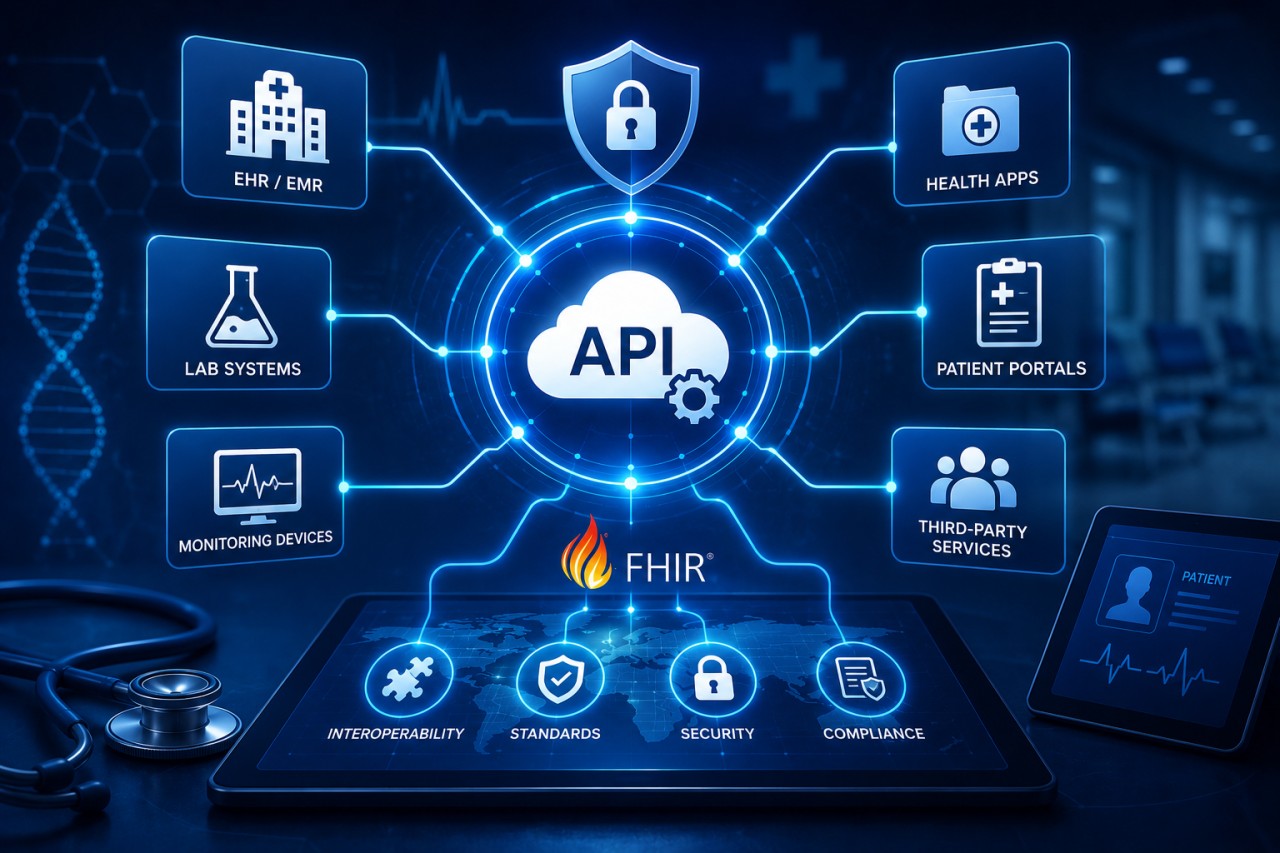
Healthcare has been quietly going through one of the most significant technology shifts in its history. Over the past decade, the paper chart gave way to the Electronic Health Record (EHR). The in-person office visit got a digital twin in telemedicine. Patient portals, wearables, remote monitoring devices, and AI-driven diagnostic tools all joined the ecosystem. And behind nearly every one of these innovations is the same fundamental technology: an API.
Healthcare APIs are what make it possible for a cardiologist in Boston to pull up a patient’s radiology images captured in Phoenix. They are how a pharmacy management system confirms a prescription against a patient’s medication history stored in a different EHR. They are the reason your health app can pull glucose readings from a continuous monitor and push alerts to your care team in real time.
But as connected healthcare grows, so does its attack surface. Healthcare organizations are consistently among the most targeted sectors for cyberattacks. Patient data is extraordinarily valuable on the black market. A single breach can expose millions of records, trigger massive HIPAA penalties, and destroy patient trust overnight.
This guide covers everything healthcare technology leaders, security professionals, IT architects, and compliance officers need to know about healthcare APIs. That includes how they work, which standards matter, how to secure them properly, what compliance requires, and how Identity and Access Management (IAM) sits at the center of every secure healthcare API strategy.
What Are Healthcare APIs?
Definition
Healthcare APIs (Application Programming Interfaces) are standardized software interfaces that allow different healthcare systems, applications, and platforms to communicate, share data, and trigger actions with each other securely. In simple terms, a healthcare API is a set of rules and protocols that lets one software system talk to another, whether that is an EHR platform sharing a patient record with a patient portal, or a hospital system sending lab results to a physician’s mobile app.
In the context of healthcare, these APIs handle sensitive clinical, administrative, and financial data, making security, compliance, and data governance critical from day one.
How Healthcare APIs Work
At a basic level, a healthcare API works through a request-response model. One system (the client) sends a request to another system (the server) asking for data or asking the system to perform an action. The server processes the request, verifies the identity and permissions of the requesting system, and returns the appropriate response.
For example, when a patient checks in at a specialist’s office and the front desk pulls their medical history from an external EHR, that request travels through an API. The EHR verifies that the requesting system is authorized, locates the patient record, and returns the data in a structured format the specialist’s system can read.
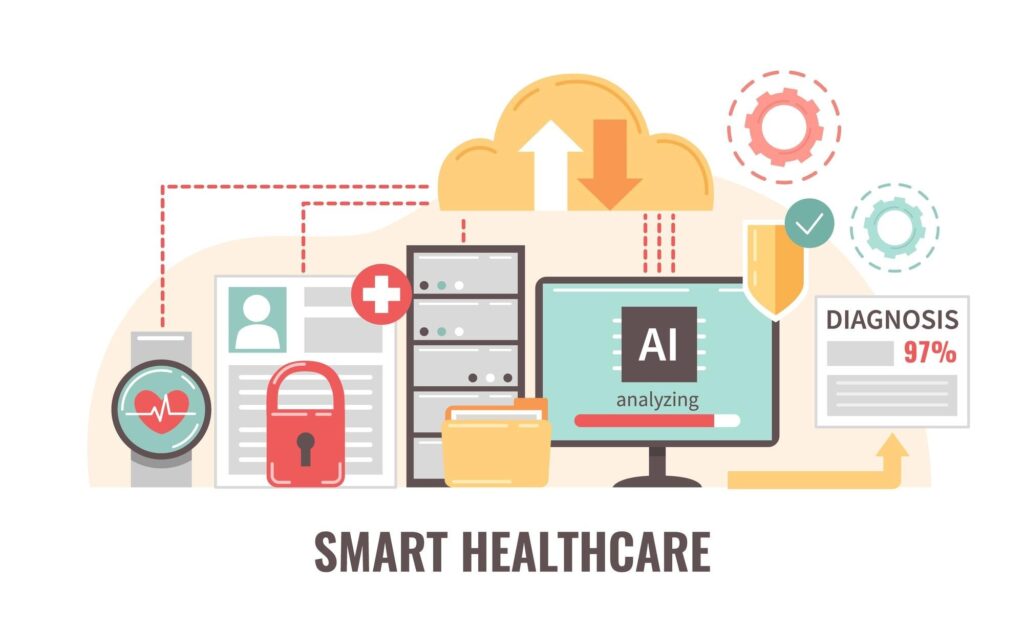
Modern healthcare APIs typically use REST (Representational State Transfer) architecture, which communicates over standard HTTPS. FHIR-based APIs use this approach extensively, making them compatible with web-based tools and mobile applications.
Types of Healthcare APIs
Healthcare APIs fall into several categories based on who uses them and what they do:
- Open APIs: Available to third-party developers with appropriate authorization. Patient-facing health apps commonly use these.
- Partner APIs: Shared between specific organizations under formal agreements, such as a hospital network sharing data with an affiliated insurer.
- Internal APIs: Used within a single organization to connect internal systems, such as linking an EHR to a billing platform.
- Composite APIs: Combine multiple API calls into a single request, useful for workflows that require data from several sources at once.
Common API Architectures in Healthcare
| Architecture | Description | Common Use |
|---|---|---|
| REST | Lightweight, HTTP-based, widely supported | FHIR APIs, patient portals, mobile health apps |
| SOAP | XML-based, formally structured | Legacy claims processing, insurance systems |
| GraphQL | Flexible query language, returns only requested data | Complex queries across multiple healthcare datasets |
| Event-driven | Triggers actions based on events in real time | Alerts, monitoring, real-time clinical decision support |
Why Healthcare APIs Matter
Better Patient Experience
When systems can share data through well-designed healthcare APIs, patients stop being asked to fill out the same form at every new provider. Their allergies, medications, diagnoses, and care history travel with them. That is not just convenient. It prevents medication errors, avoids duplicate testing, and allows providers to make faster, better-informed decisions.
Improved Care Coordination
Chronic disease management requires coordination across primary care physicians, specialists, nurses, pharmacists, and sometimes home health aides. Without API-driven data sharing, each provider works from an incomplete picture. Healthcare API integration breaks down those information silos so the whole care team sees the same data.
Faster Clinical Decisions
Clinical APIs can surface real-time decision support information directly inside a clinician’s workflow. Drug interaction alerts, evidence-based treatment recommendations, and patient risk scores can all be delivered through APIs at the point of care, not hours or days later.

Healthcare Automation
Administrative work consumes a significant portion of healthcare budgets. APIs automate prior authorization requests, claims submissions, appointment scheduling, prescription routing, lab order processing, and billing workflows, freeing clinical staff to focus on patients.
Data Accessibility and Healthcare Data Exchange
Healthcare data has historically been locked in isolated systems. APIs unlock it. When data flows freely between authorized systems, researchers get access to larger datasets, public health agencies get earlier signals of emerging outbreaks, and care quality improves across the board.
Remote Healthcare and Telemedicine Integration
The rapid growth of telemedicine depends almost entirely on API-driven connectivity. Video platforms, remote monitoring devices, e-prescription systems, and EHRs all need to exchange data through APIs to deliver a coherent virtual care experience.
AI and Predictive Healthcare
Artificial intelligence applications in healthcare, from sepsis prediction to radiology image analysis, need continuous access to structured patient data. Healthcare APIs provide the real-time data pipelines that AI models depend on to function accurately and at scale.
Healthcare API Standards Explained
HL7
HL7 (Health Level Seven International) is one of the oldest and most widely adopted standards in healthcare data exchange. It defines how clinical and administrative data is structured and transmitted between systems. HL7 Version 2 (HL7 v2) remains deeply embedded in hospital infrastructure, handling everything from lab orders to ADT (Admission, Discharge, Transfer) notifications.
HL7 v2 uses pipe-delimited text messages. It was designed in an era of point-to-point interfaces and, while effective, it lacks the flexibility needed for modern web-based API development.

HL7 FHIR
FHIR (Fast Healthcare Interoperability Resources) is the modern evolution of HL7 standards. Developed and maintained by HL7 International, FHIR uses modern web technologies including REST, JSON, and XML to make healthcare data exchange faster, more flexible, and far easier to implement.
FHIR defines discrete data units called “Resources” (Patient, Observation, Medication, Encounter, etc.) that can be queried individually. This resource-based model is what makes FHIR APIs practical for mobile apps, patient portals, and cloud-native healthcare platforms.
The ONC’s 21st Century Cures Act Final Rule mandated FHIR-based API support from certified EHR vendors, making FHIR the de facto standard for healthcare interoperability in the United States.
SMART on FHIR
SMART on FHIR (Substitutable Medical Applications, Reusable Technologies on FHIR) is a set of open standards that layers authorization and authentication on top of FHIR APIs. It uses OAuth 2.0 and OpenID Connect to allow third-party applications to securely access FHIR data with patient or provider consent.
Think of SMART on FHIR as the security and permissioning layer that makes it safe for a third-party app to connect to an EHR and access only the patient data that the patient has explicitly authorized.
DICOM
DICOM (Digital Imaging and Communications in Medicine) governs medical imaging data. APIs built on DICOM standards allow radiology images, CT scans, MRIs, and other imaging data to be shared between hospital PACS systems, teleradiology platforms, and clinical viewers.
CDA
The Clinical Document Architecture (CDA) is an HL7 standard for structured clinical documents like discharge summaries, operative notes, and progress notes. CDA-based APIs are commonly used for longitudinal patient record sharing.
X12
X12 standards govern healthcare administrative transactions including claims, eligibility verification, remittance advice, and prior authorization. Payers and providers exchange millions of X12 transactions daily through EDI (Electronic Data Interchange) APIs.
Healthcare API Standards Comparison Table
| Standard | Primary Use | Format | API Type | Maturity |
|---|---|---|---|---|
| HL7 v2 | Clinical messaging, ADT | Pipe-delimited text | Point-to-point | Legacy, widely deployed |
| HL7 v3 | Clinical documents | XML | Point-to-point | Limited adoption |
| HL7 FHIR | Interoperability, data access | JSON, XML | RESTful | Modern standard |
| SMART on FHIR | App authorization on FHIR | OAuth 2.0, OIDC | RESTful | Modern, growing |
| DICOM | Medical imaging | Binary, JSON (DICOMweb) | Web services | Established |
| CDA | Clinical documents | XML | Document exchange | Established |
| X12 | Administrative transactions | EDI | Batch/real-time | Required for HIPAA |
FHIR vs HL7 vs SMART on FHIR: Detailed Comparison
| Feature | HL7 v2 | HL7 FHIR | SMART on FHIR |
|---|---|---|---|
| Primary purpose | Clinical messaging | Data exchange and interoperability | App authorization on FHIR |
| Data format | Pipe-delimited text | JSON, XML, RDF | OAuth 2.0 tokens + FHIR |
| API architecture | Point-to-point | RESTful | RESTful with OAuth 2.0 |
| Ease of implementation | Complex, requires HL7 expertise | Moderate, uses familiar web tech | Moderate, requires OAuth knowledge |
| Mobile/web app support | Limited | Strong | Built for it |
| Security model | Minimal built-in security | Transport-level security | Full OAuth 2.0 + OIDC |
| Regulatory mandate | Legacy requirement | ONC mandated for EHR vendors | Tied to FHIR adoption |
| Best for | Hospital internal messaging | Patient data access, portals, apps | Third-party app access to EHR data |
| Adoption trend | Maintaining legacy | Rapidly growing | Rapidly growing |
The bottom line: HL7 v2 remains the backbone of hospital clinical messaging. FHIR is the future of healthcare interoperability. SMART on FHIR is how you securely authorize applications to use FHIR data. All three coexist in most modern healthcare environments.
Types of Healthcare APIs

EHR APIs and EMR APIs
Electronic Health Record APIs and Electronic Medical Record APIs are among the most important categories in healthcare. They allow authorized systems to read and write patient records, retrieve clinical notes, access medication lists, view problem lists, and integrate clinical workflows. Major EHR vendors including Epic Systems and Oracle Health (Cerner) offer FHIR-based APIs through their developer programs.
Patient APIs
Patient APIs give individuals access to their own health data. They power patient portals, consumer health apps, and personal health record (PHR) platforms. The Apple Health app, for example, uses SMART on FHIR patient APIs to pull data from participating health systems.
Claims APIs
Claims APIs connect providers and payers for electronic claims submission, status checking, and remittance processing. The CMS Interoperability and Patient Access rule requires payers to implement FHIR-based claims APIs for Medicare and Medicaid.
Pharmacy APIs
Pharmacy APIs handle e-prescribing, prescription routing, drug interaction checking, formulary lookups, and medication history access. The Surescripts network is a major hub for pharmacy API transactions.
Laboratory APIs
Lab APIs allow ordering systems to submit test orders electronically and receive structured results back. They connect hospital laboratories, reference labs, and point-of-care testing devices to EHR and clinical decision support systems.
Medical Imaging APIs
Medical imaging APIs built on DICOM and DICOMweb standards allow radiology systems, PACS, and clinical viewers to share imaging studies. Teleradiology platforms depend heavily on these APIs.
Scheduling APIs
Scheduling APIs allow patients to book appointments through third-party apps, patient portals, and health system websites. They connect scheduling systems to EHRs and care management platforms.
Billing and Insurance APIs
Billing APIs connect practice management systems to clearinghouses and payers for claims, eligibility verification, prior authorization, and payment processing. Insurance APIs allow real-time benefit verification and coverage checking.
Benefits of Healthcare APIs
Improved Interoperability
Healthcare interoperability, the ability of different systems to exchange and use data meaningfully, is the central promise of healthcare APIs. When systems speak the same language through standards like HL7 FHIR, data flows seamlessly across providers, payers, and care settings.
Better Patient Outcomes
Multiple studies have linked improved information exchange to reductions in medication errors, duplicate testing, readmission rates, and diagnostic delays. Patients whose care teams share data in real time receive more coordinated, safer care.
Real-Time Data Sharing
APIs enable real-time healthcare data exchange that was simply not possible with batch file transfers or fax-based workflows. Critical lab results, imaging reads, and medication changes can be pushed instantly to all relevant care team members.
Operational Efficiency
API-driven automation in claims processing, scheduling, prior authorization, and referral management has measurably reduced administrative costs for health systems. The more workflows that run through APIs rather than manual processes, the lower the cost per transaction.
Reduced Administrative Burden
Clinicians spend a disproportionate amount of time on documentation and administrative tasks. APIs that automate routine tasks and pre-populate clinical forms return that time to direct patient care.
Data Accuracy
Manual data entry is a leading source of clinical errors. When data flows directly between systems through APIs rather than being re-entered by hand, accuracy improves and the risk of transcription errors drops sharply.
Enhanced Research
With proper governance, de-identified patient data accessed through research APIs enables clinical trials, population health studies, and evidence-based medicine initiatives at a scale not previously achievable.
AI Integration
Machine learning models for clinical decision support, predictive analytics, and diagnostic imaging analysis all require access to large volumes of structured patient data. Healthcare APIs provide the data pipelines that make AI in healthcare operational rather than theoretical.
Healthcare API Security Challenges
The same connectivity that makes healthcare APIs valuable also creates significant security risk. The healthcare sector consistently ranks among the top targets for cybercriminals, with the average data breach in healthcare costing well over $10 million per incident according to IBM Security research.

API Abuse
Malicious actors probe healthcare APIs for weaknesses, attempting to extract patient data through excessive requests, unauthorized queries, or exploitation of business logic flaws.
Broken Authentication
Weak or improperly implemented authentication is the most common API security failure. Healthcare APIs that rely on static API keys, unencrypted credentials, or inadequate token validation are highly vulnerable. The OWASP API Security Top 10 lists broken object-level authorization and broken authentication as the top risks.
Broken Authorization
Even with strong authentication, APIs can fail to properly verify that authenticated users are only accessing data they are permitted to see. A clinician logging in to one patient’s record should never be able to query another patient’s data through a manipulated API request.
Sensitive Data Exposure
Healthcare APIs that return more data than requested (over-fetching) can inadvertently expose sensitive patient information. APIs must return only the minimum necessary data for each request, consistent with HIPAA’s minimum necessary standard.
API Injection Attacks
Injection attacks, including SQL injection and NoSQL injection, can be executed through API parameters if input validation is not properly implemented. A successful injection attack against a healthcare API can compromise entire patient databases.
Credential Theft
Phishing attacks, compromised developer credentials, and exposed API tokens in public code repositories are all vectors for credential theft that directly leads to unauthorized API access. GitHub and other code repositories regularly surface accidentally exposed healthcare API credentials.
API Rate Abuse
Without rate limiting, attackers can use automated tools to make thousands of API calls in seconds, either to extract data through enumeration or to overwhelm a system in a denial-of-service attack.
Insider Threats
Not all threats come from outside. Employees with legitimate API access can misuse it to access patient records they have no clinical reason to view, a violation that is both a HIPAA breach and a security incident.
Third-Party and Vendor Risks
Healthcare organizations increasingly connect APIs to third-party applications and digital health vendors. Each connection is a potential attack vector if the vendor’s security posture is not thoroughly vetted and continuously monitored.
Ransomware
Ransomware actors have increasingly targeted healthcare APIs as an entry point. Once inside, they can move laterally through connected systems, encrypting patient data and demanding payment. Several major ransomware incidents have begun with compromised API credentials or exploited API vulnerabilities.
API Security Best Practices for Healthcare
OAuth 2.0
OAuth 2.0 is the industry-standard authorization framework for healthcare APIs. It allows systems to grant third-party applications limited access to resources without sharing credentials directly. SMART on FHIR uses OAuth 2.0 as its foundation. Every healthcare API ecosystem should implement OAuth 2.0 for delegated authorization.
OpenID Connect (OIDC)
OpenID Connect sits on top of OAuth 2.0 and adds authentication. While OAuth 2.0 handles authorization (what you can do), OIDC handles identity (who you are). Together, OAuth 2.0 and OpenID Connect provide a complete identity and authorization layer for healthcare APIs.
JWT (JSON Web Tokens)
JWTs are the standard token format used in OAuth 2.0 and OIDC flows. A properly signed and validated JWT carries the user’s identity claims and permissions in a compact, tamper-evident format. Healthcare API security requires strict JWT validation, including signature verification, expiration checking, and audience validation.
API Gateway
An API gateway acts as the single entry point for all API traffic. It enforces authentication, performs rate limiting, handles SSL termination, logs requests, and routes traffic to backend services. Azure API Management, AWS API Gateway, Kong, and Apigee are commonly used in healthcare environments.
API Rate Limiting
Rate limiting caps the number of requests a client can make in a given time window. It protects against both deliberate abuse and accidental runaway processes that could overwhelm backend systems.
Encryption
All healthcare API traffic must be encrypted in transit using TLS 1.2 or 1.3. Data at rest must also be encrypted. Unencrypted API traffic carrying PHI (Protected Health Information) is a direct HIPAA violation.

Zero Trust Architecture
Zero Trust operates on the principle that no user, device, or system should be trusted by default, regardless of whether it is inside or outside the network perimeter. For healthcare APIs, Zero Trust means every request is authenticated, every access decision is authorized based on context, and least-privilege principles limit what each identity can access.
Identity and Access Management (IAM)
IAM is the operational backbone of healthcare API security. It governs who can access which APIs, under what conditions, with what level of permission. Without strong IAM, API security policies exist on paper but not in practice.
Multi-Factor Authentication (MFA)
Any human user accessing healthcare APIs or the administrative consoles that manage them should be required to authenticate with MFA. This includes clinicians using EHR APIs, developers accessing API management portals, and administrators managing API credentials.
API Monitoring and Anomaly Detection
Continuous monitoring of API traffic is essential for detecting unusual patterns that may indicate an attack in progress. Modern API security platforms use behavioral analytics to establish baselines and flag anomalies in real time.
API Logging and Audit Trails
Every API request touching PHI must be logged with sufficient detail to support audit investigations. Logs should capture the requesting identity, timestamp, resource accessed, and action taken. These logs are critical for HIPAA breach investigations and compliance audits.
Vulnerability Testing and API Security Assessments
Healthcare APIs should undergo regular security assessments including penetration testing, OWASP API Security Top 10 validation, and automated vulnerability scanning. New API versions should be security-tested before deployment.
IAM in Healthcare API Security
Identity and Access Management is not just one piece of the healthcare API security puzzle. It is the piece that makes all the other pieces work.
Identity Governance and Administration (IGA)
Identity Governance ensures that access rights across healthcare APIs are appropriate, reviewed, and revoked when no longer needed. IGA platforms automate access certifications, detect excessive privileges, and enforce separation of duties. In healthcare, where the workforce is large and roles change frequently, automated identity governance is essential.
Role-Based Access Control (RBAC)
RBAC assigns API permissions based on a user’s role within the organization. A nurse has access to patient medication APIs but not to administrative financial APIs. A billing specialist has access to claims APIs but not to clinical note APIs. RBAC makes access policy manageable at scale.
Attribute-Based Access Control (ABAC)
ABAC extends RBAC by adding dynamic context to access decisions. It can enforce policies like “a physician may access this patient’s records only if they have an active care relationship with the patient” or “access is permitted only from hospital network IP ranges during business hours.” ABAC is particularly powerful for fine-grained healthcare data access control.
Single Sign-On (SSO)
SSO allows clinicians and staff to authenticate once and access all authorized healthcare systems and APIs without re-entering credentials. This reduces authentication fatigue, decreases the likelihood of insecure credential practices, and streamlines clinical workflows where speed directly affects patient care.
Privileged Access Management (PAM)
Healthcare API infrastructure, including API gateways, identity providers, and integration platforms, requires privileged accounts for administration. PAM solutions manage, monitor, and control these privileged accounts to prevent misuse.
Patient Identity Management
Accurate patient identity management is foundational to safe and effective healthcare API use. Duplicate records, mismatched identities, or incorrect patient matching through APIs can lead to data being delivered to the wrong party, which is both a clinical safety risk and a HIPAA violation. Healthcare organizations should implement enterprise Master Patient Index (MPI) solutions alongside their API platforms.

Clinician Identity Management
Clinicians move between facilities, roles, and systems constantly. Managing clinician identities across complex healthcare environments requires federated identity solutions that can handle role changes, temporary privileges, and cross-organizational access without creating security gaps.
API Authentication and Authorization Workflow
A properly secured healthcare API authentication and authorization flow looks like this:
- The client application requests authorization from an Identity Provider (IdP) such as Microsoft Entra ID, Okta, or Ping Identity.
- The user authenticates with MFA.
- The IdP issues an OAuth 2.0 access token (JWT format) with specific scopes limiting what the application can access.
- The application presents the token to the API Gateway.
- The API Gateway validates the token signature, expiration, and scopes.
- The API Gateway forwards the request to the backend service, which performs a final authorization check.
- The response is returned, logged, and monitored.
Compliance Requirements for Healthcare APIs
HIPAA Compliance
HIPAA (Health Insurance Portability and Accountability Act) requires administrative, physical, and technical safeguards for all systems that create, receive, maintain, or transmit Protected Health Information (PHI). Healthcare APIs that handle PHI must implement access controls, audit logging, encryption, and breach notification capabilities. Every API that touches PHI is within HIPAA’s scope.
HITECH Act
The HITECH Act (Health Information Technology for Economic and Clinical Health Act) strengthened HIPAA enforcement and increased penalties for breaches. It also created incentives for EHR adoption that drove the proliferation of healthcare APIs. HITECH’s breach notification requirements directly apply to API-related incidents.
GDPR
For healthcare organizations handling data on EU residents, the General Data Protection Regulation adds additional requirements around consent, data minimization, right of access, and the right to erasure. Healthcare APIs serving European patients must implement mechanisms to honor GDPR data subject rights.
PCI DSS
Healthcare organizations that process patient payments through APIs must comply with PCI DSS (Payment Card Industry Data Security Standard). This applies to billing APIs, payment portals, and any system that processes cardholder data.
NIST Cybersecurity Framework
The NIST Cybersecurity Framework provides a risk-based approach to managing cybersecurity that healthcare organizations widely adopt. Its five functions (Identify, Protect, Detect, Respond, Recover) map well to healthcare API security program design.
OWASP API Security Top 10
The OWASP API Security Top 10 is the authoritative reference for API-specific vulnerabilities. Healthcare API security programs should use it as a baseline for threat modeling, security testing, and developer security training.
OWASP API Security Top 10 Checklist for Healthcare:
- Broken Object Level Authorization (BOLA) controls implemented
- Authentication mechanisms reviewed and hardened
- Excessive data exposure prevented through response filtering
- Resource and rate limits enforced
- Function-level authorization verified
- Mass assignment protections in place
- Security misconfiguration review completed
- Injection attack protections validated
- Improper asset management inventory maintained
- Insufficient logging and monitoring remediated
Common Challenges When Implementing Healthcare APIs

Legacy System Integration
Most health systems operate a complex mix of legacy platforms alongside modern systems. Connecting a 20-year-old claims processing system to a modern FHIR API layer requires middleware, data transformation, and often significant custom development. Integration platforms like MuleSoft and Microsoft Azure Integration Services are commonly used to bridge this gap.
Data Standardization
Even with FHIR as a standard, real-world healthcare data arrives in dozens of different formats, coding systems (ICD-10, SNOMED CT, LOINC), and quality levels. Normalization and data quality work is often the most time-consuming part of healthcare API integration projects.
Security Implementation
Implementing proper API security is not trivial. Small healthcare organizations may lack the in-house expertise to implement OAuth 2.0, SMART on FHIR, and Zero Trust correctly. Getting it wrong creates compliance exposure and security risk simultaneously.
Compliance Complexity
HIPAA, HITECH, state privacy laws, and ONC regulations create a complex compliance landscape that every healthcare API implementation must navigate. Misunderstanding which rules apply to which API or which business associate agreements are required is a common and costly mistake.
Vendor Integration
The healthcare technology market is highly fragmented. Integrating multiple vendor systems, each with their own API dialects, authentication mechanisms, and data models, requires careful architecture and strong API management capabilities.
API Versioning
Healthcare APIs evolve. A breaking change in an API that dozens of downstream systems depend on can cause clinical workflow disruptions. Managing API versions, deprecation timelines, and backward compatibility requires disciplined API lifecycle management.
Performance and Scalability
Healthcare APIs handle mission-critical workflows at enterprise scale. A patient access API at a large health system may need to handle millions of requests per day without degradation. Performance testing, horizontal scaling, and caching strategies are essential design considerations.
Healthcare API Implementation Checklist
Use this checklist when planning or auditing a healthcare API implementation:
Architecture and Standards
- FHIR R4 or later adopted for new interoperability APIs
- HL7 v2 integration layer in place for legacy systems
- SMART on FHIR implemented for third-party app authorization
- API Gateway deployed as single entry point
Security
- OAuth 2.0 and OpenID Connect implemented
- JWT validation enforced (signature, expiration, audience)
- TLS 1.2 or 1.3 enforced on all API endpoints
- MFA required for all human API consumers
- Rate limiting and throttling configured
- API security testing completed against OWASP Top 10
IAM and Identity
- Identity Provider (IdP) integrated
- RBAC and ABAC policies defined and enforced
- Patient identity matching (MPI) in place
- Privileged accounts managed through PAM solution
- Access certifications scheduled
Compliance
- PHI data flow mapped and documented
- Business Associate Agreements in place with API partners
- Audit logging enabled on all PHI-touching APIs
- Breach notification procedures documented
- HIPAA Security Rule technical safeguards implemented
Operations
- API monitoring and anomaly detection active
- Incident response plan includes API breach scenarios
- API inventory maintained and reviewed quarterly
- Vendor API security assessments completed
Future Trends in Healthcare APIs
AI-Powered APIs
The next generation of clinical APIs will not just deliver data. They will deliver intelligence. APIs that surface predictive risk scores, AI-generated clinical documentation, real-time diagnostic support, and natural language processing of clinical notes are already emerging. The challenge will be ensuring that AI-generated outputs delivered through APIs are auditable, explainable, and accurate.
Accelerating FHIR Adoption
FHIR adoption is accelerating globally, driven by regulatory mandates, major EHR vendor commitments, and the growing ecosystem of FHIR-compatible tools. FHIR R5 introduces additional capabilities for clinical data exchange, and the FHIR Bulk Data specification enables population-level data access for value-based care and research.
Cloud-Native Healthcare APIs
Healthcare organizations are migrating to cloud infrastructure at an accelerating pace. Cloud-native API architectures deployed on platforms like Microsoft Azure, Google Cloud Healthcare API, and AWS HealthLake enable elastic scalability, global availability, and access to cloud-native security and analytics services.
API-First Healthcare Organizations
Forward-thinking health systems and digital health companies are adopting an API-first strategy, designing every new capability as an API before building user interfaces on top of it. This approach accelerates integration, enables ecosystem partnerships, and makes systems more adaptable as healthcare models evolve.
Zero Trust API Architecture
The traditional network perimeter is gone in most healthcare environments. Remote clinicians, mobile devices, cloud platforms, and third-party integrations mean that trust cannot be assumed based on network location. Zero Trust API architecture that verifies every request regardless of source is becoming the standard expectation.
Healthcare Identity Fabric
The emerging concept of a healthcare identity fabric unifies identity management across clinical applications, APIs, IoT devices, and AI agents into a single coherent framework. Rather than managing identities separately in each system, a healthcare identity fabric provides a consistent identity layer that spans the entire digital health ecosystem.
Machine-to-Machine Identity
As APIs increasingly connect automated systems, IoT devices, AI agents, and background processes, the challenge of managing non-human identities grows. Machine-to-machine identity, managing credentials for service accounts, API clients, and automated agents, is an emerging priority for healthcare security teams. Solutions like certificate-based authentication, short-lived tokens, and secrets management vaults are becoming standard components of mature healthcare API security programs.
API Security Automation
Manual API security reviews cannot keep pace with the speed of modern healthcare software development. The future belongs to organizations that embed automated security testing, policy enforcement, and compliance validation directly into their API development and deployment pipelines. DevSecOps practices integrated with API security platforms will define which healthcare organizations stay ahead of threats and which fall behind.
How Avancer Corporation Helps Healthcare Organizations
Healthcare organizations face a genuinely difficult challenge: they need to open their systems to enable interoperability, patient access, and digital innovation, while simultaneously protecting sensitive patient data from a threat landscape that grows more sophisticated every year. That tension between openness and security is exactly where Avancer Corporation’s expertise delivers real value.
Avancer Corporation is an enterprise Identity and Access Management firm with deep experience in healthcare environments. The work goes well beyond selling software. Avancer’s team helps healthcare organizations design, implement, and operate the identity and security infrastructure that makes healthcare APIs work safely at scale.
Identity and Access Management (IAM) for Healthcare
Avancer designs and deploys comprehensive IAM architectures tailored to the complexity of healthcare environments. That includes integrating identity systems across multiple EHR platforms, clinical applications, and API ecosystems to create a unified access management layer.
Identity Governance and Administration (IGA)
Healthcare workforces are large, diverse, and constantly changing. Avancer’s Identity Governance services automate the access lifecycle, from provisioning new clinicians and staff with appropriate API access to certifying existing access rights and revoking privileges when roles change or employees leave. IGA keeps API access rights accurate, auditable, and compliant.
API Security Services
Avancer conducts thorough API security assessments that evaluate healthcare organizations’ API infrastructure against the OWASP API Security Top 10, HIPAA technical safeguards, and Zero Trust principles. The result is a prioritized remediation roadmap that addresses the highest-risk exposures first.
Healthcare Identity Management
Managing identities for physicians, nurses, administrative staff, vendors, patients, and automated systems in a single coherent framework is one of the hardest problems in healthcare IT. Avancer brings proven methodology and platform expertise to healthcare identity management programs, reducing identity sprawl and improving both security and user experience.
Single Sign-On (SSO)
Avancer implements enterprise SSO solutions that allow clinical staff to authenticate once and access all authorized systems, including EHR platforms, clinical decision support tools, API portals, and administrative applications. SSO reduces authentication friction in time-critical clinical environments while strengthening security.
Multi-Factor Authentication (MFA)
Avancer deploys and manages MFA solutions that are practical for clinical workflows. The right MFA approach for an emergency department nurse is different from the right approach for a remote billing specialist. Avancer’s healthcare MFA implementations balance security requirements with clinical usability.

Privileged Access Management (PAM)
Healthcare API infrastructure, from identity providers to API gateways to integration platforms, requires privileged administrative access. Avancer implements PAM solutions that manage, monitor, and record privileged sessions, preventing credential abuse and providing the audit trail that HIPAA investigations require.
Zero Trust Security for Healthcare
Avancer helps healthcare organizations design and implement Zero Trust architectures that apply consistent identity verification and least-privilege access across all API interactions, regardless of whether the request originates inside or outside the network perimeter.
Healthcare Compliance Services
HIPAA, HITECH, the 21st Century Cures Act, and state-level privacy regulations create overlapping compliance obligations for healthcare API programs. Avancer’s compliance consulting team helps organizations map their API data flows, identify compliance gaps, implement required technical controls, and prepare documentation for audits and investigations.
Managed IAM Services
For healthcare organizations that lack the internal resources to manage a full-scale IAM program, Avancer offers Managed IAM Services. This gives organizations access to enterprise-grade identity security operations, including ongoing monitoring, threat response, access certification management, and continuous compliance support, without the cost of building an in-house team.
API Security Assessments
Avancer’s API security assessment service evaluates the full stack of a healthcare organization’s API ecosystem. The assessment covers authentication and authorization design, data exposure risks, integration architecture, API lifecycle management practices, and alignment with HIPAA and NIST security requirements.
Digital Healthcare Transformation
Healthcare digital transformation is not just a technology initiative. It is an organizational change that requires careful alignment of security, compliance, clinical operations, and technology architecture. Avancer serves as a trusted advisor to healthcare organizations navigating this transformation, ensuring that the move to API-driven, cloud-native healthcare infrastructure does not create security and compliance exposure along the way.
Key Takeaways
- Healthcare APIs are the essential infrastructure of modern digital healthcare, enabling EHR integration, patient data exchange, telemedicine, clinical automation, and AI-powered care.
- HL7 FHIR is the leading standard for healthcare interoperability, mandated by the ONC for certified EHR systems. SMART on FHIR provides the authorization layer.
- Healthcare API security requires a defense-in-depth approach: OAuth 2.0, OpenID Connect, API gateways, rate limiting, encryption, Zero Trust, and continuous monitoring.
- Identity and Access Management sits at the center of every secure healthcare API program. Without it, authentication and authorization controls cannot be consistently enforced.
- HIPAA compliance requires specific technical safeguards for every API that handles Protected Health Information, including access controls, audit logging, encryption, and breach notification readiness.
- Legacy system integration, data standardization, and compliance complexity are the most common challenges in healthcare API implementation projects.
- The future of healthcare APIs includes AI-powered capabilities, accelerating FHIR adoption, cloud-native architectures, Zero Trust models, and healthcare identity fabric frameworks.
Conclusion
Healthcare APIs are not a technology trend. They are the operational foundation on which modern, connected, patient-centric healthcare is built. Every real-time lab result, every coordinated care handoff, every telemedicine visit, every patient-controlled health app interaction depends on APIs working securely and reliably behind the scenes.
The opportunity is enormous. Better interoperability means better care. Faster data exchange means faster clinical decisions. Connected ecosystems mean fewer errors, lower costs, and more engaged patients. But the risks are equally significant. Healthcare data is among the most sensitive and most sought-after information in the world, and a healthcare API ecosystem with weak security is a liability waiting to become a catastrophe.
The organizations that get this right are the ones that treat security and interoperability not as competing priorities but as complementary ones. They adopt strong standards like HL7 FHIR. They implement rigorous API authentication and authorization using OAuth 2.0 and SMART on FHIR. They enforce Zero Trust principles. And they build Identity and Access Management programs that give them real control over who accesses what, when, and why.
Avancer Corporation helps healthcare providers, health systems, payers, and digital health companies do exactly that. From healthcare IAM strategy and implementation to API security assessments, Identity Governance, Zero Trust architecture, HIPAA compliance consulting, and Managed IAM Services, Avancer brings the specialized expertise that healthcare organizations need to modernize their digital ecosystems without compromising security or compliance.
If your organization is expanding its healthcare API capabilities, addressing API security gaps, or undertaking a broader digital health transformation, the right time to build a proper identity and security foundation is now, before the next integration project, not after the next incident.
Frequently Asked Questions About Healthcare APIs:
What are Healthcare APIs?
Healthcare APIs are software interfaces that allow different healthcare systems, applications, and platforms to communicate and exchange data securely. They enable EHR systems, patient portals, mobile health apps, payers, labs, and pharmacies to share patient information using standardized protocols and data formats.
How do Healthcare APIs work?
Healthcare APIs work through a request-response model. A client system sends a structured request to a server system asking for data or an action. The server authenticates the request, verifies the requester’s authorization, processes the request, and returns the appropriate data or confirmation. Most modern healthcare APIs use REST architecture over HTTPS, with FHIR defining the data model and SMART on FHIR handling authorization.
What is FHIR?
FHIR (Fast Healthcare Interoperability Resources) is a modern healthcare data exchange standard developed by HL7 International. It uses RESTful web services and common data formats like JSON and XML. FHIR organizes healthcare data into discrete “Resources” (Patient, Observation, Medication, etc.) that can be queried and exchanged individually. The ONC mandated FHIR-based APIs for certified EHR systems under the 21st Century Cures Act.
What is HL7?
HL7 (Health Level Seven) is a set of international standards for the exchange of healthcare data. HL7 Version 2 is one of the most widely deployed clinical messaging standards in hospital environments, handling ADT notifications, lab orders, and clinical results. HL7 also develops FHIR, which is the modern successor designed for web-based interoperability.
What is SMART on FHIR?
SMART on FHIR is an open standard that adds a secure authorization layer to FHIR APIs using OAuth 2.0 and OpenID Connect. It allows third-party applications to request access to FHIR data with patient or provider consent. SMART on FHIR is how consumer health apps, clinical decision support tools, and research applications connect securely to EHR systems.
