
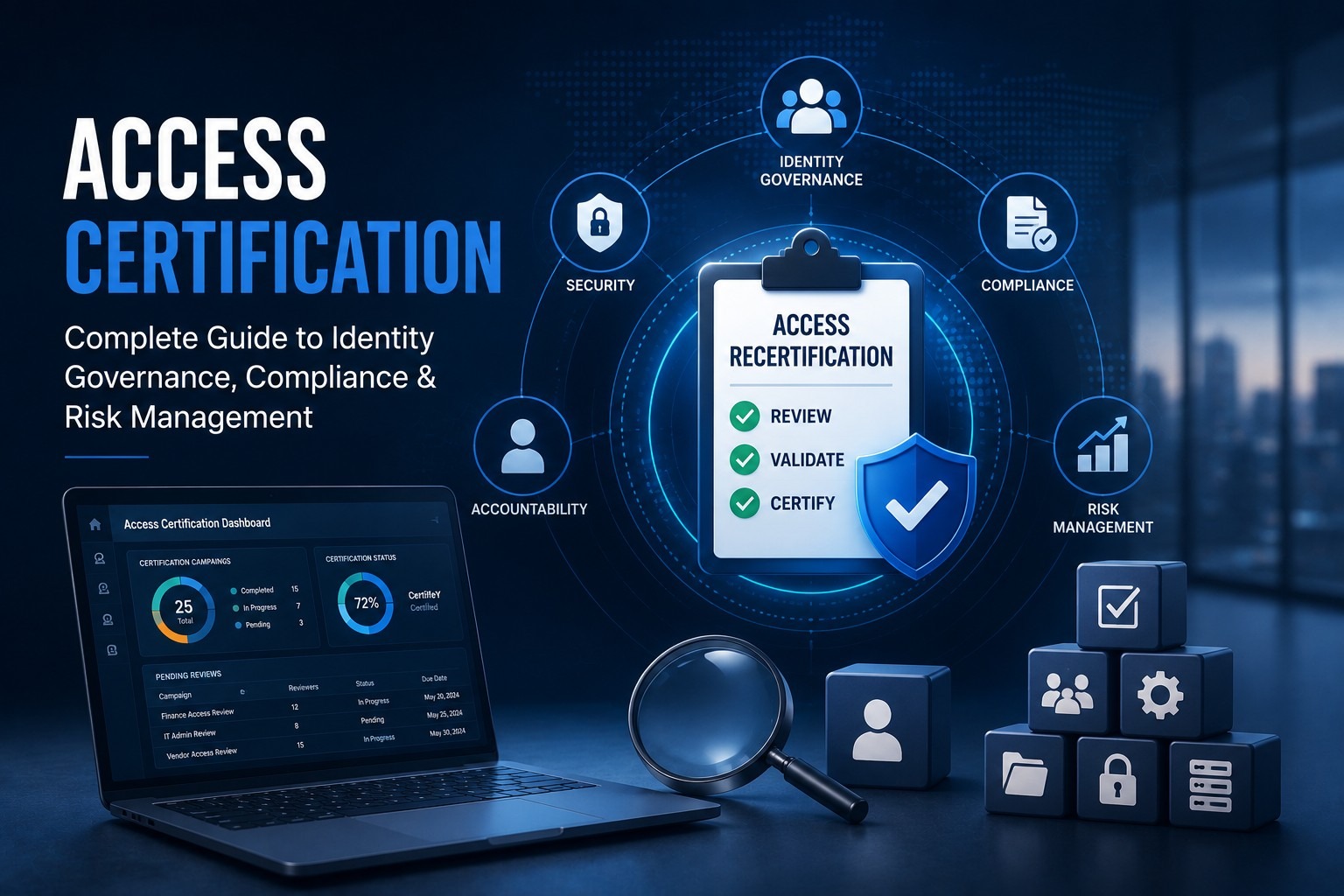
Access certification is the process of systematically reviewing and validating user access rights across enterprise systems to ensure that every user, account, and entitlement is appropriate, authorized, and necessary. Organizations run access certification campaigns to confirm who has access to what, remove excessive permissions, and generate audit evidence for regulatory compliance. It is one of the most critical controls in any identity governance and administration (IGA) program.
Every enterprise faces the same underlying problem: user access accumulates over time. Employees change roles, contractors finish projects, systems get retired, and yet access permissions linger. What starts as a well-scoped access model quickly becomes a tangled web of excessive privileges, orphaned accounts, and dormant credentials. That is the access problem at scale, and it is precisely what access certification is designed to solve.
In a world where hybrid workforces are the norm, cloud applications multiply by the quarter, and regulatory requirements grow more demanding each year, the ability to continuously validate who has access to your systems is no longer optional. It is foundational to enterprise security and compliance.
What Is Access Certification?
Definition
Access certification (also called access recertification or user access review) is a formal, periodic, or continuous process through which organizations review and validate user entitlements across applications, systems, and data repositories. Reviewers, typically managers or application owners, confirm whether each user’s access remains appropriate, and any access that is no longer justified is revoked.
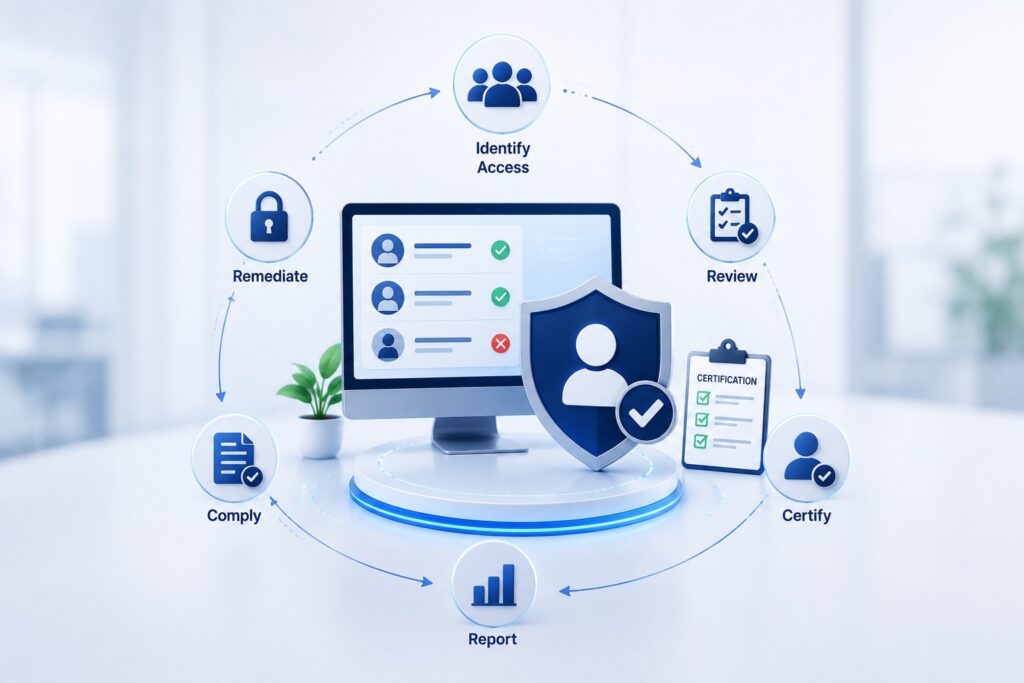
In plain terms: access certification answers the question “Does this person still need this access?” and acts on the answer.
How Access Certification Works
The mechanics of access certification follow a defined cycle. An identity governance platform or access certification tool collects a snapshot of all user entitlements across connected systems. These entitlements are then packaged into review campaigns and assigned to designated reviewers, usually direct managers, application owners, or data stewards.
Each reviewer evaluates the access assigned to users in their scope and makes a decision: certify (keep) or revoke. Once the review window closes, any access flagged for revocation is automatically removed or queued for deprovisioning. The entire cycle, including decisions, timestamps, and remediation actions, is captured in audit logs.
Modern platforms like SailPoint, Saviynt, Microsoft Entra ID Governance, One Identity, and IBM Security Verify Governance automate most of this workflow, reducing the manual effort involved and improving accuracy through AI-driven risk scoring and access recommendations.
Why It Matters
Without a structured access certification process, organizations accumulate risk silently. Users retain access to systems they no longer need. Service accounts go unreviewed for months. Former employees retain active credentials. These conditions create real attack vectors. According to Verizon’s Data Breach Investigations Report, compromised credentials and excessive privileges are consistently among the top factors in enterprise data breaches.
Access certification is not just a security control. It is also a compliance requirement under SOX, HIPAA, GDPR, ISO 27001, SOC 2, and PCI DSS, all of which require organizations to demonstrate that user access is regularly reviewed and controlled.
Access Certification vs. Access Reviews vs. Identity Governance
These three terms are often used interchangeably, but they describe distinct concepts with different scopes, frequencies, and stakeholders.
| Aspect | Access Certification | Access Reviews | Identity Governance |
|---|---|---|---|
| Definition | Formal validation of user entitlements with a certification decision | Broader review of access policies, roles, and permissions | Overarching framework for managing identity lifecycle, access policies, and compliance |
| Objective | Confirm or revoke specific user access rights | Assess and improve access control effectiveness | Ensure the right people have the right access at the right time |
| Frequency | Periodic (quarterly, semi-annual, annual) or continuous | Ad hoc, triggered by events or audits | Ongoing, embedded in operational processes |
| Stakeholders | Managers, application owners, data stewards | Security teams, compliance officers, IAM architects | CISOs, IAM architects, compliance officers, business owners |
| Key Output | Certified or revoked access; audit trail | Access gap analysis; remediation recommendations | Policies, roles, workflows, audit reports |
| Business Outcome | Reduced access risk; compliance evidence | Improved access hygiene | Enterprise-wide identity security and governance maturity |
Understanding the difference is important when designing an identity governance program. Access certification is a tactical execution within the broader strategic framework of identity governance and administration.
Why Access Certification Is Critical for Enterprise Security

Preventing Privilege Creep
Privilege creep is one of the most common and underappreciated risks in enterprise environments. It happens gradually. A developer gets temporary admin access to debug a production issue. A manager moves to a new department but retains all permissions from their previous role. A contractor finishes an engagement, but their account remains active with broad system access.
Over time, individual users accumulate far more access than their current role requires. This bloated access profile significantly expands the blast radius if that account is ever compromised. Privilege creep is not an isolated problem. In large enterprises, studies have shown that a significant percentage of users carry entitlements from previous roles that were never removed.
Regular access certification cycles catch privilege creep before it becomes a liability.
Eliminating Excessive Permissions
Excessive permissions are closely related to privilege creep but often originate from provisioning practices. Over-permissioned accounts are frequently the result of “copy user” provisioning, where new employees receive the same access as an existing colleague in a similar role, inheriting all of that colleague’s historical access rather than only what the new role requires.
Access certification helps organizations identify and trim these excessive permissions, moving toward a least privilege model where each user has exactly the access they need, and nothing more.
Identifying Orphan Accounts
Orphan accounts are user accounts that no longer have an active, identifiable owner. They are created when employees leave, contractors wrap up, or systems are migrated, and the deprovisioning process is incomplete or delayed. Orphan accounts are particularly dangerous because they can go undetected for months or years, providing an entry point for malicious insiders or external attackers.
A robust access certification process surfaces orphan accounts by identifying accounts that cannot be matched to an active user or that have no recognized reviewer. These accounts are then reviewed, terminated, or transferred to appropriate ownership.
Reducing Insider Threats
Insider threats, whether intentional or accidental, are among the most costly security incidents enterprises face. An employee with excessive access can exfiltrate data, whether with malicious intent or simply through poor judgment. Access certification reduces this risk by ensuring that users only have the access they actually need for their current responsibilities.
When access reviews are combined with identity analytics and risk scoring, organizations can prioritize reviews of high-risk accounts, those with administrative privileges, access to sensitive data, or anomalous usage patterns, further reducing the insider threat surface.
Supporting Zero Trust
Zero Trust security is built on the principle of “never trust, always verify.” One of its core tenets is the continuous validation of user identity and access rights. Access certification is not just compatible with Zero Trust. It is a fundamental operational control that makes Zero Trust real.
Without ongoing access certification, Zero Trust remains aspirational. With it, organizations can continuously validate that access decisions reflect current business needs, current risk posture, and current policy, which is exactly what Zero Trust requires.
Business Benefits of Access Certification

Improved Security
The most direct benefit is a cleaner, tighter access model. Removing unnecessary permissions reduces the attack surface available to both external attackers and malicious insiders. Organizations that run regular access certification campaigns consistently report fewer accounts with excessive privileges and better visibility into who can access what.
Better Compliance
Access certification is a direct response to regulatory requirements. SOX section 404 requires organizations to demonstrate internal controls over financial systems, including access controls. HIPAA mandates periodic review of who can access protected health information. GDPR requires data controllers to ensure access to personal data is limited to authorized users. SOC 2, PCI DSS, and ISO 27001 all carry similar access review requirements.
When auditors ask “show me evidence that you review and control user access,” a well-documented access certification program with complete audit logs is exactly the answer they are looking for.
Stronger Governance
Access certification is not just a technical control. It is a governance mechanism that engages business stakeholders directly. When managers are required to certify the access of their direct reports, it creates accountability and builds awareness of access risk across the organization, not just within the security team.
This distributed ownership model is a hallmark of mature identity governance programs and is a key differentiator between organizations with reactive and proactive security postures.
Reduced Audit Costs
Audit preparation is expensive. When access reviews are manual, ad hoc, and poorly documented, organizations spend significant time and resources reconstructing access history and demonstrating compliance before each audit cycle. Automated access certification platforms generate audit-ready reports continuously, dramatically reducing the time and cost associated with audit preparation.
Operational Efficiency
Modern access certification platforms eliminate the inefficiency of spreadsheet-based reviews. Automated campaign creation, smart assignment of reviewers, AI-driven recommendations, and bulk decision capabilities turn a weeks-long manual process into a streamlined workflow that reviewers can complete in hours.
This efficiency gain matters not just for the security team but for the business managers who participate in reviews. Reducing reviewer burden increases participation rates and the overall quality of decisions.
Better User Experience
Access certification improves the employee experience in ways that are not immediately obvious. When access is well-managed, employees spend less time waiting for approvals or dealing with access-related help desk tickets. Role-based access models that are kept clean through regular certification make onboarding faster and more consistent.
Reduced Identity Risk
Every excessive entitlement, every orphan account, and every stale credential is an identity risk. Access certification systematically reduces the inventory of these risks over time. Organizations that run mature access certification programs develop a measurably stronger identity security posture, with fewer high-risk accounts and better alignment between business roles and system permissions.
The Complete Access Certification Process
Step 1: Discover Identities
Before you can certify access, you need a complete picture of all identities in your environment. This means aggregating user accounts from HR systems, Active Directory, LDAP directories, cloud platforms, SaaS applications, and any other identity stores. The discovery phase also identifies service accounts, shared accounts, and privileged accounts that need to be included in the review scope.
Identity discovery is where many organizations first encounter the depth of their identity sprawl. It is not uncommon for enterprises to discover thousands of accounts they did not know existed across shadow IT systems and legacy applications.
Step 2: Collect Entitlements
Once identities are discovered, the next step is collecting the entitlements associated with each identity. This includes application roles, group memberships, file share permissions, database access, cloud resource permissions, and any other access right that has been granted.
Entitlement collection requires connectors to each system that holds access data. Modern IGA platforms like SailPoint IdentityNow, Saviynt Enterprise Identity Cloud, and Microsoft Entra ID Governance maintain pre-built connector libraries for hundreds of applications, making this process significantly more scalable than manual approaches.
Step 3: Assign Reviewers
With entitlements collected, the platform assigns each access item to the appropriate reviewer. Reviewer assignment logic is configurable and typically maps to the organizational hierarchy. Direct managers review their reports’ access. Application owners review accounts within their applications. Data owners review access to sensitive data they are responsible for protecting.
Smart reviewer assignment is a critical design decision. Assigning the wrong reviewers leads to rubber-stamped approvals, which defeats the purpose of the exercise.
Step 4: Review Access
Reviewers receive notifications directing them to their certification queue. For each item in the queue, they review the user’s access and make a certification decision. Well-designed platforms surface contextual information to help reviewers make informed decisions: last login date, role description, peer access comparison, and risk score.
This context is what separates a meaningful access review from a checkbox exercise. When reviewers understand what they are certifying and can see relevant risk signals, they make better decisions.
Step 5: Approve or Revoke Access
Based on the reviewer’s decision, the platform either certifies (retains) the access or initiates a revocation workflow. Revocation can be immediate or staged, depending on the organization’s policies. For privileged access, revocation is typically immediate. For standard application access, a grace period or secondary approval may apply.
Some platforms support escalation workflows, where access that is not reviewed within a defined window is automatically escalated to a secondary reviewer or flagged for administrative action.
Step 6: Generate Audit Reports
Every decision made during the certification cycle is captured with a timestamp, reviewer identity, and the reason for the decision. At the close of the campaign, the platform generates comprehensive audit reports documenting the scope of the review, the decisions made, any access that was revoked, and the completion rate.
These reports are the primary artifact that regulators and auditors examine when evaluating access certification compliance. They need to be complete, accurate, and readily accessible.
Step 7: Continuous Monitoring
Access certification is not a point-in-time event. Leading organizations are moving toward continuous certification models where access is reviewed on a rolling basis, triggered by events such as role changes, high-risk access requests, anomalous usage, or changes in employment status, rather than on a fixed quarterly or annual schedule.
Continuous monitoring, powered by identity analytics and AI-driven risk scoring, allows organizations to prioritize access reviews based on actual risk rather than the calendar, making the entire process more efficient and more effective.
Common Access Certification Challenges
Even organizations that recognize the importance of access certification struggle with execution. The challenges are predictable, and most have well-established solutions.
Reliance on Manual Spreadsheets
Many organizations still run access certification campaigns by exporting user lists to spreadsheets and emailing them to managers. This approach is slow, error-prone, lacks audit trail integrity, and scales poorly. Spreadsheet-based reviews invite rubber-stamping and make it nearly impossible to demonstrate a credible access review to auditors.
Delayed Reviews
When certification campaigns take weeks or months to complete, the access data being reviewed can become stale before the cycle finishes. Slow processes are often caused by manual workflows, unclear ownership, and lack of automated reminders. By the time some reviews are complete, the business context has already changed.
Reviewer Fatigue
Managers asked to review hundreds of access items with minimal context will naturally default to approving everything. Reviewer fatigue is a well-documented problem in access certification programs and is one of the most significant threats to the integrity of the process. Reducing cognitive load through smart recommendations, risk scoring, and pre-filtered queues is essential to maintaining review quality.
Inaccurate Entitlement Data
Certification campaigns are only as good as the underlying entitlement data. If the system does not accurately reflect who has access to what, the review process cannot be reliable. Data quality problems are often rooted in poor connector coverage, delayed synchronization, or inconsistent naming conventions across systems.
Excessive Application Scope
Large enterprises may have hundreds or thousands of applications, each with its own access model. Certifying access across this entire landscape simultaneously is impractical. Organizations need to prioritize by risk, focusing certification campaigns on high-value systems, sensitive data repositories, and privileged access first.
Orphan Account Blind Spots
Traditional certification campaigns are built around active user accounts with identified managers. Orphan accounts, by definition, have no obvious reviewer. Without a specific workflow for handling ownerless accounts, they fall through the cracks of every certification cycle.
Best Practices for Access Certification
Risk-Based Reviews
Not all access is created equal. Admin accounts, access to financial systems, access to sensitive personal data, and privileged accounts represent a different risk profile than a standard application user. Risk-based certification prioritizes high-risk entitlements for more frequent and more rigorous review, while lower-risk access can be reviewed on a lighter schedule.
Risk scoring, informed by factors like access sensitivity, user behavior analytics, and peer group analysis, allows organizations to focus their certification effort where it matters most.
Role-Based Reviews
Well-defined roles simplify certification dramatically. When access is granted based on business roles (such as “Finance Analyst” or “HR Business Partner”) rather than individual entitlements, reviewers can evaluate whether a user should have a given role rather than auditing dozens of granular permissions. Role-based access control (RBAC) is a prerequisite for scalable access certification.
Role mining, the process of analyzing actual access patterns to derive optimal role definitions, is a capability offered by platforms like SailPoint, Saviynt, and Oracle Identity Governance, and it pays dividends in certification efficiency.
Automated Certification Campaigns
Manual certification campaign setup introduces delays and inconsistencies. Automated campaign management, where campaigns are triggered on a schedule or by events such as an employee role change, allows organizations to maintain continuous certification coverage without relying on manual initiation from the security team.
Continuous Certification
The shift from periodic to continuous certification is one of the most significant advances in access governance. Rather than reviewing all access once a year, continuous certification models use risk triggers and event-driven workflows to surface the right access for review at the right time. This approach is more responsive to the actual pace of business and provides a stronger compliance posture.
SoD Analysis
Segregation of duties (SoD) is the principle that no single user should have access rights that allow them to complete a high-risk process end-to-end without oversight. Common SoD conflicts include having the ability to both create and approve financial transactions, or both request and fulfill purchase orders.
Access certification campaigns should incorporate SoD analysis to surface and remediate access combinations that violate separation of duties policies. SAP GRC and similar platforms offer sophisticated SoD conflict detection that can be integrated into certification workflows.
Policy-Based Reviews
Access should be reviewed against defined policies, not just against informal expectations. Policy-based certification uses formally defined access policies to flag violations automatically, reducing reviewer discretion in cases where the right answer is clear and ensuring consistent enforcement of access standards.
Audit Documentation
Every access certification campaign should produce complete, tamper-evident audit documentation. This includes the campaign scope, the list of reviewers, the decisions made, the access revoked, and the timeline of the campaign. Organizations should retain certification records in accordance with their applicable regulatory requirements, typically three to seven years depending on the regulation.
Compliance Regulations That Require Access Certification

SOX (Sarbanes-Oxley Act)
SOX requires publicly traded companies to maintain and demonstrate effective internal controls over financial reporting. Section 404 specifically mandates controls over access to financial systems, including evidence that access rights are regularly reviewed, appropriate, and revoked when no longer needed. SOX auditors consistently test access controls as part of their assessment, making access certification a direct compliance requirement for public companies and their subsidiaries.
HIPAA (Health Insurance Portability and Accountability Act)
HIPAA’s Security Rule requires covered entities and business associates to implement access controls and conduct periodic technical and non-technical evaluations of security measures. Specifically, organizations must review information system activity, manage user IDs, and establish procedures for terminating access when employment ends. Access certification is the primary mechanism for demonstrating ongoing compliance with these requirements.
GDPR (General Data Protection Regulation)
GDPR requires that access to personal data be limited to authorized individuals and that organizations be able to demonstrate appropriate access controls. The regulation’s principles of data minimization and purpose limitation translate directly into requirements for least-privilege access and regular access reviews. Organizations processing EU personal data must be able to demonstrate that only authorized personnel can access that data.
ISO 27001
ISO 27001’s Annex A controls include specific requirements for access control management, including user access provisioning, privileged access management, and the review of user access rights. Control A.9.2.5 specifically requires that asset owners review user access rights at regular intervals. Access certification is the primary mechanism for satisfying this control.
SOC 2
SOC 2 trust service criteria, particularly the Common Criteria related to logical and physical access controls, require organizations to demonstrate that access is granted based on authorized need, that access is reviewed periodically, and that access is removed promptly when no longer appropriate. These criteria are directly addressed by a well-documented access certification program.
PCI DSS (Payment Card Industry Data Security Standard)
PCI DSS Requirement 7 mandates that access to system components and cardholder data be limited to only those individuals whose job requires such access. Requirement 8 requires the management of user IDs and authentication for all system components. Together, these requirements create a strong mandate for regular access reviews of any systems in the cardholder data environment.
NIST Cybersecurity Framework
The NIST Cybersecurity Framework’s “Protect” function includes identity management and access control as core categories. The framework specifically calls for managing access permissions and authorizations, incorporating least-privilege principles, and maintaining awareness of users, devices, and systems that have access to organizational assets. Access certification is a central operational practice for organizations implementing the NIST framework.
How Identity Governance Platforms Automate Access Certification
The difference between a mature access certification program and a compliance checkbox exercise often comes down to tooling. Modern identity governance and administration (IGA) platforms transform access certification from a painful manual process into a streamlined, data-driven operation.
AI-Driven Access Recommendations
Leading platforms use machine learning to analyze peer group behavior, historical access patterns, and role definitions to generate access recommendations for each review item. When a manager sees that 90% of their peers in similar roles do not have a particular access right, or that a user has not logged into a system in nine months, that context changes the quality of the certification decision.
SailPoint’s AI-driven recommendations and Saviynt’s Access Risk Management capabilities both demonstrate what modern access intelligence looks like in practice.
Risk Scoring
Every access entitlement carries a risk profile based on factors like the sensitivity of the data it protects, the privileges it grants, and the user’s behavioral patterns. Risk-scored certification campaigns allow organizations to prioritize high-risk access for immediate attention while applying lighter review processes to lower-risk entitlements.
Automated Certification Campaigns
Platforms like Microsoft Entra ID Governance, One Identity Manager, and IBM Security Verify Governance support fully automated campaign creation, reviewer assignment, notification, escalation, and reporting. What once required weeks of manual coordination can be executed automatically on a configured schedule, freeing the identity governance team to focus on exceptions and program improvement rather than operational overhead.
Role Mining and Role Management
Effective access certification depends on well-defined roles. Role mining analyzes actual access patterns across the user population to identify natural access groupings that can form the basis of business roles. Once roles are defined and certified, managing access becomes significantly more efficient, as new users are assigned roles rather than individual entitlements, and certification campaigns can operate at the role level rather than the entitlement level.
Identity Analytics
Identity analytics platforms surface anomalies and patterns that would otherwise be invisible in access data. They can identify users whose access significantly exceeds their peer group, accounts that have never been used, entitlements that are rarely exercised, and access combinations that suggest SoD conflicts. This intelligence feeds directly into certification prioritization and reviewer guidance.
Continuous Compliance
Continuous compliance monitoring means that the organization’s access posture is evaluated on an ongoing basis rather than at the start of a certification campaign. When a policy violation is detected, whether through a new access grant, a role change, or a behavioral anomaly, it surfaces in real time rather than waiting for the next scheduled review cycle. This shifts the organization from reactive to proactive access governance.
Access Certification and Zero Trust Security
Zero Trust is not a product. It is an architectural philosophy that assumes no user, device, or connection should be trusted by default, regardless of whether it originates inside or outside the corporate network. Access certification is one of the operational controls that makes Zero Trust real.
Continuous Verification
Zero Trust requires that access decisions be continuously validated rather than assumed to remain valid once granted. Access certification operationalizes this principle by systematically challenging existing access rights and requiring explicit reconfirmation that each grant remains appropriate. In a continuous certification model, this validation happens on a rolling basis, not just annually.
Least Privilege Enforcement
The least privilege principle holds that users should have only the access they need to perform their current job responsibilities, and nothing more. Access certification is the mechanism through which least privilege is enforced over time. Without regular certification, even the best-provisioned access model degrades as permissions accumulate and roles evolve.
Adaptive Access
Adaptive access models dynamically adjust user permissions based on context: the device being used, the network location, the time of day, and the sensitivity of the resource being accessed. Access certification provides the clean, validated entitlement foundation that adaptive access systems need to function correctly. Adaptive policies built on top of dirty, uncertified access data produce unreliable results.
Identity-Centric Security
Zero Trust has moved the security perimeter from the network edge to the identity. Every access decision is now an identity decision. When identity data is accurate and continuously certified, the Zero Trust model works as intended. When identities are stale, over-privileged, or unmanaged, Zero Trust fails in practice even if the architecture is theoretically sound.
Industries That Benefit Most from Access Certification
Banking and Financial Services
Banks, insurance companies, and financial institutions face some of the strictest access control requirements of any industry, driven by SOX, PCI DSS, and sector-specific regulations like FFIEC guidelines and the Gramm-Leach-Bliley Act. Access to financial systems, customer data, and transaction processing platforms must be tightly controlled and regularly certified. The consequences of access failure in financial services, whether through fraud, data breach, or regulatory non-compliance, are severe and well-publicized.
Healthcare
Healthcare organizations handle some of the most sensitive personal data in existence. HIPAA mandates strict access controls over electronic protected health information (ePHI). Hospitals, health insurers, and healthcare technology companies need to ensure that access to patient records, clinical systems, and billing platforms is limited to authorized personnel and regularly reviewed. Access certification is a cornerstone of HIPAA compliance in any mature healthcare organization.
Government and Public Sector
Government agencies at the federal, state, and local level are subject to compliance frameworks including FISMA, FedRAMP, and NIST SP 800-53, all of which include rigorous access control requirements. Government environments often manage access to classified systems, citizen data, and critical infrastructure, making access certification not just a compliance requirement but a national security imperative.
Retail and E-Commerce
Retail organizations that process payment card data are subject to PCI DSS, which requires strict controls over access to cardholder data environments. Beyond payment data, retailers manage large volumes of customer personal data subject to GDPR and various state privacy laws. Access certification helps retailers maintain compliance across their point-of-sale systems, e-commerce platforms, and customer data repositories.
Manufacturing
Manufacturing companies, particularly those in defense, aerospace, and critical infrastructure, handle sensitive intellectual property, proprietary processes, and sometimes classified technical data. Access certification protects competitive advantage by ensuring that access to sensitive systems is limited and regularly reviewed. Organizations in this sector are also increasingly subject to cybersecurity frameworks and contractual requirements from government customers.
Energy and Utilities
Energy companies and utilities operate critical infrastructure that is subject to NERC CIP (North American Electric Reliability Corporation Critical Infrastructure Protection) standards, which include specific access control requirements for operational technology environments. As operational technology (OT) and information technology (IT) environments converge, access certification programs must expand to cover both domains.
Telecommunications
Telecom companies manage vast networks, customer data, and interconnected systems that are attractive targets for both cybercriminals and nation-state actors. Strong identity governance and access certification programs are essential for protecting network infrastructure, customer data, and internal systems from unauthorized access.
Education
Higher education institutions manage access to student records, research data, financial systems, and administrative platforms. FERPA (Family Educational Rights and Privacy Act) and growing state privacy requirements create compliance obligations that require regular access reviews. Research universities must also protect sensitive research data, sometimes including federally funded projects with specific security requirements.
Technology and SaaS
Technology companies, particularly those that handle customer data in cloud environments, face a complex access governance challenge. Engineers need broad access to build and operate systems, but that access must be controlled and regularly reviewed to maintain SOC 2 compliance and customer trust. Access certification in technology organizations often requires tight integration with DevOps workflows and cloud-native identity systems like AWS IAM, Azure Active Directory, and Google Cloud Identity.
Access Certification Maturity Model
Organizations progress through recognizable stages as their access certification programs mature. Understanding where your organization sits on this curve helps define the path to improvement.
Level 1: Ad Hoc Access reviews are performed reactively, typically in response to audit findings or security incidents. There is no defined process, no regular schedule, and no consistent documentation.
Level 2: Defined A documented access review process exists. Reviews are performed periodically, but largely through manual, spreadsheet-based workflows. Documentation is inconsistent.
Level 3: Managed Access certification campaigns are run on a regular schedule with defined scope and reviewer assignments. An IGA platform may be in use for some systems. Audit reports are consistently produced.
Level 4: Quantitatively Managed Access certification is data-driven. Risk scoring informs reviewer prioritization. Completion rates, revocation rates, and review quality metrics are tracked. SoD analysis is integrated into certification workflows.
Level 5: Optimizing Continuous certification is in operation. AI-driven recommendations guide reviewers. Identity analytics detect anomalies in real time. Access certification is fully integrated with the broader identity governance, Zero Trust, and risk management programs.
Most organizations audit-ready for SOX or SOC 2 operate at Level 3. Organizations with mature identity governance programs and strong security postures operate at Levels 4 and 5.
Access Certification Metrics and KPIs
A mature access certification program is measurable. Organizations should track these key performance indicators to assess program effectiveness and demonstrate continuous improvement.
Campaign Completion Rate: The percentage of assigned review items that receive a decision within the campaign window. A completion rate below 85% typically indicates reviewer fatigue or unclear ownership issues.
Revocation Rate: The percentage of access items reviewed that are revoked. A very low revocation rate may indicate rubber-stamping. A very high rate may indicate over-permissioning at the provisioning stage.
Time to Complete Campaign: The average time from campaign launch to full completion. Campaigns that take longer than two to three weeks for standard access reviews are usually suffering from process or tooling issues.
Escalation Rate: The percentage of review items that require escalation due to missed deadlines or absent reviewers. High escalation rates signal reviewer engagement problems.
SoD Conflict Remediation Rate: The percentage of identified SoD conflicts that are resolved within the certification cycle. This metric is particularly relevant for SOX and financial systems compliance.
Orphan Account Discovery Rate: The number of orphan accounts identified during certification campaigns, and the time to remediate them.
Audit Finding Rate: The frequency of access-related findings in external audits. A well-run access certification program should produce a consistent downward trend in audit findings over time.
Future Trends in Identity Governance
AI-Powered Identity Governance
Artificial intelligence is fundamentally changing what is possible in identity governance. AI models trained on organizational access patterns can predict appropriate access for new users, flag anomalous access combinations in real time, and generate certification recommendations that reflect actual business context rather than static role definitions.
The next generation of IGA platforms will move beyond automating existing workflows to actually reasoning about access appropriateness, surfacing risks that human reviewers would never detect by examining individual access items in isolation.
Continuous Access Reviews
The annual access certification cycle is becoming obsolete. Leading organizations are adopting continuous certification models where access is reviewed on an event-driven basis, triggered by role changes, employment status changes, risk score changes, or anomalous behavior rather than calendar schedules.
Continuous access reviews provide a much stronger security posture because they respond to actual risk conditions rather than assuming that access remains appropriate between scheduled reviews.
Identity Threat Detection and Response (ITDR)
Identity Threat Detection and Response is an emerging capability that combines identity governance data with threat intelligence and security analytics to detect and respond to identity-based attacks. When an attacker compromises a credential, ITDR systems can identify the anomaly, assess the access rights of the compromised account, and trigger an automated response such as forcing re-authentication, suspending the account, or initiating an emergency access review.
CyberArk, SailPoint, and Microsoft are all investing heavily in ITDR capabilities, reflecting the recognition that identity is now the primary attack surface in enterprise environments.
Machine Identity Governance
The explosive growth of service accounts, API keys, certificates, and machine-to-machine credentials has created a new identity governance challenge. Machine identities now significantly outnumber human identities in most enterprise environments, yet most access certification programs focus almost exclusively on human user accounts.
Machine identity governance, the systematic inventory, classification, and certification of non-human identities, is becoming a critical capability as organizations automate more processes and expand their cloud footprints.
Cloud-Native IGA
As enterprises migrate to multi-cloud environments, traditional on-premises identity governance platforms face scalability and integration challenges. Cloud-native IGA platforms built for elastic scale, API-first integration, and cloud identity models are becoming the preferred architecture for organizations pursuing aggressive cloud transformation strategies.
ServiceNow’s identity workflows, Saviynt’s cloud-native platform, and Microsoft Entra ID Governance represent different approaches to cloud-native identity governance, and the market is still evolving rapidly.
Autonomous Identity
The furthest horizon in identity governance is autonomous identity, where AI systems not only recommend access decisions but make and execute them within defined policy boundaries, with human review reserved for exceptions and high-risk decisions. While fully autonomous identity governance is still emerging, the direction of the market is clear: human-in-the-loop access reviews will become increasingly reserved for complex, high-stakes decisions, while routine certification tasks will be handled by intelligent automation.
Building an Access Certification Program: Enterprise Implementation Guide
For organizations building or maturing their access certification program, a phased approach produces the most sustainable results. Attempting to certify all access across all systems simultaneously is a recipe for reviewer overload and poor-quality decisions.
Phase 1: Foundation (Months 1 to 3)
Start with the systems that matter most. Identify your crown jewels: financial systems, HR platforms, customer data repositories, and privileged access management systems. Connect these to your IGA platform and run your first certification campaign with a limited scope.
Key activities in this phase:
- Deploy identity connectors for priority systems
- Define reviewer assignment rules and escalation paths
- Establish baseline entitlement data
- Run a pilot certification campaign with a single business unit or application
- Document campaign results and capture lessons learned
Phase 2: Expansion (Months 4 to 9)
Extend certification coverage to the broader application portfolio. Introduce risk scoring to prioritize reviewer queues. Begin defining business roles to simplify future certification campaigns.
Key activities in this phase:
- Expand connector coverage to additional applications
- Implement risk-based prioritization in campaign design
- Launch role mining to identify natural access groupings
- Introduce SoD conflict detection in certification workflows
- Train business reviewers on platform usage and expectations
Phase 3: Optimization (Months 10 to 18)
Shift from periodic to event-driven and continuous certification. Integrate identity analytics to surface anomalies automatically. Establish governance metrics and reporting dashboards.
Key activities in this phase:
- Enable event-triggered certification for role changes and departures
- Deploy identity analytics for anomaly detection
- Establish campaign performance KPIs and executive reporting
- Integrate access certification with broader GRC and SIEM platforms
- Conduct program review and adjust campaign frequency based on risk data
Phase 4: Maturity (Ongoing)
At maturity, access certification is embedded in the organization’s operational rhythm. AI-driven recommendations reduce reviewer burden. Continuous monitoring closes the gap between periodic reviews. The program demonstrates measurable, documented improvement in access hygiene and compliance posture over time.
Access Certification Tool Selection: What to Look For
Choosing the right identity governance and access certification platform is a significant decision. The market includes established enterprise platforms and newer cloud-native solutions, each with different strengths.
Core Platform Capabilities
Connector Coverage: The platform needs pre-built connectors for your most critical applications, including SAP, Workday, Salesforce, Microsoft 365, AWS, Azure, ServiceNow, and your key line-of-business systems. Custom connector development adds cost and timeline to deployments.
Reviewer Experience: The certification interface that managers interact with directly affects review quality. A clean, context-rich interface with clear risk signals and smart recommendations will produce far better decisions than a cluttered list of entitlements with no supporting context.

Campaign Flexibility: Look for platforms that support multiple campaign types including manager certification, application owner certification, entitlement owner certification, and self-certification. The ability to configure campaign scope, frequency, and escalation rules is essential.
AI and Analytics: Modern platforms should offer AI-driven access recommendations, peer group analysis, risk scoring, and anomaly detection. These capabilities are what separate intelligent identity governance from a digitized version of the same manual process.
Audit and Reporting: The platform must generate comprehensive, tamper-evident audit reports that satisfy regulatory reviewers. Look for pre-built compliance reports for SOX, HIPAA, SOC 2, and other relevant frameworks.
Integration with IAM Ecosystem: Access certification does not exist in isolation. The platform should integrate with your provisioning systems, PAM tools, SIEM platform, and GRC system so that certification decisions trigger actual access changes and feed into broader risk management processes.
Leading Identity Governance Platforms
SailPoint: SailPoint IdentityNow and SailPoint Identity Security Cloud are widely recognized as enterprise-grade IGA platforms with strong access certification capabilities, extensive connector libraries, and sophisticated AI-driven identity intelligence. SailPoint is consistently positioned as a leader in Gartner’s Identity Governance and Administration Magic Quadrant.
Saviynt: Saviynt Enterprise Identity Cloud offers cloud-native IGA with integrated access certification, application GRC, and cloud privileged access management. Its strength in cloud environments and SaaS application coverage makes it a strong choice for organizations with significant cloud footprints.
Microsoft Entra ID Governance: For organizations deeply invested in the Microsoft ecosystem, Microsoft Entra ID Governance provides integrated access reviews, entitlement management, and lifecycle workflows within the Azure Active Directory framework. Its native integration with Microsoft 365, Azure, and other Microsoft services simplifies access certification for those environments.
One Identity Manager: One Identity offers a comprehensive IGA platform with strong on-premises and hybrid deployment support, making it a practical choice for organizations with complex legacy environments.
IBM Security Verify Governance: IBM’s IGA platform offers enterprise-grade access certification with strong analytics capabilities and integration with IBM’s broader security portfolio, including QRadar SIEM.
Oracle Identity Governance: Oracle’s platform is particularly strong in environments with significant Oracle application footprints, offering deep integration with Oracle EBS, Oracle Fusion, and other Oracle enterprise systems.
Access Certification and Privileged Access Management Integration
One of the most important integrations in a mature identity governance program is between access certification and privileged access management (PAM). Privileged accounts represent the highest-risk access in any enterprise environment. Admin accounts, service accounts with broad system permissions, and shared credentials for critical infrastructure are prime targets for attackers and require the most rigorous access governance.
Integrating PAM platforms like CyberArk, BeyondTrust, or Delinea with your IGA platform allows privileged accounts to be included in access certification campaigns alongside standard user accounts. This integration also enables just-in-time access provisioning, where privileged access is granted on demand for a specific task and automatically revoked when the task is complete, rather than being permanently assigned.
For SOX-regulated organizations, demonstrating that privileged access to financial systems is certified separately and more frequently than standard access is often a specific audit requirement. PAM-IGA integration makes this straightforward.
Segregation of Duties and Access Certification
Segregation of duties (SoD) is the principle that critical business processes should require the participation of more than one person, specifically to prevent any single individual from having the ability to commit and conceal fraud or error. SoD analysis is a critical component of access certification, particularly in financial systems and ERP environments.
Common SoD Conflicts
In SAP environments, common SoD conflicts include combinations such as:
- Ability to create vendors and process vendor payments
- Ability to create purchase orders and approve them
- Ability to record journal entries and approve general ledger postings
- Ability to create employees and process payroll
How Access Certification Addresses SoD
Access certification platforms with SoD capabilities analyze each user’s entitlement profile against a defined ruleset of conflicting access combinations. When a conflict is detected, it is surfaced to the certification reviewer with a risk rating and a recommended remediation action.
SAP GRC’s Access Control module is widely used for SoD management in SAP environments. IGA platforms like SailPoint and Saviynt offer cross-application SoD analysis that can detect conflicts spanning multiple systems, which is essential in modern enterprise environments where critical processes often cross system boundaries.
SoD remediation discovered through access certification typically involves removing one of the conflicting access rights. In cases where a legitimate business need requires an individual to hold conflicting access, a formal compensating control, such as transaction monitoring or secondary approval, must be documented and approved.
Identity Lifecycle Management and Access Certification
Access certification is most effective when it operates within a comprehensive identity lifecycle management framework. Identity lifecycle management covers the full arc of an identity’s existence within the organization: from the initial provisioning of access when a user joins, through role changes and access modifications during their tenure, to the complete deprovisioning of all access when they leave.
Joiner Processes: When a new employee joins, their initial access should be provisioned based on their role, department, and location, following least privilege principles. Well-defined joiner processes reduce the volume of excessive permissions that accumulate and need to be caught in certification campaigns.
Mover Processes: When an employee changes roles, their old access should be reviewed and removed as part of the transition, and new access appropriate to their new role should be provisioned. Without automated mover processes, role changes are a primary source of privilege creep. Organizations with mature identity lifecycle management often trigger automatic certification reviews when a mover event occurs.
Leaver Processes: When an employee leaves the organization, their access should be revoked completely and promptly. Access certification campaigns are not a substitute for timely leaver processes, but they serve as a critical safety net to catch accounts that were not properly offboarded. Regular certification campaigns consistently surface a percentage of accounts belonging to individuals who have already left the organization.
Access Governance in Multi-Cloud Environments
The shift to multi-cloud architectures has created a new dimension of complexity for access governance. Organizations that operate across AWS, Azure, and Google Cloud Platform (GCP) need to extend their access certification programs to cover cloud infrastructure permissions, not just application-level entitlements.
Cloud environments present unique access governance challenges:
Granular and Dynamic Permissions: Cloud IAM policies can be extremely granular, with hundreds of individual permissions that can be combined in complex ways. Managing and certifying these permissions requires cloud-specific tooling and expertise.
Infrastructure-as-Code Access: In DevOps environments, access to cloud resources is often managed through infrastructure-as-code pipelines. Certification of these access paths requires integration with tools like Terraform, CloudFormation, and Kubernetes RBAC.
Federated Identity: Most cloud environments federate identity from the enterprise directory, meaning that access certification for cloud resources often needs to trace back through federated identity relationships to the underlying user account.
Short-Lived Credentials: Cloud environments increasingly use short-lived credentials and role assumption patterns that are fundamentally different from traditional long-lived user accounts. Access certification programs must evolve to address these access patterns.
Platforms like Saviynt and SailPoint have invested significantly in cloud access governance capabilities, and cloud security posture management (CSPM) tools increasingly incorporate identity and access governance features.
Why Organizations Choose Avancer Corporation for Identity Governance and Access Certification
Avancer Corporation has built its reputation over years of delivering complex identity governance programs for enterprises across banking, healthcare, government, manufacturing, and technology sectors. The firm’s consulting teams combine deep technical expertise in IGA platforms with practical experience navigating the compliance and organizational challenges that make identity governance programs succeed or fail.
Identity Governance Implementation
Avancer’s IGA practice covers the full implementation lifecycle: from initial program assessment and platform selection through deployment, integration, and ongoing managed services. The firm has hands-on experience deploying SailPoint, Saviynt, Microsoft Entra ID Governance, One Identity, and IBM Security Verify Governance in complex enterprise environments, meaning clients benefit from platform-specific knowledge rather than generic methodology.
Access Certification Program Design
Designing an effective access certification program requires more than deploying a platform. It requires defining the right campaign scope, reviewer assignment logic, risk prioritization model, escalation workflows, and audit documentation standards. Avancer’s consultants bring practical experience from dozens of access certification program deployments, helping clients avoid the common pitfalls that lead to low completion rates, rubber-stamped reviews, and audit findings.
IAM and IGA Modernization
Many organizations come to Avancer with legacy identity governance programs that are no longer fit for purpose: aging platforms with poor coverage, manual processes that do not scale, and compliance programs that satisfy auditors without meaningfully reducing risk. Avancer’s modernization practice helps these organizations migrate to modern IGA platforms while preserving institutional knowledge and maintaining compliance continuity throughout the transition.
Audit Readiness and Compliance Support
Avancer’s compliance consultants understand what regulators and auditors look for in access certification programs. The firm helps clients build audit-ready programs that generate the right evidence, in the right format, at the right frequency, for SOX, HIPAA, SOC 2, PCI DSS, GDPR, and other applicable frameworks. When audit season arrives, clients with Avancer-designed programs are prepared, not scrambling.
Identity Security and Zero Trust Integration
Avancer approaches access certification not as an isolated compliance exercise but as a core component of an enterprise identity security strategy. The firm helps clients integrate access certification with their broader Zero Trust architecture, PAM program, identity threat detection capabilities, and enterprise risk management framework, ensuring that the certification program delivers security value, not just compliance evidence.
Full IAM Ecosystem Coverage
Beyond identity governance, Avancer’s capabilities span the full IAM stack: privileged access management (PAM), single sign-on (SSO), multi-factor authentication (MFA), password management, identity bridge, role management, and user provisioning and deprovisioning. This breadth means that Avancer can address the upstream and downstream processes that directly affect access certification quality, rather than treating certification as a standalone activity disconnected from the broader identity program.
Scalable, Measurable Outcomes
Avancer structures its engagements around measurable business outcomes: reduced privileged account count, improved certification completion rates, faster time-to-compliance, and documented reduction in access-related audit findings. This outcome-oriented approach gives enterprise clients confidence that their investment in identity governance produces tangible, demonstrable results.
Conclusion:
Access certification is not a once-a-year compliance exercise. It is a continuous, disciplined process of validating that every user in the enterprise has exactly the access they need, no more, and that this access is appropriate for their current role and responsibilities. When it works well, access certification reduces the attack surface available to threats, enforces the least privilege principle at scale, and produces the audit evidence that regulators require.
The organizations that treat access certification seriously, that invest in the right platforms, define thoughtful review processes, engage business stakeholders as genuine participants, and measure program effectiveness over time, are the ones that build genuine identity security maturity. They accumulate fewer excessive entitlements, detect insider threats earlier, pass audits with less pain, and are better positioned to enforce Zero Trust principles across a hybrid, multi-cloud enterprise.
Automation, AI-driven recommendations, and continuous monitoring have made it more practical than ever to run effective access certification programs at enterprise scale. The barriers that once made access certification painful, manual effort, reviewer fatigue, data quality problems, are solvable with the right tooling and the right program design.
Avancer Corporation helps enterprises at every stage of this journey: from building their first structured access review program to modernizing legacy IGA platforms and integrating certification into a comprehensive identity security architecture. The path to stronger identity governance, better compliance, and reduced identity risk starts with a clear-eyed assessment of where you are today and a practical plan to get where you need to be.
Frequently Asked Questions About Access Certification:
What is Access Certification?
Access certification is the process of reviewing and validating user access rights to ensure employees only have the permissions they need. Managers or application owners approve, revoke, or modify access, creating an audit trail for compliance.
What is the difference between Access Certification and Access Reviews?
Access certification is a formal, documented process for validating user access during scheduled campaigns. Access reviews is a broader term that includes any evaluation of user permissions. While often used interchangeably, access certification is more structured and compliance-focused.
Why is Access Certification important?
Access certification helps prevent excessive permissions, orphan accounts, and privilege creep while enforcing the principle of least privilege. It also helps organizations meet compliance requirements such as SOX, HIPAA, GDPR, PCI DSS, SOC 2, and ISO 27001.
How often should organizations perform Access Certification?
High-risk and privileged access should be reviewed quarterly, while standard user access is typically reviewed every six to twelve months. Many organizations also use event-driven certifications after role changes or other significant events.
What is Identity Governance?
Identity governance is the framework of policies, processes, and technologies that ensures the right users have the right access at the right time. It includes access certification, identity lifecycle management, role management, and compliance reporting.
What is privilege creep?
Privilege creep occurs when users gradually accumulate unnecessary access over time, often after role changes or temporary access grants. Regular access certification helps identify and remove these excessive permissions.
What is Segregation of Duties (SoD)?
Segregation of Duties (SoD) ensures that no single user has complete control over critical business processes. It prevents fraud and errors by separating conflicting responsibilities and identifying risky access combinations.
How does Access Certification improve compliance?
Access certification provides documented proof that user access is regularly reviewed and controlled. This helps organizations meet compliance requirements for regulations such as SOX, HIPAA, GDPR, PCI DSS, and ISO 27001.
9. Which regulations require Access Reviews?
Major regulations that require or recommend periodic access reviews include SOX, HIPAA, GDPR, PCI DSS, ISO 27001, SOC 2, and the NIST Cybersecurity Framework. These standards require organizations to regularly review and control user access.
What is Identity Governance and Administration (IGA)?
Identity Governance and Administration (IGA) combines identity governance with user provisioning and access management. IGA platforms automate access requests, lifecycle management, access certification, role management, and compliance reporting.
