

Every major data breach in recent memory has one thing in common: a compromised privileged account. Whether it was a stolen administrator credential, an exposed service account, or a vendor with excessive access, attackers consistently target privileged identities because they offer the fastest path to sensitive data. For organizations operating in India, this reality now carries regulatory weight. India’s Digital Personal Data Protection (DPDP) Act has fundamentally changed what it means to manage access to personal data, and Privileged Access Management has moved from a security best practice to a compliance necessity.
This guide is designed for CISOs, CIOs, compliance officers, IT directors, and risk managers who need to understand not just what PAM is, but why it sits at the center of every serious enterprise security and compliance strategy. We cover the DPDP Act requirements, the technical capabilities of modern PAM solutions, Zero Trust integration, implementation best practices, and the industries where PAM investment delivers the most measurable return.
What Is Privileged Access Management (PAM)?
Privileged Access Management (PAM) Definition
Privileged Access Management (PAM) is a cybersecurity discipline that controls, monitors, and audits the access rights of users, accounts, and systems with elevated permissions across an organization’s IT environment. PAM enforces least privilege principles, secures privileged credentials, records privileged sessions, and provides the audit trail necessary for regulatory compliance and forensic investigation.
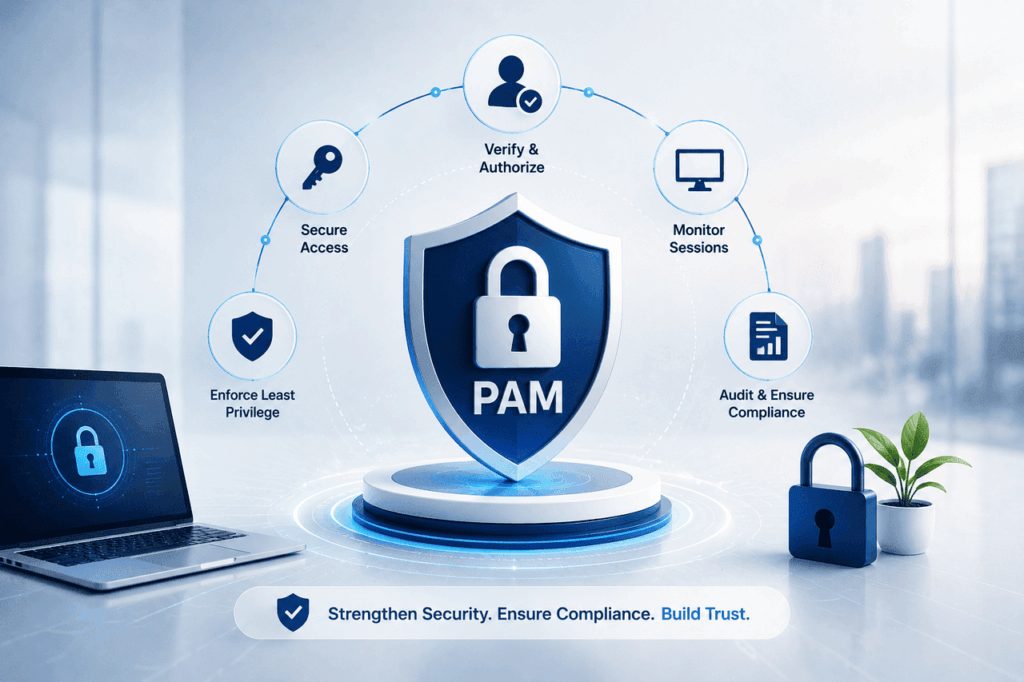
In simpler terms: PAM governs who can do what, when, and where inside your most sensitive systems, and it keeps a verifiable record of every action taken.
How PAM Works
PAM operates by sitting between privileged users and the systems they need to access. Rather than letting an administrator connect directly to a server using a known, static password, a PAM solution injects credentials dynamically, brokers the session, records activity, and revokes access when the session ends. This architecture eliminates the need for users to ever know the actual password to a privileged account.
The workflow typically follows this sequence:
- A privileged user requests access to a target system through the PAM platform.
- The request triggers an approval workflow (or automatic approval for pre-authorized access).
- The PAM solution checks out a credential from the password vault and injects it into the session.
- The session is monitored and recorded in real time.
- Upon session termination, the credential is automatically rotated.
- All session metadata and activity logs are forwarded to SIEM systems for security analytics.
This architecture ensures that no single individual holds standing access to critical systems, and every privileged action is fully auditable.
Core Components of PAM
Modern enterprise PAM solutions are built around several interconnected capabilities:
- Credential Vaulting: Centralized, encrypted storage for all privileged account passwords, SSH keys, API tokens, and certificates.
- Password Vault: Automated management and rotation of privileged credentials on a scheduled or event-driven basis.
- Privileged Session Management (PSM): Brokering and recording of privileged sessions including RDP, SSH, and web-based administrative consoles.
- Secrets Management: Secure storage and dynamic delivery of application credentials, API keys, and service account passwords used by DevOps pipelines and automated workflows.
- Just-In-Time (JIT) Access: Provisioning elevated privileges only when needed, for a defined duration, and automatically revoking them after the task is complete.
- Endpoint Privilege Management: Removing local administrator rights from endpoints and enforcing least privilege at the workstation level.
- Access Certification: Periodic reviews to confirm that privileged access assignments remain appropriate and business-justified.
Understanding India’s DPDP Act
What Is the DPDP Act?
The Digital Personal Data Protection Act, enacted in 2023, is India’s primary legislation governing the collection, processing, storage, and transfer of personal data of Indian citizens. The Act establishes the rights of data principals (individuals whose data is collected) and the obligations of data fiduciaries (organizations that process that data). It represents a significant shift in India’s regulatory landscape, aligning the country with global standards like GDPR while addressing uniquely Indian contexts.
Key Objectives
The DPDP Act is built around several core principles:
- Lawful and transparent data processing: Personal data must be collected and processed only for specific, clearly communicated purposes.
- Data minimization: Organizations should collect only the data necessary for the stated purpose.
- Storage limitation: Personal data should not be retained longer than necessary.
- Accuracy: Data fiduciaries are responsible for maintaining the accuracy of personal data.
- Security safeguards: Organizations must implement appropriate technical and organizational measures to protect personal data.
- Accountability: Data fiduciaries must be able to demonstrate compliance through documentation and audit trails.
Organizations Covered
The DPDP Act applies broadly. Any organization that processes digital personal data of Indian residents, regardless of where the organization is headquartered, falls under its scope. This includes:
- Indian corporations processing customer or employee data
- Multinational companies with Indian operations or Indian users
- Government bodies and public sector undertakings
- Healthcare providers, hospitals, and diagnostic labs
- Financial institutions including banks, NBFCs, and insurance companies
- E-commerce platforms and technology companies
- Educational institutions collecting student data
Compliance Requirements
From a data security standpoint, the DPDP Act requires data fiduciaries to implement reasonable security safeguards. While the Act does not prescribe specific technical controls in exhaustive detail, the requirement for reasonable security is interpreted within the context of established frameworks like ISO 27001, NIST, and the RBI Cybersecurity Framework. Specifically relevant to PAM are requirements around:
- Access controls that prevent unauthorized processing of personal data
- Audit trails demonstrating who accessed personal data and when
- Mechanisms to enforce data processing limitations
- Notification and response processes for data breaches
- Vendor and third-party risk management
Penalties for Non-Compliance
The DPDP Act establishes a tiered penalty structure. Significant breaches of security safeguards that compromise personal data can attract penalties up to Rs. 250 crore (approximately USD 30 million). Failure to notify the Data Protection Board of India of a breach, or non-compliance with other specific obligations, carries separate penalty tiers reaching up to Rs. 200 crore. For large enterprises and Significant Data Fiduciaries, cumulative penalties can be substantial. Beyond financial penalties, the reputational damage from a publicized breach affecting Indian consumers carries its own business impact.
Why Privileged Accounts Pose the Greatest Security Risk
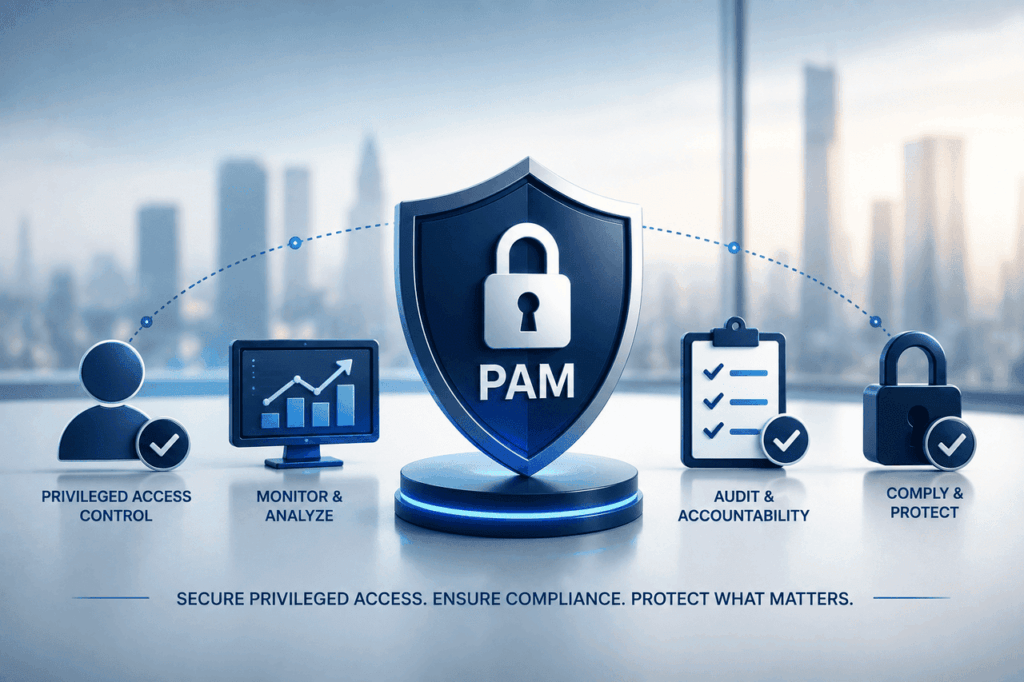
Not all accounts carry the same risk profile. A standard employee account with access to email and a CRM system is a manageable risk. A database administrator account with read access to 10 million customer records is an entirely different matter. Understanding the specific risk categories helps security teams prioritize where PAM controls are most urgently needed.
Administrator Accounts
Domain administrator and local administrator accounts have the broadest access across IT infrastructure. A compromised domain admin credential gives an attacker the ability to move laterally across an entire Active Directory forest, escalate privileges, disable logging, deploy ransomware, and exfiltrate data. Attackers specifically target these accounts through credential theft techniques including pass-the-hash, Kerberoasting, and credential dumping using tools like Mimikatz.
Service Accounts
Service accounts are used by applications and automated processes to authenticate to other systems. They are often over-privileged (given broad access during initial setup and never reviewed), use static passwords that rarely rotate, and operate in the background without human oversight. Many organizations do not even have a comprehensive inventory of their service accounts, making them a significant and often invisible attack surface.
Cloud Privileged Identities
Cloud environments introduce new privileged identity challenges. IAM roles in AWS, service principals in Microsoft Azure, and service accounts in Google Cloud Platform can each carry elevated permissions. Misconfigured cloud IAM policies are one of the most common causes of cloud data breaches. Cloud-native privileged identities require PAM approaches tailored to ephemeral infrastructure, API-based access, and multi-cloud complexity.
Third-Party Vendors
Vendor and contractor access represents one of the most difficult privileged access challenges. Third parties often connect to client environments using shared credentials, personal VPNs, and without meaningful session monitoring. Several high-profile breaches, including the Target breach that exposed 40 million payment cards, originated through a third-party vendor’s compromised credentials. DPDP compliance requires that access granted to data processors (vendors who process personal data on behalf of the data fiduciary) be governed, documented, and auditable.
DevOps Credentials
Modern DevOps pipelines use thousands of credentials: API keys, SSH keys, database connection strings, cloud access tokens, and service-to-service authentication secrets. Historically these were hard-coded into application code or stored in configuration files, making them vulnerable to exposure through code repositories, build logs, and container images. DevOps secrets management is now a core PAM requirement for any organization running CI/CD pipelines.
Database Administrators
Database administrators have privileged access to the most sensitive personal data an organization holds. Insider threats from DBAs, whether malicious or negligent, represent a direct DPDP compliance risk. A DBA who exports a database of customer records without authorization, or who inadvertently leaves a database query log containing personal data in an unprotected location, creates both a security incident and a regulatory compliance failure.
How PAM Helps Organizations Achieve DPDP Compliance
The DPDP Act’s requirement for reasonable security safeguards maps directly to PAM capabilities. Here is how specific PAM controls address specific compliance requirements.
Least Privilege
The principle of least privilege ensures that users, applications, and systems have only the minimum access rights required to perform their designated functions. Under the DPDP Act, data fiduciaries must ensure personal data is accessed only for specified, consented purposes. Least privilege access controls operationalize this by preventing administrators from browsing personal data stores that have no connection to their job function.
PAM enforces least privilege through role-based access control (RBAC), attribute-based access control (ABAC), and granular permission policies that limit what actions a privileged user can perform even after authentication.
Credential Vaulting
Credential vaulting eliminates the practice of administrators storing passwords in spreadsheets, sticky notes, shared password managers, or email threads. A centralized password vault encrypts all privileged credentials, enforces access policies, and ensures that no one can retrieve a credential without leaving an auditable record. This directly supports the DPDP Act’s requirement for demonstrable access controls and audit trails.
Password Rotation
Automated password rotation ensures that privileged credentials are changed on a regular schedule or immediately after use. This limits the window of opportunity for a stolen credential to be leveraged by an attacker. For organizations subject to DPDP compliance audits, automated rotation logs provide concrete evidence of access control hygiene.
Session Monitoring
Real-time privileged session monitoring allows security operations teams to observe privileged user activity as it happens. Behavioral anomalies such as an administrator accessing an unusually large number of customer records outside of normal working hours can trigger alerts, enabling security teams to intervene before a breach escalates. Session monitoring is directly relevant to the DPDP Act’s requirements around preventing unauthorized processing of personal data.
Session Recording
Every privileged session should be recorded, creating a video-like audit trail of exactly what was done during the session. Session recordings are invaluable for forensic investigation following a security incident, for compliance audits demonstrating that personal data was accessed appropriately, and for proving that a breach did or did not involve inappropriate use of privileged access.
Audit Logging
Comprehensive audit logs capture every privileged access request, approval, denial, credential checkout, session start, session end, and command executed. These logs provide the evidence base that compliance officers need when demonstrating adherence to the DPDP Act, responding to regulatory inquiries, or conducting internal investigations.
Just-In-Time (JIT) Access
Just-In-Time access is one of the most powerful DPDP compliance tools available. Rather than granting permanent standing privileges to administrators, JIT access provisions elevated permissions only when a specific, approved task requires them. Once the task is complete, the elevated access is automatically revoked. This dramatically reduces the attack surface by ensuring that no one holds standing access to personal data repositories.
Just Enough Administration (JEA)
Just Enough Administration extends the JIT concept by limiting not just when access is granted, but what that access permits. Rather than giving a DBA full administrative access to a production database containing personal data, JEA allows the organization to grant only the specific commands or operations needed for a defined task. This granular control directly supports the DPDP Act’s data minimization and access limitation principles.
Core Features Every Enterprise PAM Solution Should Include
When evaluating PAM solutions from vendors like CyberArk, Delinea, BeyondTrust, ARCON, or One Identity, enterprise security teams should assess against a consistent capability framework.

Password Vault
The password vault is the foundation of any PAM deployment. Capabilities to evaluate include encryption standards (AES-256 minimum), high availability and disaster recovery options, integration with directory services including Microsoft Active Directory and LDAP, support for cloud-based credential stores, and role-based access to vault contents.
Secrets Management
Enterprise PAM must address machine-to-machine authentication, not just human-to-system access. Secrets management capabilities should cover API key management, certificate lifecycle management, dynamic secrets generation (where credentials are created on demand and expire automatically), and integration with DevOps platforms including HashiCorp Vault, Kubernetes, and CI/CD pipelines.
Privileged Session Management
A mature PSM capability goes beyond simple session recording. Look for protocol support covering RDP, SSH, HTTPS, and database protocols; session isolation (users connect through the PAM proxy, never directly to the target); live session monitoring with the ability to terminate suspicious sessions; and session search and playback with full-text indexing of commands executed.
Session Analytics
Advanced PAM platforms incorporate user and entity behavior analytics (UEBA) to establish behavioral baselines for privileged users and detect anomalies. Analytics capabilities include risk scoring based on access patterns, time-of-day and location anomalies, peer comparison analysis, and integration with identity threat detection and response (ITDR) platforms.
Approval Workflows
Enterprise PAM deployments need flexible approval workflows that match organizational processes. This includes multi-level approval chains, time-bounded access windows, emergency (break-glass) access procedures with automatic notification, and integration with ITSM platforms like ServiceNow.
Access Certification
Periodic access certification campaigns ensure that privileged access assignments remain business-justified. Integration with Identity Governance and Administration (IGA) platforms like SailPoint enables automated discovery of access anomalies, manager certification workflows, and remediation tracking.
Risk-Based Authentication
Not all privileged access requests carry the same risk level. Risk-based authentication adjusts the authentication requirements based on contextual factors including the sensitivity of the target system, the requestor’s behavioral history, time and location of the request, and device compliance status.
MFA Integration
Multi-factor authentication is a baseline requirement for all privileged access. Enterprise PAM solutions should support FIDO2/WebAuthn, TOTP authenticator apps, hardware tokens, and push-based MFA. Integration with Microsoft Entra ID (formerly Azure AD) and other identity providers enables organizations to leverage existing MFA investments.
PAM and Zero Trust Security
Identity as the New Perimeter
The traditional network perimeter, a defined boundary between trusted internal networks and untrusted external networks, no longer reflects the reality of modern enterprise IT. With remote work, SaaS applications, cloud infrastructure, and third-party integrations, trusted and untrusted traffic mixes continuously. Zero Trust architecture responds to this reality by treating every access request as potentially hostile, regardless of where it originates.
In a Zero Trust model, identity is the new perimeter. The question is not “is this request coming from inside the network?” but rather “has this identity been verified, is this device compliant, is this access pattern consistent with established behavior, and is this the minimum access necessary for the stated purpose?”
Continuous Verification
Zero Trust replaces the concept of implicit trust after successful authentication with continuous verification throughout a session. Privileged session monitoring feeds directly into this model. As a privileged user works within a session, behavioral analytics continuously assess whether the activity pattern matches the established profile. Anomalies trigger step-up authentication requirements or session termination.
Least Privilege Access
Least privilege is both a PAM principle and a Zero Trust requirement. Zero Trust architecture mandates that no user, workload, or device should hold more access than necessary for its current task. PAM enforces this through JIT access, JEA, and dynamic credential provisioning.
Adaptive Access Controls
Modern PAM platforms implement adaptive access controls that adjust in real time based on risk signals. Microsoft Defender for Identity and similar ITDR platforms feed threat intelligence into PAM decision engines, enabling dynamic responses to credential abuse, lateral movement attempts, and other identity-based attacks.
PAM vs IAM vs IGA
Identity security is built on three complementary disciplines that are frequently confused. Understanding how they differ and how they work together is essential for building a coherent enterprise security architecture.
| Dimension | PAM | IAM | IGA |
|---|---|---|---|
| Primary Focus | Privileged accounts and elevated access | All user identities and authentication | Access governance, lifecycle, and compliance |
| Scope | Administrators, service accounts, DevOps credentials, cloud roles | Employees, contractors, customers, B2B partners | All identities from a governance and compliance perspective |
| Core Capabilities | Credential vaulting, session monitoring, JIT access, secrets management | SSO, MFA, directory services, identity federation | Access certification, role management, SOD controls, audit reporting |
| Primary User | Security operations, IT infrastructure teams | IT operations, help desk, application owners | Compliance, audit, HR, IT governance |
| Compliance Relevance | Privileged access controls, audit trails, breach prevention | Authentication assurance, access provisioning | Access review documentation, regulatory reporting |
| Representative Vendors | CyberArk, Delinea, BeyondTrust, ARCON | Microsoft Entra ID, Okta, IBM Security Verify | SailPoint, One Identity, Saviynt |
| Relationship | PAM secures the highest-risk accounts | IAM governs all identity lifecycle | IGA certifies and audits all access decisions |
The most mature enterprise security programs integrate all three. IAM manages the lifecycle of all identities including privileged ones. IGA provides governance oversight across all access including privileged access. PAM adds the deep session monitoring, credential vaulting, and behavioral analytics that privileged accounts require. Together they form a comprehensive Identity Security architecture.
Best Practices for Implementing PAM
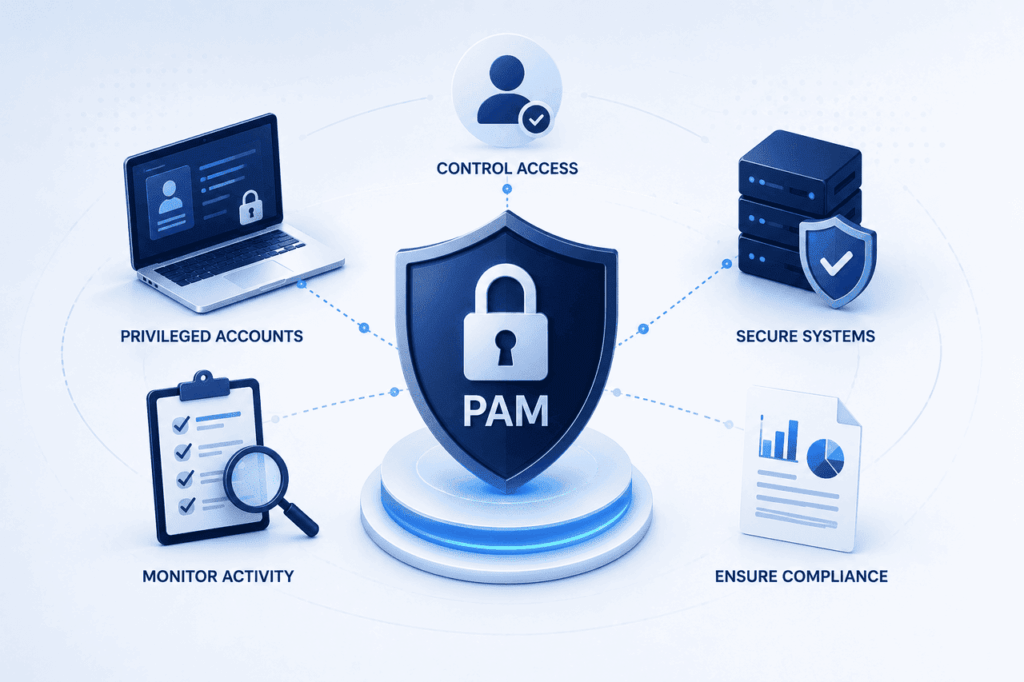
A well-designed PAM program follows a phased approach that prioritizes risk reduction while building organizational capability over time.
Discover Privileged Accounts
You cannot protect what you do not know exists. The first step in any PAM implementation is a comprehensive privileged account discovery exercise that inventories all administrator accounts, service accounts, application accounts, cloud IAM roles, SSH keys, API tokens, and shared credentials. Many organizations discover 3x to 5x more privileged accounts than they expected.
Remove Standing Privileges
Standing privileges, permanent elevated access that never expires, are the single highest-risk configuration in enterprise IT. The goal is to move from a model where administrators hold permanent access to one where elevated access is provisioned on demand, for a defined duration, and automatically revoked. This transition requires JIT access capabilities and workflow integration with change management processes.
Automate Password Rotation
Manual password management for privileged accounts is error-prone, inconsistent, and does not scale. Automated password rotation should be implemented for all vaulted credentials, with rotation frequency calibrated to the sensitivity of the account. Critical infrastructure credentials may rotate after every use; less sensitive accounts may rotate daily or weekly.
Monitor Sessions
Deploy privileged session monitoring for all critical systems. Prioritize systems that store or process personal data covered by the DPDP Act, financial systems, core infrastructure including domain controllers and DNS servers, and production cloud environments. Session monitoring data should feed into SIEM platforms for correlation with other security events.
Integrate PAM with SIEM
PAM generates rich telemetry that becomes significantly more valuable when combined with other security data. Integration with SIEM platforms like Microsoft Sentinel, Splunk, or IBM QRadar enables correlation of privileged access events with network anomalies, endpoint alerts, and threat intelligence feeds. This integration is foundational for a functioning Security Operations Center.
Conduct Regular Access Reviews
Even the best JIT access architecture requires periodic reviews to ensure that standing access grants, emergency access procedures, and service account permissions remain appropriate. Quarterly or semi-annual privileged access certification campaigns, ideally integrated with IGA platforms like SailPoint, provide the documentation that compliance frameworks require.
Train Administrators
Technical controls are more effective when the people operating within them understand why they exist. Administrator training should cover the rationale behind least privilege, the risks associated with credential sharing, safe practices for handling privileged credentials, and the procedures for requesting and using JIT access. Security-aware administrators are an asset; uninformed administrators inadvertently become a risk.
Common Mistakes Organizations Make with Privileged Access
Even organizations that have invested in PAM technology often undermine their own programs through preventable operational mistakes.
Shared admin accounts: Using a single “admin” account shared among multiple administrators destroys accountability. When something goes wrong, there is no way to determine which individual was responsible. Every privileged user should have their own named account, even when operating within shared administrative roles.
Hard-coded credentials: Embedding passwords, API keys, or database connection strings directly in application code remains surprisingly common. Hard-coded credentials inevitably end up in version control repositories, container images, and build logs, where they can be discovered by attackers or inadvertently exposed.
Lack of monitoring: Deploying PAM technology without activating session monitoring is a common failure. Organizations implement credential vaulting as a compliance checkbox but do not configure the alerting, session monitoring, and SIEM integration that would make the deployment genuinely protective.
Excessive permissions: Administrators often receive broader permissions than their role requires because scoping permissions accurately takes time. The result is accounts with Domain Admin rights when Local Admin would suffice, or DBA accounts with write access to production databases when read-only access meets the business need.
Manual password management: Even organizations that have deployed a password vault often maintain a parallel shadow IT practice of spreadsheet-based password management for legacy systems, vendor accounts, or emergency credentials. This undermines the vault’s completeness and creates unmonitored access paths.
Poor audit trails: Compliance is ultimately about evidence. Organizations that cannot produce a complete audit trail of privileged access activity during a regulatory inquiry or breach investigation find themselves in a very difficult position. Audit logging must be comprehensive, tamper-evident, and retained for appropriate periods.
Industries That Benefit Most from PAM
Banking and Financial Services
Financial institutions operate under the most demanding regulatory environment of any sector. RBI cybersecurity framework requirements, PCI DSS compliance for payment systems, and DPDP obligations for customer personal data all converge on the need for comprehensive privileged access controls. A breach of a banking system’s administrative credentials can result in fraudulent transactions, regulatory censure, and customer trust damage that takes years to repair.
Healthcare
Healthcare organizations store some of the most sensitive personal data that exists: medical histories, diagnoses, treatment records, genetic information, and insurance details. Hospital systems, diagnostic labs, and health insurance companies face simultaneous obligations under the DPDP Act, potential HIPAA requirements for cross-border operations, and the clinical reality that patient safety depends on system availability. PAM protects electronic health record systems, clinical applications, and the infrastructure that supports them.
Government
Government organizations are high-value targets for nation-state actors and sophisticated cybercriminal groups. Privileged access to government infrastructure, citizen databases, and law enforcement systems carries national security implications. CERT-In guidelines emphasize privileged access controls as a foundational security requirement for government entities.
Manufacturing
Industrial manufacturers increasingly operate converged IT/OT environments where enterprise IT networks connect to operational technology systems controlling physical production processes. Privileged access to industrial control systems, SCADA environments, and manufacturing execution systems requires PAM approaches that account for the unique constraints of OT environments.
Retail and E-Commerce
Retail organizations process large volumes of customer personal data including purchase histories, payment information, and behavioral data. PCI DSS requirements for payment systems align closely with PAM best practices. With the DPDP Act adding a compliance layer, retail CISOs need PAM programs that address both payment security and personal data protection.
Telecom
Telecommunications providers handle massive volumes of call records, messaging data, location information, and subscriber personal data. Network infrastructure administration requires privileged access controls that scale to complex, distributed environments. Telecom organizations are also frequent targets for SIM swapping attacks and network infrastructure intrusions.
Energy and Utilities
Critical infrastructure operators face both regulatory requirements and existential security risks. Privileged access to energy management systems, grid control infrastructure, and utility customer systems must be governed with extreme care. A successful attack on energy infrastructure has implications far beyond the operator itself.
Technology and SaaS
Technology companies, particularly those offering SaaS platforms, must protect both their own infrastructure and the customer data entrusted to them. Cloud-native PAM capabilities, DevOps secrets management, and privileged access governance for multi-tenant environments are specific requirements for technology organizations.
Education
Educational institutions hold substantial volumes of student personal data, research data, and financial information. University IT environments are notoriously complex, combining research computing, administrative systems, and student services. Least privilege controls and session monitoring are increasingly necessary as educational institutions face growing cyber threat activity.
Future Trends in Privileged Access Management

AI-Driven PAM
Artificial intelligence is transforming how PAM platforms detect anomalies and respond to threats. AI models trained on privileged user behavior can identify subtle deviations from established patterns that rule-based systems miss. AI-driven PAM platforms can reduce false positives in alert generation while improving detection rates for genuine insider threats and credential abuse. Predictive risk scoring enables security teams to prioritize their attention on the highest-risk access events.
Identity Threat Detection and Response (ITDR)
ITDR has emerged as a distinct security category that addresses the detection of and response to identity-based attacks. ITDR platforms monitor identity infrastructure, including Active Directory, Microsoft Entra ID, and PAM systems, for attack techniques like Kerberoasting, DCSync, Golden Ticket attacks, and privilege escalation. ITDR integration with PAM enables organizations to respond to identity-based threats in real time rather than discovering them during post-incident forensics.
Passwordless Administration
The long-term direction of privileged access is toward eliminating passwords entirely in favor of cryptographic authentication methods. FIDO2-based passwordless authentication, certificate-based access, and hardware security keys reduce the risk of credential theft attacks that target static passwords. Major PAM vendors are integrating passwordless capabilities into their platforms, and Microsoft Entra ID provides strong support for passwordless administrator authentication.
Cloud-Native PAM
As enterprise workloads migrate to AWS, Azure, and Google Cloud Platform, PAM architectures must adapt. Cloud-native PAM addresses IAM role management, cloud service account governance, dynamic secrets for ephemeral infrastructure, and privileged access for containerized workloads. The challenge is governing privileged access across multiple cloud providers with inconsistent IAM models while maintaining a unified audit trail.
Machine Identity Security
The number of machine identities, including service accounts, API keys, certificates, and workload identities, now exceeds human identities in most enterprise environments by a significant margin. Machine identity security addresses the full lifecycle of non-human credentials: discovery, issuance, rotation, revocation, and governance. This is an area of rapid growth and is increasingly being integrated into comprehensive PAM platforms.
DevSecOps Integration
Security is being shifted left into the development pipeline. PAM capabilities are being embedded directly into DevOps workflows, enabling developers to access secrets securely through platform integrations rather than hard-coded credentials. Integrations between PAM platforms and tools like GitHub Actions, GitLab CI, Jenkins, and HashiCorp Vault are making secrets management a native part of the development process rather than a post-deployment security control.
PAM Compliance Mapping: DPDP, GDPR, ISO 27001, PCI DSS, and NIST
| PAM Control | DPDP Act | GDPR | ISO 27001 | PCI DSS | NIST CSF |
|---|---|---|---|---|---|
| Least Privilege | Data minimization, access limitation | Article 5, 25 | A.9.2 | Req. 7 | PR.AC-4 |
| Credential Vaulting | Security safeguards | Article 32 | A.9.4 | Req. 8 | PR.AC-1 |
| Session Recording | Audit trail for accountability | Article 5(f) | A.12.4 | Req. 10 | DE.CM-3 |
| JIT Access | Purpose limitation | Article 5(b) | A.9.2 | Req. 7 | PR.AC-4 |
| Password Rotation | Security safeguards | Article 32 | A.9.4 | Req. 8 | PR.AC-1 |
| MFA | Authentication assurance | Article 32 | A.9.4 | Req. 8 | PR.AC-7 |
| Audit Logging | Accountability, evidence | Article 5(2) | A.12.4 | Req. 10 | DE.CM-7 |
| Access Certification | Access governance | Article 5 | A.9.2 | Req. 7 | PR.AC-4 |
PAM Implementation Maturity Model
Organizations implementing PAM typically progress through recognizable maturity stages. Understanding where you are helps prioritize the next investment.
Level 1 – Ad Hoc: No formal PAM program. Privileged accounts are managed manually. Shared admin accounts are common. No session monitoring. Password rotation is infrequent or non-existent.
Level 2 – Basic: Password vault deployed for critical systems. Basic access controls in place. Some session recording. Limited integration with other security tools. Coverage gaps in cloud and DevOps environments.
Level 3 – Defined: Comprehensive PAM program covering on-premises and cloud environments. JIT access implemented for critical systems. SIEM integration active. Regular access certification campaigns. Documented policies and procedures.
Level 4 – Managed: Full session monitoring with behavioral analytics. ITDR integration. Automated response to anomalous privileged access events. Secrets management integrated into DevOps pipelines. Machine identity governance in place.
Level 5 – Optimized: AI-driven risk scoring and adaptive access controls. Continuous compliance monitoring. Passwordless administration for critical systems. PAM fully integrated with IGA platform. Zero Trust architecture realized.
PAM Deployment Checklist for DPDP Compliance
Use this checklist to assess your organization’s PAM readiness against DPDP Act requirements.
Discovery and Inventory
- Complete inventory of all privileged accounts across on-premises and cloud environments
- Service account discovery and documentation
- Cloud IAM role inventory
- SSH key and API token discovery
- DevOps credential inventory
Access Control
- Password vault deployed for all critical privileged accounts
- Least privilege model enforced across all administrator roles
- Standing privileges removed or minimized for critical systems
- JIT access implemented for systems storing personal data
- Third-party vendor access managed through PAM platform
Session Management
- Session monitoring enabled for all privileged access to personal data systems
- Session recording enabled with tamper-evident storage
- Real-time alerting configured for anomalous privileged activity
- Emergency (break-glass) access procedures documented and monitored
Credential Management
- Automated password rotation enabled for all vaulted accounts
- Hard-coded credentials eliminated from application code
- Secrets management platform deployed for DevOps pipelines
- Certificate lifecycle management in place
Audit and Compliance
- Comprehensive audit logging enabled and forwarded to SIEM
- Log retention policy aligned with DPDP Act requirements
- Quarterly access certification campaigns scheduled
- Incident response procedures updated to include PAM data
Integration
- PAM integrated with IAM/identity provider
- PAM integrated with SIEM platform
- PAM integrated with ITSM for approval workflows
- IGA platform connected for access governance
Why Organizations Trust Avancer Corporation for PAM and Identity Security
Avancer Corporation brings together deep expertise in Privileged Access Management, Identity Security, Identity Governance and Administration, and Zero Trust architecture. For organizations navigating the complexity of DPDP compliance alongside the ongoing demands of enterprise security operations, Avancer provides a structured, experience-backed approach.
Privileged Access Risk Assessment: Avancer’s PAM assessment methodology identifies privileged account sprawl, standing privilege risks, service account exposure, and DevOps credential vulnerabilities before attackers can exploit them. The assessment delivers a prioritized risk register and a roadmap for remediation.
PAM Strategy and Architecture: Avancer architects enterprise PAM programs that align with organizational size, industry, regulatory obligations, and technology stack. Whether an organization is evaluating CyberArk, Delinea, BeyondTrust, ARCON, or an open-source alternative, Avancer provides vendor-neutral guidance that keeps the focus on business outcomes rather than product features.
Enterprise PAM Deployment: Avancer’s implementation teams have deployed PAM solutions across banking, healthcare, government, manufacturing, and technology organizations. Implementation services cover credential vaulting, session management configuration, JIT access workflows, SIEM integration, and custom connector development for legacy systems.
PAM and IAM Integration: Isolated PAM deployments create governance gaps. Avancer integrates PAM platforms with enterprise IAM solutions including Microsoft Entra ID, Okta, and IBM Security Verify, ensuring that privileged identity lifecycle events including onboarding, role changes, and offboarding are reflected in PAM access policies in real time.
IGA Integration for Access Governance: Avancer connects PAM platforms with IGA solutions like SailPoint to enable automated privileged access certification, role-based provisioning policies, and compliance reporting that satisfies both internal audit requirements and external regulatory demands including the DPDP Act.
Zero Trust Architecture: Avancer designs and implements Zero Trust frameworks that treat privileged identity as the highest-priority security control surface. This includes network segmentation, conditional access policies, continuous verification mechanisms, and privileged session analytics that feed into a unified Zero Trust policy engine.

DPDP and Global Compliance Alignment: Avancer’s compliance advisory team maps PAM controls to specific DPDP Act obligations, cross-referencing with ISO 27001, NIST, RBI cybersecurity framework requirements, PCI DSS, and HIPAA where applicable. This multi-framework approach ensures that a single PAM investment satisfies multiple regulatory obligations simultaneously.
Continuous Privileged Account Monitoring: Post-deployment, Avancer provides managed services and operational support to ensure that PAM controls remain effective as environments evolve. This includes monitoring for new privileged account creation, drift in access configurations, and emerging threat patterns that require policy updates.
Cyber Resilience Advisory: Avancer works with security leadership teams to embed PAM into broader cyber resilience programs, connecting privileged access controls with incident response planning, business continuity, and security awareness programs.
The consultative approach Avancer brings is grounded in practical deployment experience across complex enterprise environments. The goal is not to sell a product but to help organizations build a PAM program that actually works under real operational conditions and holds up under regulatory scrutiny.
Conclusion: Privileged Access Management as a Strategic Security Investment
The evidence from thousands of breach investigations, regulatory enforcement actions, and security audits points consistently in the same direction. Privileged identities are the primary target of sophisticated attacks. The organizations that suffer the worst breach outcomes, the most extensive data exposure, the longest recovery timelines, the heaviest regulatory penalties, are almost always those that lacked mature privileged access controls.
India’s DPDP Act has made this a regulatory imperative for any organization that processes personal data of Indian residents. The Act’s requirements for security safeguards, audit trails, access limitation, and breach notification map directly onto PAM capabilities. Organizations that build PAM programs aligned with these requirements are not just achieving compliance; they are building a security foundation that reduces breach risk, improves operational accountability, and demonstrates the data stewardship that customers and regulators expect.
The key takeaways for security and compliance leaders are straightforward:
- Privileged accounts represent the highest-value attack target in any enterprise environment and must be treated accordingly.
- PAM is a foundational requirement for DPDP Act compliance, not an optional enhancement.
- Least privilege, credential vaulting, session monitoring, JIT access, and audit logging are the core controls that translate compliance obligations into technical reality.
- Zero Trust architecture cannot be realized without mature privileged access management at its core.
- PAM, IAM, and IGA are complementary disciplines that deliver their greatest value when integrated into a unified Identity Security program.
- Modern PAM challenges extend beyond human administrators to include service accounts, cloud roles, DevOps credentials, and machine identities.
- AI-driven analytics, ITDR integration, and passwordless administration are shaping the next generation of privileged access management.
Organizations that treat PAM as a strategic security investment rather than a compliance checkbox will find that the returns extend well beyond regulatory adherence. Reduced breach probability, faster incident detection, improved audit readiness, and stronger vendor risk management are all measurable outcomes of a well-executed PAM program.
Avancer Corporation helps organizations at every stage of this journey, from initial risk assessment through full program deployment and ongoing operational support. The path to DPDP compliance and a mature Identity Security posture starts with understanding where privileged access risks exist today.
Frequently Asked Questions About Privileged Access Management
What is Privileged Access Management (PAM)?
Privileged Access Management (PAM) is a cybersecurity framework that controls, monitors, and audits the access of users and systems with elevated permissions across an organization’s IT environment. PAM secures privileged credentials through vaulting and automated rotation, enforces least privilege access principles, monitors and records privileged sessions, and provides the audit trails required for regulatory compliance. PAM solutions protect administrator accounts, service accounts, cloud roles, and DevOps credentials from theft, misuse, and unauthorized access.
Why is PAM important for enterprise security?
Privileged accounts are the primary target in the majority of major cyberattacks. Attackers who compromise a privileged credential gain the ability to move laterally through a network, access sensitive data systems, disable security controls, and deploy malware at scale. PAM reduces this risk by eliminating standing privileges, rotating credentials automatically, monitoring privileged sessions in real time, and providing the behavioral analytics needed to detect abuse before it escalates into a full breach.
How does PAM support DPDP compliance?
India’s Digital Personal Data Protection (DPDP) Act requires organizations to implement reasonable security safeguards to protect personal data, maintain audit trails of data access, enforce access controls aligned with processing purposes, and manage third-party access to data. PAM directly addresses each of these requirements through least privilege enforcement, credential vaulting, session recording, JIT access, audit logging, and vendor access management. Organizations with mature PAM programs are significantly better positioned to demonstrate DPDP compliance during regulatory reviews.
What is the difference between PAM and IAM?
Identity and Access Management (IAM) governs the full lifecycle of all user identities in an organization: provisioning, authentication, authorization, and deprovisioning for employees, contractors, and customers. Privileged Access Management (PAM) is a specialized subset that focuses specifically on accounts with elevated permissions, adding capabilities like credential vaulting, session monitoring, JIT access, and behavioral analytics that standard IAM platforms do not provide. The two are complementary and most effective when integrated.
What is the difference between PAM and IGA?
Identity Governance and Administration (IGA) provides the governance layer over all access decisions, covering access request workflows, role management, segregation of duties controls, access certification campaigns, and compliance reporting. PAM provides the technical controls that protect privileged accounts during active use. IGA ensures that privileged access assignments are periodically reviewed, remain business-justified, and are documented for audit purposes. Together, PAM and IGA cover both the operational security and the governance compliance dimensions of privileged access.
What are privileged accounts?
Privileged accounts are any accounts that hold elevated permissions beyond those of a standard user. This includes domain administrator and local administrator accounts, service accounts used by applications and automated processes, database administrator accounts, cloud IAM roles with broad permissions, DevOps pipeline credentials, network device management accounts, and emergency or break-glass accounts. Privileged accounts can belong to human users or to non-human entities like applications, scripts, and automated workflows.
What is Just-In-Time (JIT) access?
Just-In-Time (JIT) access is a privileged access model where elevated permissions are provisioned on demand for a specific, defined purpose and automatically revoked once the task is complete or the access window expires. Rather than granting permanent administrator access that sits unused most of the time and creates unnecessary risk, JIT access ensures that elevated permissions exist only when actively needed. This dramatically reduces the attack surface exposed by standing privileges.
What is credential vaulting?
Credential vaulting is the practice of storing all privileged credentials, including passwords, SSH keys, API tokens, and certificates, in a centralized, encrypted vault rather than in spreadsheets, email, shared password managers, or application code. A credential vault enforces access policies that require authentication and authorization before any credential can be retrieved, maintains a complete audit log of every access event, and integrates with automated rotation processes to ensure credentials are regularly refreshed.
How does PAM improve overall cybersecurity posture?
PAM improves cybersecurity posture across multiple dimensions simultaneously. It eliminates the hard-coded and shared credentials that attackers exploit most easily. It reduces the blast radius of a compromised account by limiting standing privileges. It provides real-time visibility into what privileged users are doing, enabling faster detection of insider threats and credential abuse. It integrates with SIEM platforms to enrich security event data with privileged access context. And it provides the audit trails that security teams need for effective incident response and forensic investigation.
Which industries need PAM most urgently?
All industries that handle sensitive personal data, financial information, or critical infrastructure need PAM. Banking and financial services, healthcare, government, telecom, energy and utilities, retail, and technology organizations face the combination of high data sensitivity, regulatory compliance obligations, and active threat actor interest that makes PAM a non-negotiable investment. However, any organization subject to the DPDP Act, PCI DSS, HIPAA, GDPR, ISO 27001, or SOC 2 has regulatory obligations that a mature PAM program directly supports.
