

Identity and access management for higher education means controlling who can reach which campus systems and data – students, faculty, staff, alumni, contractors, visiting researchers, and now AI agents from the moment they arrive until well after they leave. It’s not the same problem enterprise IT solves. A university onboards and deprovisions tens of thousands of accounts every semester, layers legacy administrative systems under a growing stack of cloud SaaS tools, and spans multiple campuses and research networks that a typical corporation never has to reconcile.
That churn creates the exact gaps attackers look for: a graduated student’s email still active, a departed adjunct’s VPN access never revoked, a research assistant with database permissions nobody remembers granting. Getting IAM right on campus means designing for that scale and turnover from the start, not retrofitting a corporate framework built for a stable, predictable workforce.
What Makes IAM Different on Campus
Population churn sets higher education apart from most IAM use cases. A mid-sized university might onboard eight thousand new students each fall while deprovisioning a similar number of graduates every semester, unlike a corporate hiring calendar. Faculty add complexity: joint appointments, single-term adjuncts, rotating postdocs, alumni with indefinite access. Technical debt compounds it: decades-old student information systems sit under a growing stack of cloud tools for admissions and aid, and multi-campus setups add cross-institution access needs.
That’s the specific reason why identity and access management matters more on campus than in a typical office: the population keeps turning over, and “inside” versus “outside” keeps blurring.
The Regulatory Landscape
Higher-ed IAM sits under several overlapping regulations, and the biggest mistake institutions make is treating them as interchangeable. Each imposes different obligations and applies under different conditions.
FERPA
FERPA is a legal requirement for any institution receiving federal education funding, which in practice covers nearly every degree-granting college through Title IV participation. It requires limiting disclosure of education records without consent, restricting school-official access to those with a “legitimate educational interest,” authenticating anyone requesting records, and keeping audit records of disclosures. What FERPA does not do is mandate specific security technology. The U.S. Department of Education’s FERPA guidance is explicit that tools like MFA or SSO are recommended controls institutions can use to meet FERPA’s underlying duties, not obligations FERPA itself imposes.
HIPAA
HIPAA applies only conditionally on a campus, to a covered-entity health care component, typically a student health center or clinic that conducts electronic health care transactions. Where it applies, the HHS Security Rule makes access control, unique user identification, audit controls, authentication, and workforce security legal requirements for that component, though HIPAA stays technology-neutral about how an institution implements them. Most student health records are actually protected under FERPA rather than HIPAA, even where the clinic is itself a covered entity, which makes understanding how IAM applies in healthcare settings useful context for any campus with a health center.
GLBA and PCI DSS
The GLBA Safeguards Rule applies conditionally, through the Title IV Program Participation Agreement, but that covers nearly every institution disbursing federal financial aid. Per the FTC’s Safeguards Rule guidance, it’s a legal requirement to maintain a written information-security program, enforce access controls and mandatory MFA, encrypt sensitive data, log and monitor activity, oversee service providers, and report qualifying breaches to the FTC within thirty days.
PCI DSS works differently. It applies only to systems that store, process, or transmit cardholder data, bookstore point-of-sale terminals, tuition portals, athletics ticketing, and it is not a legal requirement at all. Per the PCI Security Standards Council, it’s a contractual obligation enforced through merchant and payment-brand agreements meaning its access-control provisions function as recommended controls that institutions handling payment data commit to meeting through those agreements, covering least privilege, unique IDs with no shared accounts, mandatory MFA, and detailed access logging.
Current Risk Data
The numbers behind higher-ed identity risk have moved sharply in the wrong direction. Comparitech researcher Rebecca Moody documented 3.7 million U.S. higher-ed records breached in 2025, nearly double the 1.9 million reported in 2024. Comparitech’s separate H1 2026 ransomware roundup found a split trend: global education ransomware attacks fell 13 percent, but higher-ed attacks rose more than 8 percent even as K-12 attacks dropped 26 percent, with a median ransom demand of $420,620, up 53 percent year over year.
Sophos told a more encouraging story on one axis. Its State of Ransomware in Education 2025 survey of 441 IT leaders found higher-ed institutions stopped 38 percent of ransomware attacks before encryption, up from 21 percent, while the average ransom payment fell from $4 million to $463,000. Verizon’s 2026 Data Breach Investigations Report counted 1,252 education-sector breaches, more than half involving malware, and 65 percent of those involving ransomware.
Underneath those headline numbers, security teams increasingly point to compromised or reused login credentials as one of the most common ways attackers get into campus systems, rather than sophisticated exploits. That tracks with the EDUCAUSE 2025 Cybersecurity and Privacy Workforce report, which surveyed 141 higher-ed security professionals and found teams that are relatively stable, two-thirds saw little or no turnover, but still stretched thin against a growing attack surface.
Practical Controls and Best Practices
Core Controls
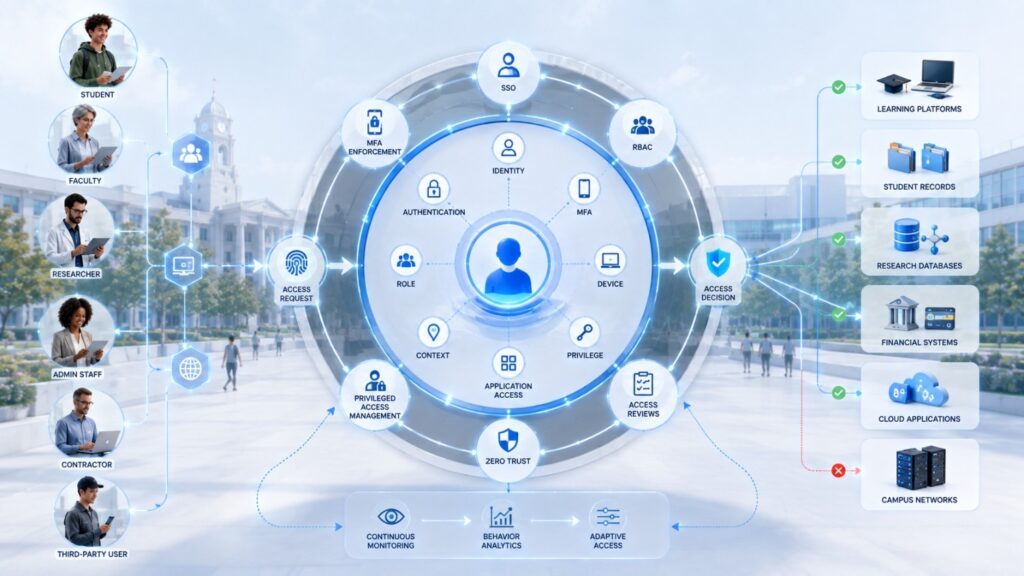
SSO and MFA form the baseline, cutting password sprawl and closing the gap reused passwords leave open. Role-based access control (RBAC) ties permissions to a role instead of ad hoc access, and attribute-based access control extends that for complex rules aid status, research clearance, campus affiliation. Privileged access management adds oversight for sensitive accounts. Choosing well starts with structuring a scalable IAM architecture, weighing MFA against adaptive authentication, and mapping role-based access controls to operations.
NIST SP 800-207’s zero trust architecture trusts no device or user by default and continuously verifies identity before granting access – suited to a campus with no stable perimeter. These layered defenses aren’t unique to higher education: Avancer Corporation and similar identity and access management specialists build the same multi-factor authentication and role-based provisioning models for hospitals, banks, and government agencies, then adapt them to a campus’s mix of students, faculty, staff, and short-term researchers.
Identity Lifecycle
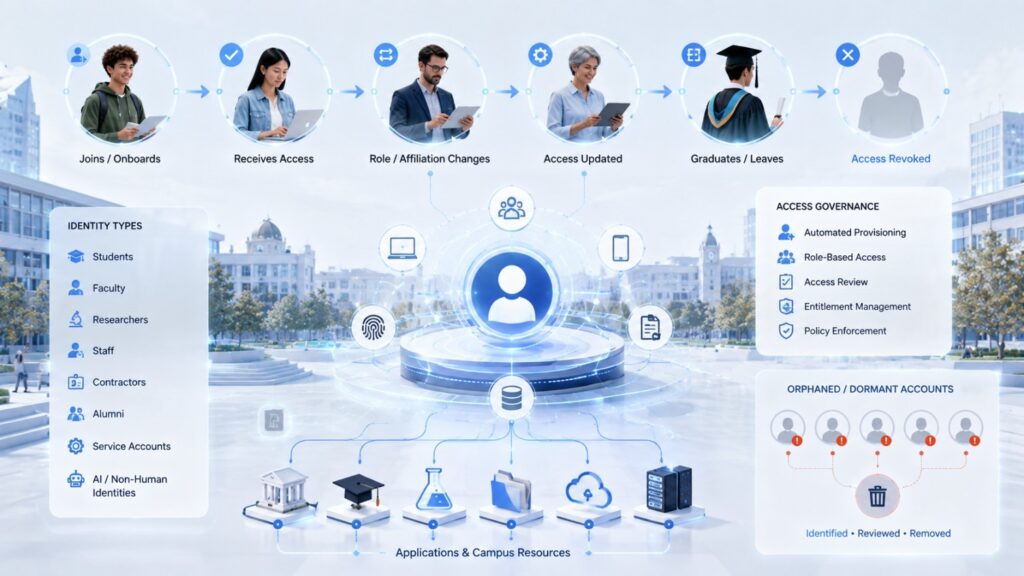
Controls only work if the underlying identity lifecycle, joiner, mover, leaver, actually functions. IT and security leaders frequently flag dormant accounts left behind by graduated students, departed staff, and former contractors as a recurring gap in campus access control. Many institutions still rely on manual, ticket-driven deprovisioning tied to registrar or HR workflows, a pattern IT leaders consistently describe as a lag point between someone leaving and their access actually being revoked. That lifecycle problem increasingly extends beyond human users, too: security teams are calling out non-human identities, service accounts, bots, and AI-driven automation, as a fast-growing blind spot that traditional joiner-mover-leaver processes were never designed to catch.
Common Pitfalls
Orphaned accounts top the list of recurring failures, closely followed by manual, spreadsheet-driven access reviews that can’t keep pace with a population this size. Institutions that skip periodic access recertification tend to discover, usually during an audit or an incident, that dozens of accounts still hold access nobody can justify. Specialists like Avancer Corporation are often brought in specifically to run those access audits and clear the orphaned-account backlog before it resurfaces at the next review cycle.
Third-party EdTech and SaaS vendors have become a recurring source of exposure, as the 2026 Canvas/Instructure breach illustrated. As first reported by BleepingComputer and widely covered since, that incident was attributed to the ShinyHunters group between late April and mid-May 2026 and exposed data belonging to roughly 275 million users across 8,809 institutions, making it the largest education breach on record and a reminder that an institution’s own access controls are only as strong as its vendors’.
Getting Started
Start with an inventory, not a purchase. Most institutions don’t actually know how many active accounts exist across every system, who has access to what, or which permissions still make sense. An access audit answers that question before any new tool gets evaluated. From there, prioritize the highest-risk gaps first: privileged accounts, financial aid and payment systems, and anything tied to a departed employee.
Because most campus IT departments already run lean, a fair number of institutions start this work by bringing in outside IAM implementation help, whether that’s a systems integrator like Avancer Corporation or a similarly specialized consultancy, to run the initial audit and design the roadmap before handing day-to-day operation back to internal staff. Build the lifecycle policy next: joiner, mover, leaver rules with defined timelines, so the audit’s findings don’t just get fixed once and drift back to where they started.
Conclusion:
IAM on a college campus will never look like IAM in a conventional enterprise, and treating it that way is usually where the trouble starts. The population turns over constantly, the regulatory landscape splits into legal requirements, best practices, and conditional obligations that depend entirely on what a given system touches, and the risk data keeps trending toward more records exposed, not fewer. Whether that means starting with a single access-review cycle in the registrar’s office or engaging a specialized IAM partner like Avancer Corporation to accelerate the roadmap, the institutions that treat identity as core infrastructure, not an afterthought, are the ones that keep pace with both the regulators and the threat landscape.

Frequently Asked Questions:
What is identity and access management (IAM) in higher education?
IAM in higher education is the set of policies, processes, and technologies that control who can access which campus systems and data, from student information systems and learning platforms to research infrastructure and financial aid records, for students, faculty, staff, alumni, contractors, and researchers throughout their time affiliated with the institution.
Does FERPA require identity and access management or specific security controls?
FERPA is a legal requirement for institutions receiving federal education funding, and it does require limiting access to education records to those with a “legitimate educational interest” and authenticating who is requesting records. However, FERPA does not mandate specific security technology like MFA or SSO. Those are recommended controls institutions use to meet FERPA’s underlying access and authentication duties, not a FERPA mandate in themselves.
Does HIPAA apply to colleges and universities?
Only conditionally. HIPAA applies to a covered-entity health care component, such as a campus health center or student health service that conducts electronic health care transactions, not to the institution as a whole. Most student health and treatment records are actually protected under FERPA, even at institutions where the health clinic is itself a HIPAA covered entity.
What happens to a student’s account and access when they graduate?
In a well-managed IAM program, a student’s access is deprovisioned or downgraded according to a defined lifecycle policy. Some systems are cut off immediately, while others, like alumni email, may persist in a limited form. The common failure mode is manual, delayed deprovisioning that leaves accounts active well past graduation.
What is zero trust and how does it apply to higher education?
Zero trust, as defined in NIST SP 800-207, is a security model that assumes no user or device should be trusted by default, even inside the network, and instead continuously verifies identity and context before granting access. For higher education, this is a recommended control, not a legal mandate, that’s particularly well-suited to campuses because it doesn’t rely on a stable, well-defined network perimeter.
