
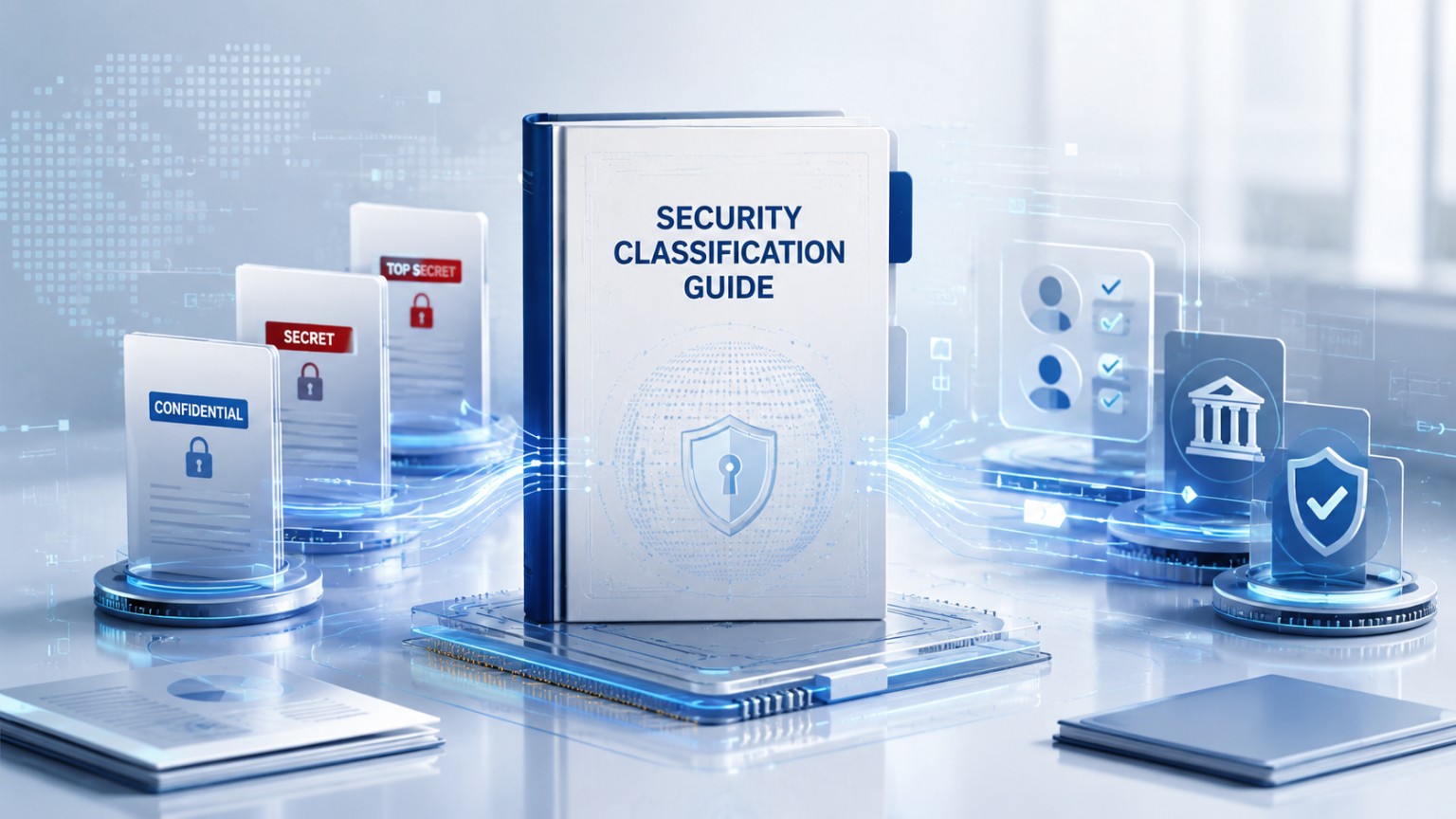
What Is a Security Classification Guide? Cyber Awareness 2026 – A Security Classification Guide (SCG) is a document issued by an Original Classification Authority (OCA) that identifies specific information requiring protection in the interest of national security. It tells personnel exactly what information within a program, system, or project is classified, at what level, and for how long. If you’ve encountered this term in the 2026 Cyber Awareness Challenge, that’s because the SCG is the single most important reference tool for anyone performing derivative classification – the process most government and contractor personnel actually do when they handle classified material.
This isn’t a corporate data-sensitivity label or a generic IT policy. An SCG is a U.S. government instrument rooted in Executive Order 13526 and enforced through Department of Defense regulations. Understanding how it works is essential for anyone who touches classified national security information.
What Does a Security Classification Guide Do?
An SCG serves as the authoritative road map for classification decisions within a specific program or project. It answers three critical questions about each piece of information:
- Is this information classified?
- At what level? (Confidential, Secret, or Top Secret)
- For how long? (the declassification date, event, or exemption)
Without an SCG, personnel working on classified programs would have no consistent basis for deciding how to mark and protect the information they produce. Every memo, briefing, email, or technical document generated from existing classified material depends on this guidance.
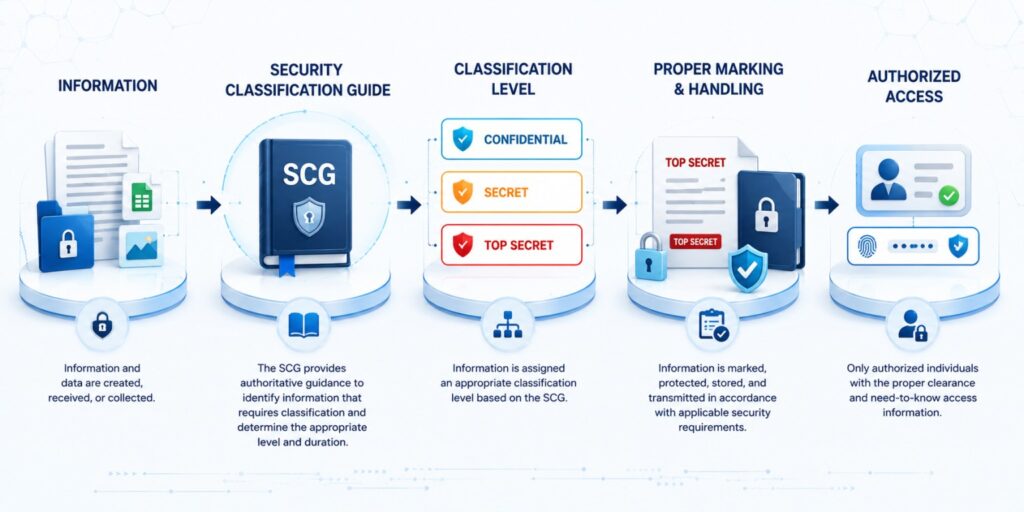
Think of it this way: an Original Classification Authority makes the initial decision that certain information needs protection. The SCG is how that decision gets communicated to everyone else the analysts, engineers, contractors, and support staff who will handle that information going forward.
Why Is a Security Classification Guide Important in Cyber Awareness?
The Cyber Awareness Challenge, including the 2026 version hosted by DISA covers the full spectrum of information security responsibilities that DoD personnel face daily. Classification isn’t just an abstract concept; it directly affects how you create documents, send emails, discuss projects, and store files.
The training emphasizes SCGs because most classification actions in the U.S. government are derivative, not original. The vast majority of people who handle classified information don’t make original classification decisions. Instead, they incorporate, paraphrase, or restate information that was already classified by someone else. The SCG is the primary tool they use to do that correctly.
Getting derivative classification wrong has real consequences. Overclassification buries important information behind unnecessary restrictions, slowing down mission-critical work. Underclassification exposes national security information to unauthorized access. Either failure undermines the system.
What Information Does an SCG Identify?
A well-constructed SCG identifies specific information elements and maps them to classification parameters. According to guidance from the Information Security Oversight Office (ISOO) under the National Archives, an SCG typically addresses:
- Program elements – specific technical details, capabilities, vulnerabilities, or operational information
- Classification level – Confidential, Secret, or Top Secret for each element
- Classification duration – a specific date, an event that triggers declassification, or a notation that the information is exempt from automatic declassification
- Declassification instructions – what happens when the classification expires
- Portion marking guidance – how to mark individual paragraphs or sections of a document
- Compilation considerations – whether unclassified pieces, when combined, create classified information
An SCG may also identify information that is explicitly not classified, which is just as important for preventing overclassification.
What Are the Classification Levels?
Executive Order 13526 establishes three levels of classification for national security information:
Top Secret – Applied when unauthorized disclosure could reasonably be expected to cause exceptionally grave damage to national security. The OCA must be able to identify or describe the nature of that damage.
Secret – Applied when unauthorized disclosure could reasonably be expected to cause serious damage to national security.
Confidential – Applied when unauthorized disclosure could reasonably be expected to cause damage to national security. This is the lowest classification level currently in use.
These levels are not interchangeable with corporate labels like “Internal” or “Restricted.” They carry specific legal meaning under federal law, and the consequences for mishandling information at any of these levels range from administrative action to criminal prosecution.
How Does a Security Classification Guide Support Derivative Classification?
Derivative classification is the process of incorporating, paraphrasing, restating, or generating in new form information that is already classified, and then marking that new material consistent with the classification of the source. This is the classification activity that most people perform.
The SCG is one of two authorized sources for making derivative classification decisions (the other being the markings on existing classified source documents). When you’re creating a new briefing that pulls together information from a classified program, you consult the program’s SCG to determine:
- Which elements of the information you’re using are classified
- What level to assign your new document
- How to mark individual portions
- What declassification instructions to carry forward
Here’s a practical example: A defense contractor is writing a systems engineering document for a missile defense program. The document incorporates technical specifications from several classified sources. The contractor consults the program’s SCG, identifies which specifications are Secret and which are Confidential, marks each portion accordingly, and assigns the overall document the highest classification level of any information it contains.
Without the SCG, that contractor would be guessing and guessing about classification is never acceptable.
Security Classification Guide vs. Data Classification Policy
This distinction trips people up, especially those who work in both government and private-sector environments.
A Security Classification Guide is a U.S. government document created by an Original Classification Authority under Executive Order 13526. It specifically addresses classified national security information. Only designated OCAs within the executive branch can create one, and it carries the force of federal regulation.
A data classification policy is a corporate or organizational framework that categorizes information by sensitivity typically using labels like Public, Internal, Confidential, and Restricted. Any organization can create one. It’s a governance tool, not a legal instrument tied to national security law.
The concepts are related in principle (both organize information by sensitivity and prescribe handling requirements), but they operate in completely different legal and operational contexts. If someone asks you about a “Security Classification Guide” in the context of cyber awareness training, they’re asking about the U.S. government system – not a corporate IT policy.
What Should You Do When Handling Classified Information?
Regardless of your specific role, these principles apply whenever you encounter or create classified material:
- Verify your authorization. You need both the appropriate clearance level and a legitimate need-to-know before accessing classified information.
- Consult the SCG. Before creating derivative material, check the applicable Security Classification Guide for the program you’re working on.
- Mark correctly. Apply portion markings, overall classification markings, and declassification instructions as specified by the SCG or source document.
- Use approved systems. Classified information must be processed, stored, and transmitted only on systems accredited for that classification level.
- Report concerns. If you suspect a classification error, an unauthorized disclosure, or improper handling, report it through your security office.
Common Mistakes People Make With Classified Information
Years of Cyber Awareness training highlight the same recurring failures:
Sharing with unauthorized individuals. Having a clearance isn’t enough – the person must also have need-to-know for that specific information. A colleague with a Top Secret clearance doesn’t automatically have access to every Top Secret program.
Ignoring classification markings. Treating marked documents casually – leaving them on a desk, discussing them in unsecured areas, or forwarding them over unclassified email — remains one of the most common violations.
Assuming unmarked means unclassified. Just because a document lacks markings doesn’t mean the information isn’t classified. If it originated from a classified program, consult the SCG before treating it as unclassified.
Using unauthorized communication tools. Sending classified information over regular email, messaging apps, or personal devices creates an immediate security incident. In 2026, this risk extends to collaboration platforms, cloud services, and AI tools that haven’t been accredited for classified use.
Failing to apply compilation rules. Individual unclassified facts can become classified when combined. The SCG addresses these compilation scenarios, and ignoring them is a form of underclassification.
Why Security Classification Guides Matter in 2026
The information environment that DoD and intelligence community personnel work in today bears little resemblance to the paper-based systems where classification policies originated. Remote work arrangements, cloud-based collaboration platforms, mobile devices, and cross-organizational data sharing have dramatically expanded the attack surface for classified information.
The 2026 Cyber Awareness Challenge reflects this reality. Threats aren’t just about someone physically walking out with documents anymore. Social engineering attacks target personnel through email, messaging platforms, and even AI-generated communications. Insider threats exploit digital access that would have been much harder to abuse in a pre-network era.
SCGs remain essential precisely because the digital environment makes it easier to inadvertently create, share, or expose derivative classified material. When you’re collaborating in real time across multiple systems and organizations, having a clear, program-specific reference for what’s classified and what isn’t prevents the kind of errors that create security incidents.
The fundamentals haven’t changed: know what’s classified, mark it correctly, protect it appropriately, and report problems immediately. But the digital context makes disciplined use of Security Classification Guides more important than it’s ever been.
Conclusion:
A Security Classification Guide is the bridge between an Original Classification Authority’s decisions and the day-to-day work of everyone who handles classified information. It’s specific, authoritative, and program-focused — not a general policy or a suggestion. In the context of the 2026 Cyber Awareness Challenge, understanding the SCG means understanding your personal responsibility when you create, handle, or share national security information. The digital tools and platforms may keep evolving, but the underlying requirement remains the same: know the classification guidance, apply it correctly, and protect what needs protecting.
Frequently Asked Questions:
What is a security classification guide cyber awareness 2026?
A security classification guide cyber awareness 2026 is a document created by an Original Classification Authority that identifies specific information within a program or project requiring classification. It specifies the classification level (Confidential, Secret, or Top Secret) and duration for each identified element of information.
What is the purpose of an SCG?
The purpose is to provide clear, consistent guidance so that all personnel handling a program’s information make the same classification decisions. It enables accurate derivative classification and prevents both over- and under-classification.
Is a Security Classification Guide used for derivative classification?
Yes. The SCG is one of two authorized sources for derivative classification decisions (the other being markings on existing classified source documents). Anyone performing derivative classification must consult the applicable SCG to determine proper markings and handling.
What are the three levels of classified information?
The three levels are Confidential, Secret, and Top Secret. Each level corresponds to the degree of damage that unauthorized disclosure could reasonably be expected to cause to national security – from “damage” (Confidential) to “exceptionally grave damage” (Top Secret).
What is the difference between an SCG and a data classification policy?
An SCG is a U.S. government instrument tied to Executive Order 13526 and national security law. It applies only to classified national security information and is created exclusively by authorized government officials. A data classification policy is a corporate governance tool that any organization can create to categorize its own information by sensitivity level.
Why is a Security Classification Guide important for cyber awareness?
Because most classification actions are derivative people incorporating existing classified information into new documents — the SCG is the primary tool for making those decisions correctly. Cyber awareness training ensures personnel understand this responsibility and can apply classification guidance in increasingly complex digital environments.
