
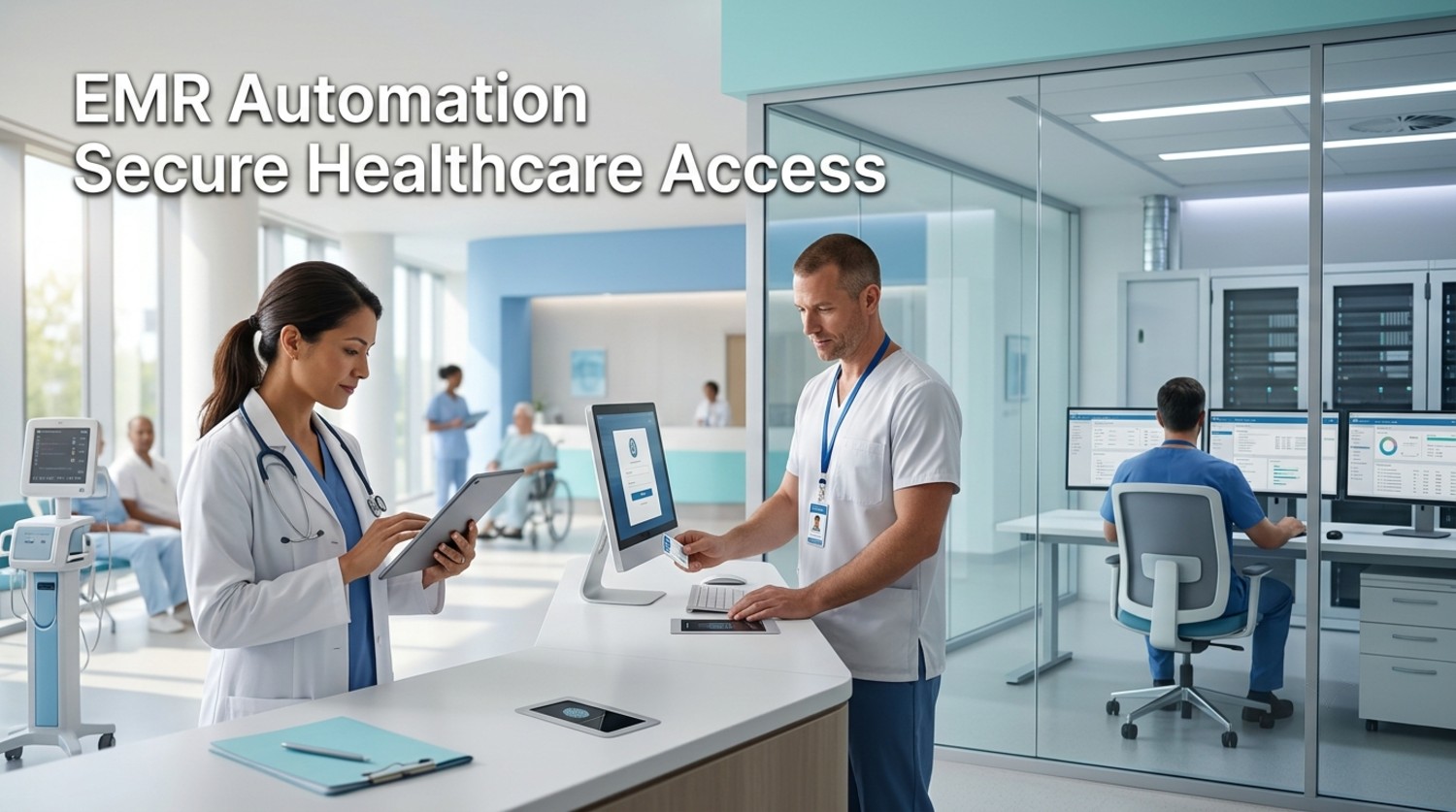
Every hospital runs on data. Patient records, clinical workflows, billing systems, care coordination tools – all of it flows through electronic medical records platforms that have become the operational backbone of modern healthcare. But behind every login, every access request, and every clinical transaction is an identity. And in most healthcare organizations, managing those identities is still surprisingly manual, fragmented, and risky.
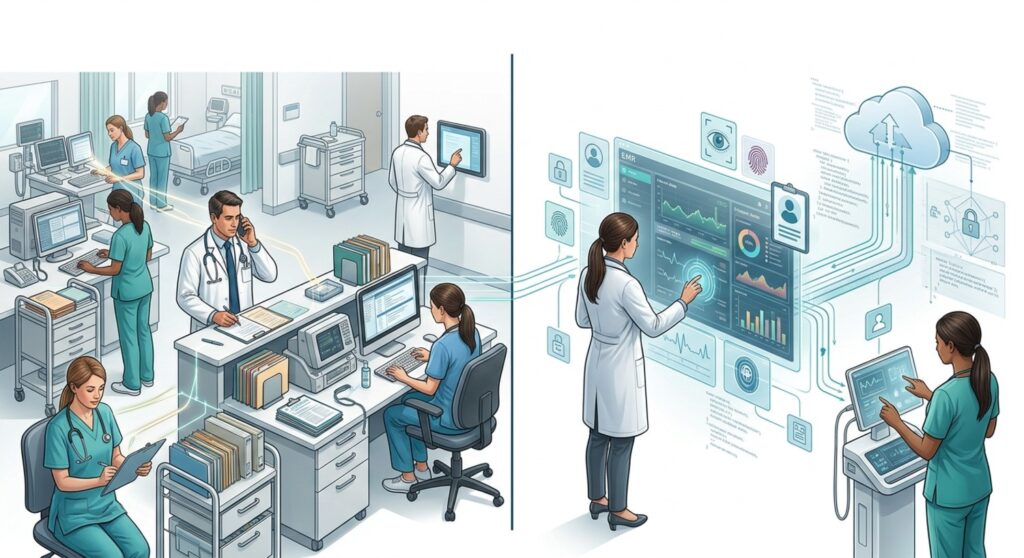
Healthcare IT environments today support thousands of users – physicians, nurses, pharmacists, administrative staff, contractors, and third-party vendors each needing timely, appropriate access to sensitive systems. The average large hospital operates with multiple EMR systems, dozens of integrated clinical applications, and a workforce that turns over, shifts roles, and spans multiple locations. Managing identity across that environment without automation is not just inefficient. It creates real security exposure, compliance risk, and patient care delays.
What is EMR automation? In short, it is the use of technology to automate identity workflows, clinical processes, and access management functions within electronic medical records systems, reducing manual effort while improving security and compliance.
Cyber threats targeting healthcare have grown sharply. Ransomware attacks, insider threats, and credential-based breaches consistently rank among the most common and costly incidents in the industry. The Identity Defined Security Alliance reports that 84 percent of organizations experienced an identity-related breach in a single year. Healthcare is among the highest-risk sectors. When access to an EMR system is compromised, the consequences go beyond data loss patient safety, clinical continuity, and regulatory standing are all at risk.
This guide covers the full landscape of EMR automation and healthcare identity and access management (IAM): what it means, why it matters, how to implement it, and what the future of healthcare identity security looks like.
What Is EMR Automation?
Definition
EMR automation refers to the use of software, integration platforms, and identity management tools to automate tasks within electronic medical records systems that would otherwise require manual intervention. This includes automating user provisioning and deprovisioning, access requests, role assignments, password management, audit logging, and identity lifecycle management across EMR and EHR platforms.
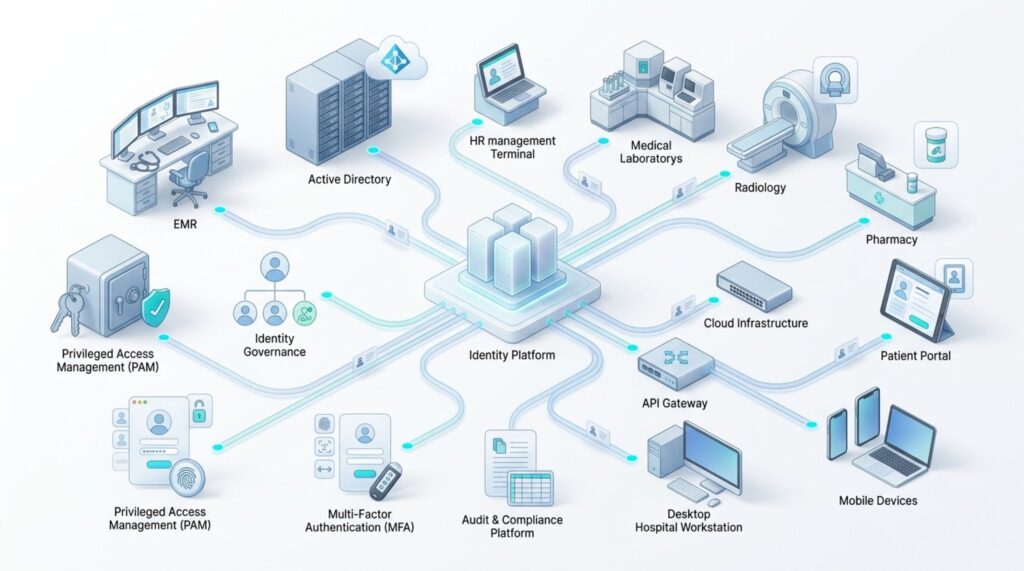
At its core, EMR automation is about removing the human bottleneck from identity and access operations so that clinicians get the access they need quickly, access is removed promptly when it is no longer needed, and security policies are enforced consistently without depending on individual administrators to catch every exception.
How EMR Automation Works
EMR automation works by connecting your identity management platform typically an Identity Governance and Administration (IGA) solution or an IAM platform to your HR system, your EMR software, and other clinical applications. When a new physician is hired, their HR record triggers an automated workflow that provisions their accounts across Epic, Oracle Health (Cerner), MEDITECH, or whichever EMR platform your organization runs, along with any connected clinical systems. Their access is based on predefined roles tied to their department, specialty, and facility.
When that same physician transfers to a different department, changes their employment status, or leaves the organization, the identity platform detects the change and automatically adjusts or removes access. No ticket required. No manual steps. No risk of someone forgetting to disable an account.
Integration relies on standard connectors, APIs, and identity synchronization protocols. Modern EMR platforms like Epic and Oracle Health support SCIM (System for Cross-domain Identity Management), LDAP synchronization, and API-based integration, which makes identity automation both feasible and scalable.
Why Modern Hospitals Need Automated EMR Systems
Manual identity management cannot keep pace with healthcare’s operational complexity. A mid-size hospital with 3,000 employees may process hundreds of identity changes per month new hires, transfers, contract workers, role changes, leaves of absence, and terminations. Each one requires accurate, timely access changes across multiple systems.
When those changes are handled manually, delays are inevitable. A new nurse waiting three days for EMR access cannot do their job. A terminated employee whose access was not revoked represents an active security risk. An overprivileged contractor with access to systems they were never supposed to use is a HIPAA violation waiting to happen.
Automated EMR systems solve all of these problems simultaneously. They reduce onboarding time from days to hours, improve security through consistent policy enforcement, and create the audit trails that regulators and compliance teams require.
Common Identity Management Challenges in EMR Systems
Understanding where the pain points are is the first step toward fixing them. Healthcare organizations that have not yet implemented identity automation typically share a predictable set of challenges.
Manual User Provisioning
In many hospitals, provisioning a new employee’s access to the EMR system still involves a mix of paper forms, email chains, and IT tickets. Someone in HR notifies IT, IT creates accounts, department heads approve access levels, and someone eventually enters the data into the system. This process can take days. It is error-prone. And it scales poorly.
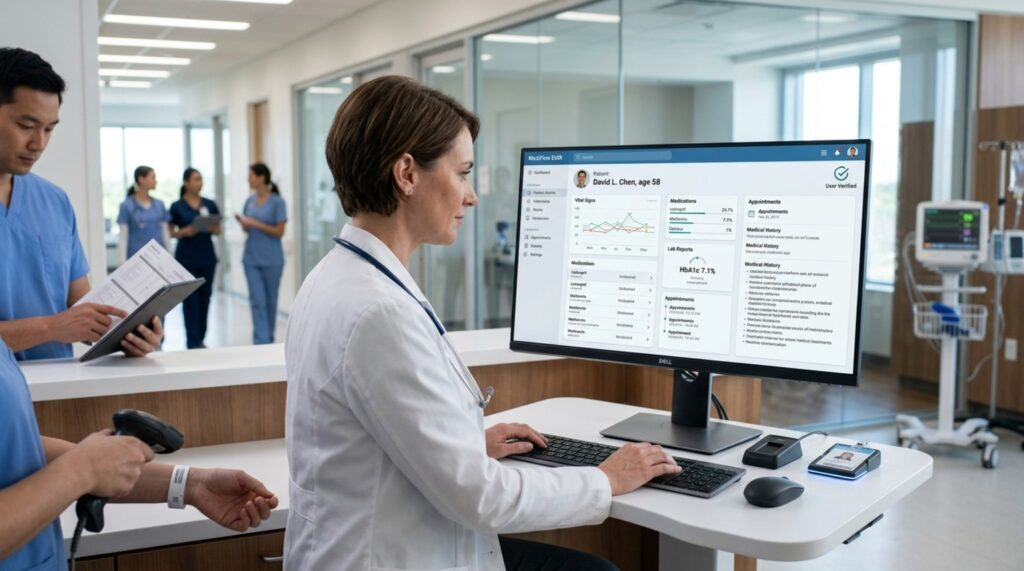
When a hospital is onboarding multiple new staff members simultaneously during a hiring surge, a merger, or a seasonal increase in patient volume manual provisioning creates backlogs that directly affect patient care capacity.
Delayed Access for Clinicians
Delayed EMR access is not just an IT problem. When a hospitalist arrives for their first day and cannot access patient records, a nurse cannot document a medication administration, or a new resident cannot view lab results, the clinical team has to work around the system. Workarounds introduce risk. They lead to incomplete documentation, communication gaps, and in some cases, clinical errors.
Healthcare identity management that automates the provisioning process eliminates this problem. Access is ready when the clinician is.
Excessive User Permissions
Least privilege access giving users only the permissions they need for their specific role is a foundational security principle. It is also one of the most commonly violated in healthcare. Over time, users accumulate permissions as they change roles, take on temporary assignments, or request access for specific projects. Without regular access reviews and automated role enforcement, these permissions accumulate and are rarely cleaned up.
This permission creep creates serious risk. An employee with access to patient records across departments they no longer work in is a potential insider threat vector and a compliance liability.
Identity Silos
Many healthcare organizations have acquired systems over time without a unified identity strategy. The result is a fragmented landscape where Epic has its own user database, the radiology system manages its own credentials, the billing platform has separate logins, and the pharmacy system operates independently. These identity silos create administrative overhead, inconsistent access policies, and security gaps.
When a user leaves the organization, IT has to manually remove access from each system. Miss one, and you have an orphaned account that could be exploited.
Orphaned Accounts
Orphaned accounts active accounts belonging to users who have left the organization are among the most common findings in healthcare security audits. A 2022 KPMG survey found that 40 percent of healthcare organizations had active accounts belonging to former employees. These accounts, particularly those with elevated privileges, represent significant security risk.
Automated deprovisioning through an integrated healthcare IAM platform eliminates orphaned accounts by triggering immediate access removal when an HR termination event is detected.
Contractor and Third-Party Access
Healthcare organizations rely heavily on contractors, temporary staff, locum physicians, medical device vendors, and IT service providers. Each of these third parties needs some level of access to clinical systems. Managing contractor identity is particularly challenging because these users often fall outside standard HR workflows, are engaged on variable timelines, and may need access to sensitive systems without going through the same onboarding process as full-time employees.
Without a formal identity governance program, third-party access frequently goes unreviewed, overpermissioned, and unmonitored. That creates serious risk both from accidental data exposure and deliberate misuse.
How Identity and Access Management Improves EMR Automation
IAM is the technology and process framework that makes true EMR automation possible. Here is how the key components work together.
Automated User Provisioning
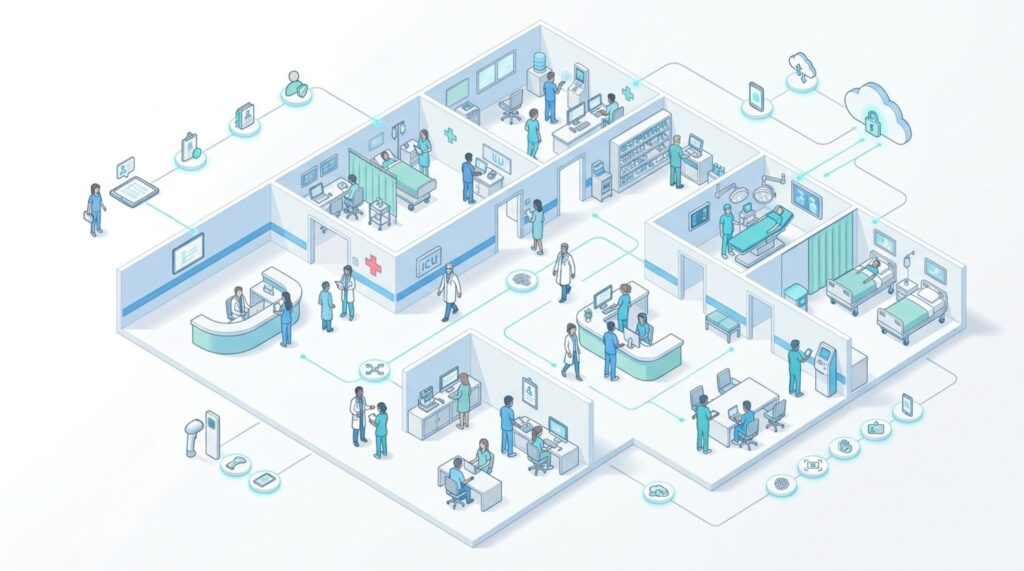
Automated user provisioning connects your HR system Workday, SAP SuccessFactors, or another platform to your EMR and clinical applications. When a new hire is entered in HR, the identity platform automatically creates the necessary accounts, assigns the appropriate roles, configures the user’s access to EMR software, and notifies the user with their credentials or instructions for self-service enrollment.
The process is driven by role definitions. A hospitalist gets one set of permissions. A charge nurse gets another. A billing specialist gets access to financial systems but not clinical records they have no need for. Role-based provisioning enforces least privilege from day one.
Automated Deprovisioning
Deprovisioning is where manual identity management fails most visibly. When someone leaves a healthcare organization, their access should be removed immediately. Automated deprovisioning triggers the moment an HR termination event is processed. All accounts across the EMR, clinical applications, email, and other connected systems are disabled or deleted based on predefined policy. No manual steps. No delays.
For healthcare organizations, this is not just a security control. It is a HIPAA requirement. The HIPAA Security Rule requires covered entities to implement procedures to terminate access when employment ends.
Identity Lifecycle Management
Identity lifecycle management covers the entire span of a user’s relationship with your organization: onboarding, role changes, transfers, leaves of absence, and offboarding. Healthcare identity lifecycle management automation ensures that identity changes ripple correctly through all connected systems without manual intervention.
When a nurse is promoted to charge nurse, their access profile updates automatically. When a physician takes a six-month leave, their access is suspended rather than deleted, then restored when they return. When a hospitalist moves from one facility to another within the same health system, their access adjusts to reflect the new location and department.
Role-Based Access Control (RBAC)
Role-based access control is the foundation of healthcare access management. Rather than assigning permissions on an individual basis, RBAC groups users by their job function and assigns a predefined set of permissions to each role. A pharmacist role includes access to medication management modules. A cardiologist role includes access to cardiac imaging systems. An administrative coordinator role includes scheduling and registration functions but not clinical documentation.
When combined with EMR automation, RBAC makes provisioning fast, consistent, and scalable. New users inherit the permissions of their role automatically. When roles change, permissions update accordingly.
Many organizations extend RBAC with attribute-based access control (ABAC), which adds contextual factors – location, time of day, device type to the access decision. ABAC is particularly useful in healthcare where access needs may vary by care setting or clinical context.
Single Sign-On (SSO)
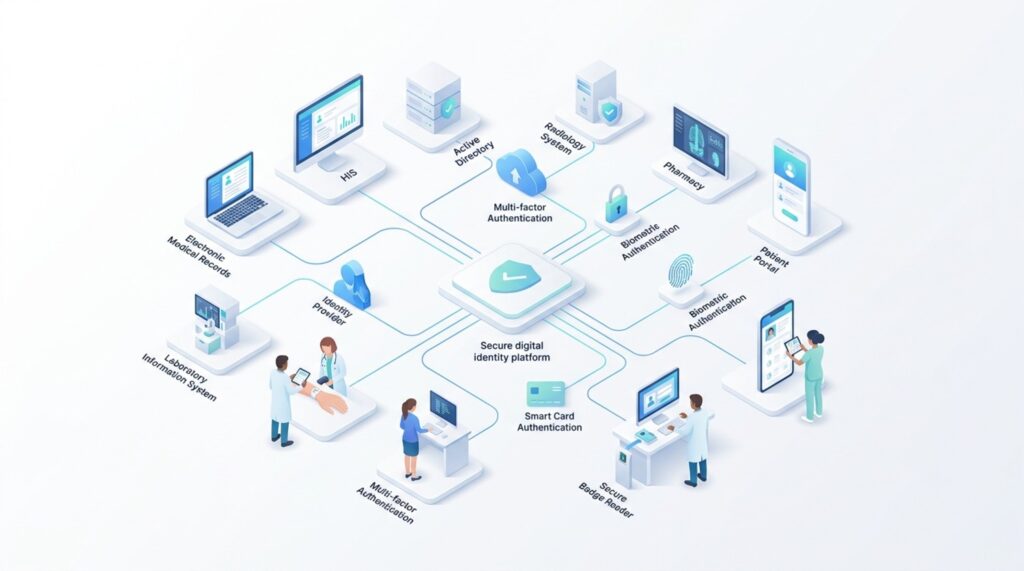
Single sign-on allows clinicians to authenticate once and access all their authorized systems without logging in repeatedly. In a busy clinical environment, this matters enormously. A nurse who needs to access the EMR, a medication dispensing system, a radiology application, and a patient communication platform throughout a shift does not have the time to authenticate to each system separately.
SSO reduces authentication friction, increases compliance with security policies (because users are less likely to share passwords or leave sessions open when login is easy), and gives IT a centralized place to enforce authentication policies. When a user’s access is terminated, a single action in the identity platform revokes all SSO-connected sessions.
Multi-Factor Authentication (MFA)
Multi-factor authentication adds a second layer of verification beyond the password – a push notification, a biometric, a hardware token, or a one-time code. MFA is one of the most effective controls against credential-based attacks. Even if a password is compromised, an attacker cannot access the system without the second factor.
For healthcare organizations, MFA is increasingly a compliance expectation. HIPAA does not mandate MFA explicitly, but it does require covered entities to implement access controls and safeguards proportional to the risk. Given the frequency and severity of healthcare data breaches, MFA is widely considered a baseline requirement.
Clinical environments require MFA solutions designed for fast-paced workflows. Badge-tap authentication and biometric options allow clinicians to authenticate quickly at shared workstations without disrupting care delivery.
Password Management
Healthcare IT environments are notorious for password-related security issues. Users write passwords on sticky notes, reuse passwords across systems, or share credentials with colleagues when they are locked out. These behaviors are understandable given the burden of managing multiple complex passwords but they create serious security risk.
Automated password management through a self-service portal allows users to reset their own passwords, manage credential recovery, and sync passwords across systems without calling the help desk. Healthcare password management solutions that integrate with EMR platforms reduce IT overhead and eliminate the most common cause of EMR-related help desk tickets.
Privileged Access Management (PAM)
Privileged access management addresses the accounts with elevated permissions: system administrators, database administrators, EMR superusers, and IT staff with access to the underlying infrastructure. These accounts are high-value targets for attackers. If a privileged account is compromised, the potential for damage – data theft, ransomware deployment, system disruption is enormous.
PAM solutions control, monitor, and audit privileged access. Session recording, just-in-time access provisioning, credential vaulting, and privileged access certification are all components of a mature PAM program in healthcare.
Benefits of IAM-Driven EMR Automation
The business case for healthcare IAM and EMR automation is clear. Here is a breakdown of the specific benefits organizations realize.

Faster Clinician Onboarding
The average large hospital spends between 30 and 60 minutes of IT staff time provisioning a single new user manually. With automated provisioning, that drops to near zero the process runs without human intervention. Clinicians who previously waited two to five days for EMR access can be productive from their first day. Health systems that automate onboarding consistently report reducing new hire provisioning time by 80 percent or more.
Improved Patient Care
There is a direct line between identity management and patient care quality. When clinicians have the right access at the right time, they can document accurately, retrieve patient histories quickly, and coordinate care without workarounds. When identity management fails access is delayed, systems are locked out, or wrong permissions are assigned clinicians waste time on administrative friction that should be spent with patients.
Better Healthcare Productivity
Every minute a clinician spends managing credentials, waiting for access, or navigating login issues is a minute not spent on care. Healthcare IAM automation frees up clinical and administrative staff from identity-related friction. Password resets, access requests, and account management issues that previously required help desk involvement are handled through self-service workflows.
Stronger Cybersecurity
Automated identity lifecycle management eliminates orphaned accounts, enforces least privilege, and ensures access policies are applied consistently. MFA and adaptive authentication reduce the risk of credential-based attacks. Privileged access management limits the exposure of high-value accounts. Together, these controls significantly reduce the attack surface of the healthcare environment.
The Ponemon Institute’s Cost of a Data Breach Report consistently shows healthcare as having the highest average breach cost of any industry over $10 million per incident in recent years. Strong IAM controls are among the most effective investments in breach prevention.
Reduced IT Workload
Password resets alone account for 20 to 30 percent of help desk volume in many organizations. Add in access requests, account creation, and permission changes, and identity management consumes a substantial portion of IT capacity. Automation reduces that workload dramatically, freeing IT staff to focus on higher-value work.
Better Audit Readiness
Healthcare compliance programs require organizations to demonstrate who has access to what, when access was granted, and whether access has been reviewed. Manual identity management makes this difficult. An automated IAM platform maintains complete, accurate audit logs of all identity events – provisioning, deprovisioning, access changes, certifications, and more that can be produced quickly during an audit or regulatory review.
Reduced Operational Costs
The cost savings from healthcare IAM automation are substantial. Reduced help desk volume, faster onboarding, lower breach risk, and reduced audit preparation time all translate to measurable financial benefit. Organizations that have implemented IAM automation typically report ROI within 12 to 18 months.
Enhanced User Experience
Clinicians do not think about identity management they just want systems that work. SSO reduces login friction. Self-service password management eliminates the frustration of being locked out. Automated provisioning means access is ready when they are. A well-implemented healthcare IAM program is essentially invisible to end users and that is exactly the point.
Integrating IAM with Leading EMR Platforms
One of the most important practical questions healthcare organizations face when planning identity automation is how their IAM platform will integrate with their EMR software. Here is what that looks like for the major platforms.

Epic
Epic is the most widely deployed EMR system in the United States. It supports SCIM for identity synchronization, LDAP integration for directory-based provisioning, and a range of API connections for custom workflows. Most enterprise IAM platforms offer pre-built connectors for Epic that handle account creation, role assignment, and deprovisioning automatically. Epic’s security model includes granular role templates that align well with RBAC-driven provisioning.
Identity synchronization with Epic typically involves mapping HR roles to Epic security classes and maintaining real-time sync between the identity platform and Epic’s user management system. SSO integration with Epic is well-documented and widely implemented using SAML 2.0.
Oracle Health (Cerner)
Oracle Health, formerly Cerner, supports standard identity integration protocols including SCIM and SAML. Its Millennium platform includes a robust security model that maps well to role-based provisioning. Oracle Health’s transition from Cerner branding has brought increased focus on cloud-native identity integration, and the platform supports modern IAM connectors from most major vendors.
User lifecycle automation for Oracle Health typically involves bidirectional synchronization between the identity platform and the Cerner user registry, with role assignments driven by HR data and department-level configurations.
MEDITECH
MEDITECH supports identity integration through its Expanse platform, which includes support for SAML-based SSO and API-based user management. MEDITECH environments often involve a mix of legacy and modern integration patterns, and IAM implementations typically include both API connectors and directory synchronization to cover the full user population.
MEDITECH’s Expanse platform has made significant progress on modern identity integration standards, and organizations running Expanse can take advantage of SCIM-based provisioning for streamlined user lifecycle management.
athenahealth
athenahealth is widely used in ambulatory care settings. It supports SAML-based SSO and OAuth 2.0 for application integration. IAM integration with athenahealth typically focuses on SSO enablement and automated provisioning through the platform’s API. For multi-site ambulatory organizations, automated identity management for athenahealth is particularly valuable given the high volume of per-location user management required.
eClinicalWorks
eClinicalWorks serves a large share of the ambulatory market. It supports SAML SSO and provides API access for user management. Integration with enterprise IAM platforms typically uses the eClinicalWorks API for automated provisioning and deprovisioning, with SSO handling authentication across the clinical workflow.
Allscripts
Allscripts, now operating primarily as Veradigm, supports standard identity integration approaches including SAML for SSO. IAM integration for Allscripts environments typically involves API-based provisioning alongside directory synchronization. Organizations transitioning from Allscripts to alternative platforms can use their IAM layer to manage identity continuity during the migration.
Integration Approach Considerations
Across all EMR platforms, the integration approach involves several consistent elements: a bidirectional identity synchronization mechanism, a role mapping framework that translates HR job codes to EMR security roles, a workflow engine that handles lifecycle events, and an audit logging layer that captures all identity changes. The specific protocols and connectors vary by platform, but the architectural pattern is consistent.
Healthcare Compliance and EMR Identity Management
Healthcare identity management is not just a security concern. It is a compliance requirement with legal and financial consequences.
HIPAA
The Health Insurance Portability and Accountability Act’s Security Rule requires covered entities and their business associates to implement technical safeguards that control access to electronic protected health information (ePHI). Specifically, the rule requires unique user identification, automatic logoff, encryption and decryption, and audit controls. IAM automation directly supports all of these requirements.
The HIPAA Privacy Rule requires that access to PHI be limited to the minimum necessary for each user’s job function a principle that aligns directly with role-based access control and least privilege enforcement.
HITECH Act
The Health Information Technology for Economic and Clinical Health (HITECH) Act strengthened HIPAA enforcement and increased penalties for breaches involving ePHI. HITECH also expanded breach notification requirements, making it more important than ever to detect and respond to unauthorized access quickly. Automated access logging and real-time anomaly detection through IAM platforms directly support HITECH compliance.
NIST Cybersecurity Framework
The NIST Cybersecurity Framework provides a widely adopted structure for managing cybersecurity risk. The Healthcare and Public Health Sector has specific guidance for applying the NIST framework, and identity management is central to multiple framework functions Identify, Protect, Detect, and Respond. IAM automation supports all of these functions simultaneously.
Audit Logging
Comprehensive audit logging is both a compliance requirement and a security control. Every access event, privilege change, account creation, and deprovisioning action should be logged with timestamps, user identifiers, and system context. Automated IAM platforms generate these logs automatically, store them in tamper-resistant repositories, and make them searchable for compliance reporting.
Access Certification
Access certification the periodic review of user access rights by managers and application owners is a key component of healthcare identity governance. Manual access certification processes are time-consuming and frequently incomplete. Automated access certification workflows generate review campaigns, route approval tasks to the appropriate reviewers, track responses, and automatically remediate excess access when reviews flag it.
PHI Protection
Every element of healthcare IAM role-based access, least privilege, MFA, privileged access management, automated deprovisioning serves the ultimate goal of protecting protected health information. When identities are managed well, PHI is accessible to those who need it and protected from everyone else.
Zero Trust for Healthcare EMR Systems
Zero Trust is an architectural model based on the principle that no user, device, or network connection should be trusted by default. In healthcare, where users access EMR systems from hospital workstations, remote locations, personal devices, and mobile platforms, Zero Trust provides a framework for consistent, risk-based access enforcement.
Continuous Identity Verification
Traditional perimeter-based security assumes that users inside the network are trustworthy. Zero Trust rejects that assumption. Every access request is verified against the user’s current identity status, device posture, location, and behavioral context not just at login, but continuously throughout the session.
For healthcare, continuous verification means that even authenticated clinicians are subject to ongoing risk assessment. If a user’s behavior deviates from their normal pattern accessing records outside their usual patient population, logging in from an unfamiliar location, or attempting to export large amounts of data the system can trigger additional verification or block the action.
Least Privilege Access
Least privilege is both a Zero Trust principle and a healthcare compliance requirement. Zero Trust architectures enforce least privilege dynamically, adjusting access based on context rather than granting broad standing permissions. In an EMR context, this might mean a physician has access to their own patients’ records but must request elevated access for records outside their normal care relationship and that request is logged and reviewed.

Adaptive Authentication
Adaptive authentication adjusts the authentication requirement based on risk. A clinician logging in from their normal workstation at the hospital during regular hours might be authenticated with a badge tap. The same clinician logging in from a home IP address at midnight requesting access to administrative functions would trigger MFA and possibly a manager approval workflow.
Adaptive authentication improves security without creating friction for normal clinical workflows. It concentrates security controls where the risk is highest.
Secure Remote Access
Telehealth, remote work, and distributed care models have expanded the healthcare perimeter significantly. Physicians accessing EMR systems from home, nurses checking patient data on mobile devices, and administrators working remotely all require secure remote access that does not create productivity barriers.
Zero Trust network access (ZTNA) replaces traditional VPN-based remote access with identity-based, application-level connectivity. Users are granted access to specific applications based on their verified identity and device posture not broad network access that can be exploited laterally.
Best Practices for Automating EMR Identity Management
Organizations that have successfully implemented healthcare IAM automation share a set of common practices. Use this checklist as a framework for your own program.
Identity Governance Foundation
- Establish a formal identity governance program with executive sponsorship
- Define role structures that align with clinical and administrative job functions
- Document access policies for each EMR application and data type
- Implement access certification campaigns on a quarterly or semi-annual basis
- Create a governance committee that includes IT, clinical informatics, compliance, and HR
Automated Lifecycle Management
- Connect your HR system as the authoritative source of identity truth
- Automate provisioning workflows triggered by HR events (hire, transfer, role change, termination)
- Implement automated deprovisioning with same-day or immediate trigger on termination events
- Manage contractor and third-party identities through a formal lifecycle process with defined expiration dates
- Automate leave-of-absence access suspension and restoration
Access Reviews and Recertification
- Schedule regular access reviews for all EMR users
- Automate review campaigns with routing to appropriate managers and application owners
- Track and remediate stale or excess access identified during reviews
- Document review outcomes for compliance reporting
- Prioritize privileged access reviews quarterly at minimum
Privileged Access Controls
- Implement a PAM solution for all privileged EMR accounts
- Vault privileged credentials and rotate them automatically
- Enable session recording for privileged access sessions
- Implement just-in-time access for elevated privileges where possible
- Review and certify privileged access quarterly
Integration Planning
- Map identity integration requirements for each EMR platform and clinical application
- Use standards-based connectors (SCIM, SAML, LDAP) where available
- Test integration workflows thoroughly before go-live, including edge cases (name changes, dual roles)
- Plan for identity continuity during EMR migrations and upgrades
- Establish monitoring for identity synchronization failures
Ongoing Monitoring and Improvement
- Monitor identity events in real time with alerting for anomalous behavior
- Review orphaned account reports monthly
- Track provisioning and deprovisioning SLAs
- Measure help desk ticket volume related to identity and access
- Conduct annual maturity assessments of your healthcare IAM program
Future Trends in Healthcare Identity Automation
Healthcare identity management is evolving rapidly. These trends will shape the next generation of EMR automation and healthcare IAM programs.

AI-Driven Identity Governance
Artificial intelligence is beginning to transform identity governance. AI-powered IGA platforms can analyze access patterns across the organization to identify anomalies, suggest role optimizations, flag access that appears inconsistent with peer groups, and automate access review decisions for low-risk cases. In healthcare, AI-driven identity governance can identify when a clinician’s access pattern deviates from their normal behavior an early indicator of either insider threat or compromised credentials.
AI-driven role mining analyzes existing access patterns to suggest optimized role definitions that enforce least privilege more precisely than manually constructed roles.
Passwordless Authentication
The long-predicted shift to passwordless authentication is accelerating. FIDO2 and WebAuthn standards enable biometric authentication, hardware security keys, and device-based authentication that eliminates the shared secret of the password entirely. For healthcare, where password management is a significant operational burden and credential theft is a primary attack vector, passwordless authentication offers both security and workflow improvements.
Badge-tap and fingerprint-based authentication at clinical workstations are already deployed in many hospitals. As FIDO2 support expands across EMR platforms, fully passwordless clinical workflows will become the standard.
Identity Threat Detection and Response (ITDR)
Identity Threat Detection and Response is an emerging category that focuses specifically on detecting and responding to identity-based attacks. ITDR platforms analyze identity telemetry authentication events, access patterns, privilege usage to detect threats that traditional security tools miss. In healthcare, where credential-based attacks are the leading entry point for ransomware, ITDR provides an important layer of defense.
ITDR capabilities are increasingly being integrated into IGA and PAM platforms, giving healthcare security teams unified visibility across the identity attack surface.
FHIR-Based Identity Integration
HL7 FHIR (Fast Healthcare Interoperability Resources) is becoming the standard for healthcare data exchange. As FHIR adoption expands, identity management is increasingly being integrated into FHIR-based workflows. FHIR-based identity integration enables patient identity matching across systems, practitioner credential verification through standard APIs, and identity-aware data access controls that align with healthcare interoperability standards.
Organizations investing in healthcare interoperability should include identity management in their FHIR strategy.
Cloud-Native Healthcare IAM
Healthcare organizations are accelerating their cloud adoption. Cloud-native IAM platforms designed for healthcare environments offer significant advantages over on-premises identity infrastructure faster deployment, automatic updates, scalable architecture, and native integration with cloud-based EMR platforms. As more EMR vendors offer cloud-hosted or SaaS deployment options, cloud-native IAM becomes both more practical and more necessary.
Cloud-native healthcare IAM also supports the distributed, multi-site care delivery models that are increasingly common in health systems. Identity policies can be enforced consistently across hospital campuses, ambulatory clinics, telehealth platforms, and remote care settings without managing complex on-premises infrastructure.
Why Healthcare Organizations Choose Avancer Corporation
For healthcare organizations looking to modernize their identity infrastructure, implementing automation across EMR platforms, and building a sustainable identity governance program, Avancer Corporation brings deep healthcare IAM expertise and a proven implementation approach.
Avancer has worked with hospitals, health systems, ambulatory networks, and specialty care organizations to design and deploy identity management programs that address the specific challenges of healthcare environments. The work spans the full identity stack: IGA, PAM, SSO, MFA, password management, and EMR-specific integrations.
EMR and EHR Identity Integration Avancer’s team has hands-on experience integrating IAM solutions with Epic, Oracle Health (Cerner), MEDITECH, athenahealth, eClinicalWorks, and Allscripts. Integration projects include automated provisioning and deprovisioning, SSO enablement, role mapping, and lifecycle workflow design that accounts for the specific access model of each platform.
Identity Lifecycle Automation Avancer’s approach to healthcare identity lifecycle management starts with the HR system as the authoritative identity source. Provisioning and deprovisioning workflows are designed to handle the full range of healthcare workforce scenarios including contractors, locum physicians, agency staff, and medical students with the same consistency as full-time employees.
Identity Governance Programs Healthcare identity governance requires more than technology. Avancer helps organizations define role structures, establish governance policies, implement access certification programs, and build the operational processes needed to maintain a sustainable governance program. This includes training for managers and application owners who participate in access review campaigns.
HIPAA Compliance Support Avancer’s identity automation implementations are designed with HIPAA compliance built in. Audit logging, access controls, deprovisioning workflows, and access certification programs all support the technical safeguard requirements of the HIPAA Security Rule. Avancer works with compliance and legal teams to document the identity program in terms that satisfy auditors and regulators.
Zero Trust Implementation Avancer helps healthcare organizations implement Zero Trust principles across their identity and access environment. This includes adaptive authentication, least privilege enforcement, privileged access management, and ZTNA for remote access scenarios. Zero Trust implementations are staged to minimize disruption to clinical workflows while progressively improving the security posture.
Healthcare Cybersecurity and Digital Transformation Identity is the foundation of healthcare cybersecurity. Avancer’s healthcare cybersecurity consulting practice helps organizations assess their current identity risk, develop roadmaps for identity modernization, and implement the controls needed to reduce breach risk and meet regulatory requirements. For organizations undergoing digital transformation cloud migrations, EMR consolidations, or expansion into new care delivery models Avancer provides identity architecture guidance that keeps security and compliance at the center.
Healthcare organizations that engage Avancer consistently report faster clinician onboarding, reduced help desk volume, improved audit outcomes, and stronger security posture. The combination of healthcare domain expertise and deep IAM technical capability makes Avancer a practical partner for organizations at any stage of identity maturity.
Conclusion:
EMR automation is no longer an optional enhancement. It is a clinical necessity, a security requirement, and a compliance expectation. Healthcare organizations that continue to manage identity manually are carrying operational risk, security risk, and regulatory risk that grows with every new user, every new system, and every new threat.
Identity is the foundation of secure healthcare systems. Every access control, every compliance requirement, every security policy ultimately traces back to the identity layer. When that layer is automated, governed, and continuously monitored, the entire healthcare IT environment becomes more secure, more efficient, and more resilient.
The path forward is clear: automate identity lifecycle management, implement role-based access control, deploy SSO and MFA across clinical systems, build a healthcare identity governance program, and adopt Zero Trust principles that match your security controls to the actual risk of each access request.
Healthcare organizations that invest in IAM-driven EMR automation see measurable returns in reduced breach risk, faster clinician productivity, lower IT overhead, and stronger compliance posture. And in healthcare, where the cost of a data breach is the highest of any industry and patient safety depends on reliable system access, those returns matter in ways that go beyond balance sheets.
Avancer Corporation helps healthcare organizations build secure, scalable, and future-ready identity ecosystems. From initial assessment to full deployment and ongoing governance, the work is practical, healthcare-specific, and designed to deliver results.
Frequently Asked Questions:
What is EMR automation?
EMR automation uses technology to automate identity, access, and workflows in electronic medical record systems. It includes automated provisioning, RBAC, SSO, MFA, and identity lifecycle management.
What is the difference between EMR and EHR?
An EMR is a digital patient record used within a single healthcare provider, while an EHR is designed to securely share patient information across multiple providers and healthcare organizations.
Why is IAM important for EMR systems?
IAM protects sensitive patient data by ensuring only authorized users can access EMR systems. It helps prevent data breaches, supports HIPAA compliance, and improves access security.
How does IAM automate healthcare workflows?
IAM automates user onboarding, role changes, and offboarding while enabling SSO, MFA, and self-service password resets. This reduces manual work, improves efficiency, and minimizes access errors.
What are the benefits of EMR automation?
EMR automation speeds up user provisioning, reduces IT workload, strengthens security, improves HIPAA compliance, lowers operational costs, and enhances patient care.
How does SSO improve EMR security?
SSO centralizes authentication, reduces password-related risks, simplifies user access, and enables faster deprovisioning while improving both security and clinician productivity.
Why is MFA important for hospitals?
MFA adds an extra layer of security by requiring more than a password to access systems. It helps prevent unauthorized access, phishing attacks, and ransomware incidents.
What is healthcare identity governance?
Healthcare identity governance ensures users have the right access to healthcare systems through role management, access reviews, policy enforcement, and audit reporting, helping secure patient data and maintain compliance.
How does automated provisioning improve patient care?
Automated provisioning gives clinicians immediate access to the systems they need, reducing onboarding delays and enabling faster, more efficient patient care.
What compliance standards apply to EMR systems?
Key compliance standards for EMR systems include HIPAA, HITECH, the NIST Cybersecurity Framework, and other healthcare regulations that require strong identity and access controls.
