
Salesforce has become the backbone of customer relationship management for businesses across virtually every industry. More than 150,000 organizations worldwide rely on the Salesforce platform to manage sales pipelines, automate marketing campaigns, deliver customer support, and drive operational efficiency. But deploying Salesforce is only the beginning. The real challenge, and the real opportunity, lies in managing it well over time.
What Are Salesforce Managed Services? Salesforce Managed Services is an ongoing support and administration model where a certified Salesforce consulting partner handles the day-to-day management, optimization, security, and development of your Salesforce environment. Rather than maintaining a full in-house team, businesses gain access to a dedicated pool of Salesforce expertise at a predictable, scalable cost.
For many organizations, especially small and mid-sized businesses, keeping Salesforce running at peak performance without dedicated internal resources is a persistent struggle. Platform updates roll out three times a year. Custom automation breaks. Integrations need maintenance. User adoption slips. Security gaps emerge. Each of these challenges has real business consequences, from lost revenue to compliance exposure to frustrated sales teams.
This guide covers everything decision-makers need to know about Salesforce Managed Services, from how they work and what they cost to security best practices, CRM optimization strategies, and how to choose the right Salesforce managed services provider for your organization.
What Are Salesforce Managed Services?
Definition
Salesforce Managed Services refers to the outsourced, ongoing administration, support, optimization, and development of a Salesforce CRM environment. A managed services provider takes responsibility for the health, performance, and continuous improvement of your Salesforce platform so your internal teams can focus on their core business functions.
This is not a one-time implementation project. It is a long-term engagement model designed to keep Salesforce aligned with your evolving business needs while protecting the investment you have already made.
How Salesforce Managed Services Work
A typical Salesforce managed services engagement begins with an assessment of your current environment. The provider documents existing configurations, identifies gaps, reviews integrations, and evaluates security settings. From there, a support model is established that defines response times, service levels, and the scope of ongoing work.
Day-to-day, the managed services team handles administrative requests, monitors system performance, manages user access, maintains automation workflows, applies updates, and delivers continuous improvements through a structured backlog. Businesses submit requests through a ticketing system and receive support from Salesforce-certified consultants, administrators, and developers without the overhead of hiring and retaining that talent internally.
Core Components of Salesforce Managed Services
A well-structured Salesforce managed services program typically covers:
- Salesforce administration including user management, profiles, permission sets, and configuration changes
- System monitoring and health checks to catch issues before they affect users
- Salesforce optimization to improve performance, data quality, and workflow efficiency
- Custom development including Apex code, Lightning Web Components, and Salesforce Flow automation
- Salesforce integration with ERP, marketing platforms, and other enterprise applications
- Identity and access management (IAM) including SSO, MFA, and role-based access control
- Release management to safely deploy updates and new features
- Salesforce reporting and analytics including dashboard development and CRM Analytics configuration
- Training and user adoption support to ensure your team uses Salesforce effectively
- Security and compliance monitoring to protect sensitive customer data
Why Businesses Need Salesforce Managed Services
Limited Internal Resources
Most organizations cannot justify hiring a full Salesforce team. A mid-market company might need one or two administrators, a developer, a business analyst, a security specialist, and a data architect to truly cover the platform’s capabilities. That is a significant payroll investment, and finding qualified Salesforce professionals in a competitive talent market is challenging and expensive.
Salesforce Managed Services solves this by giving businesses access to a complete team of specialists for a fraction of the cost of building that team internally. When your administrator leaves or a developer is unavailable, the engagement continues without interruption.
Continuous Platform Updates
Salesforce releases three major updates per year, known as Spring, Summer, and Winter releases. Each update introduces new features, changes to existing functionality, and occasionally deprecations that affect custom code or integrations.
Without a dedicated team monitoring and testing these updates, businesses regularly experience broken automation, unexpected behavior changes, and missed opportunities to adopt valuable new capabilities. A Salesforce managed services provider tests updates in sandbox environments, identifies impacts before they reach production, and keeps your environment current.
Customization Requirements
Out-of-the-box Salesforce works for basic use cases, but most businesses require significant customization to support their specific sales processes, service workflows, and reporting needs. Customization accumulates over time, creating technical debt if not properly managed.
Managed services providers maintain documentation of customizations, establish governance frameworks for new development, and ensure that the platform evolves in a structured, sustainable way rather than becoming a tangle of undocumented configurations.
Integration Challenges
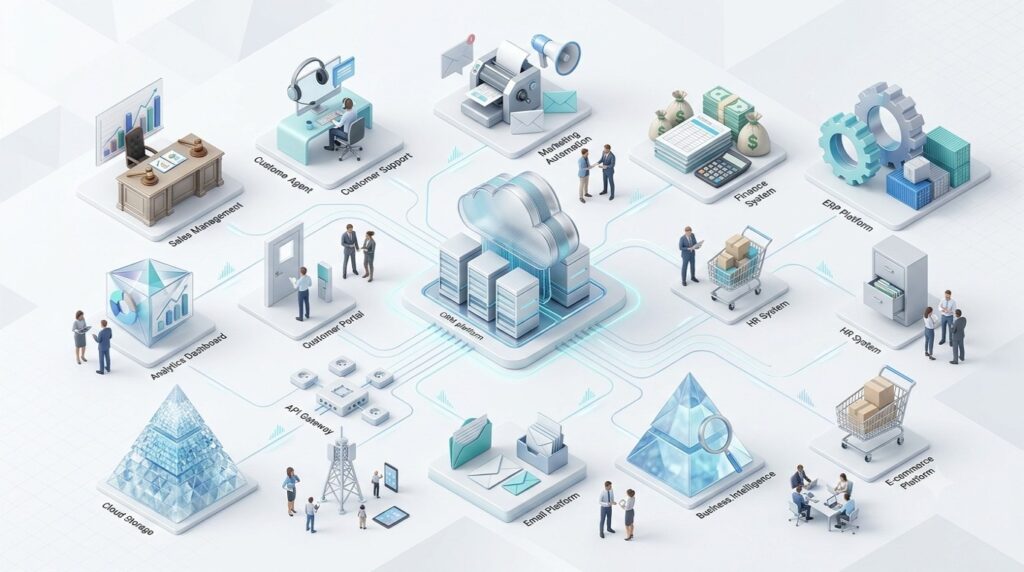
Modern businesses run dozens of applications. Salesforce typically needs to exchange data with ERP systems, marketing automation platforms, customer service tools, financial software, HR systems, and data warehouses. Salesforce integration requires ongoing maintenance as connected systems are updated, APIs change, and business processes evolve.
A managed services team monitors integration health, troubleshoots failures, and manages the API connections that keep your data flowing accurately across systems.
Security and Compliance
Salesforce holds some of the most sensitive data in your organization, including customer contact information, sales data, contract details, and financial records. Protecting that data requires continuous attention to security settings, user permissions, access controls, and audit logs.
Regulatory frameworks including SOC 2, HIPAA, GDPR, and CCPA require documented controls over how CRM data is accessed and managed. Salesforce Managed Services providers with IAM expertise can help organizations maintain the security posture and compliance documentation these regulations demand.
Key Benefits of Salesforce Managed Services

Proactive System Monitoring
Reactive support, fixing things after they break, is expensive and disruptive. A managed services provider watches your Salesforce environment continuously, monitoring performance metrics, integration logs, automation error rates, and security events. Issues are identified and resolved before they affect users or business operations.
Proactive monitoring is especially valuable during peak business periods like quarter-end sales pushes or high-volume marketing campaigns when system performance directly affects revenue.
Improved CRM Performance
A Salesforce environment that was implemented two or three years ago and never optimized often runs slower, produces lower-quality data, and supports fewer business processes than it could. Managed services teams regularly audit performance, identify redundant processes, clean data pipelines, and tune configurations for speed and reliability.
Faster Salesforce performance means faster sales cycles, more accurate forecasting, and better customer experiences delivered through Service Cloud and Experience Cloud.
Better User Adoption
Low user adoption is one of the most common reasons Salesforce investments fail to deliver expected ROI. If the system is confusing, slow, or not aligned with how users actually work, they find workarounds or abandon it entirely.
A managed services provider supports adoption through training programs, user interface improvements, streamlined data entry workflows, and ongoing feedback collection from the people who use Salesforce every day. Better adoption means better data quality, which makes every other aspect of CRM management more effective.
Faster Issue Resolution
When Salesforce issues occur, whether it is a broken workflow, a failed integration, or a permission error blocking a key user, the business impact can be immediate. Sales reps cannot log opportunities. Support agents cannot access customer history. Reports are missing critical data.
Managed services providers offer defined service level agreements with guaranteed response and resolution times. Certified experts who know your environment can diagnose and resolve issues significantly faster than an overwhelmed internal IT generalist trying to navigate an unfamiliar platform.
Reduced Operational Costs
The fully-loaded cost of a Salesforce team including salary, benefits, training, turnover, and downtime during hiring gaps is substantially higher than a managed services engagement. Organizations typically reduce their Salesforce support costs by 30 to 50 percent when transitioning from in-house management to a managed services model.
Beyond direct labor savings, managed services reduce the cost of errors, prevent expensive compliance incidents, and ensure the business is getting maximum value from its Salesforce license investment.
Enhanced Reporting and Analytics
Salesforce contains enormous amounts of valuable business data, but turning that data into actionable insights requires well-designed reports, dashboards, and analytics configurations. Many organizations have Salesforce CRM data sitting in the system but lack the visibility to use it effectively.
Managed services teams build and maintain reporting frameworks that give sales leaders, marketing managers, and operations teams the visibility they need, from pipeline dashboards to customer health scores to revenue forecasting.
Business Process Automation
Salesforce Flow, Process Builder, and workflow rules enable powerful automation that eliminates manual work, reduces errors, and accelerates business processes. But automation requires expertise to design, build, test, and maintain correctly.
Managed services providers bring deep experience with Salesforce automation, helping businesses identify high-value automation opportunities and implement them correctly. This includes lead routing, approval workflows, case escalations, contract management processes, and cross-system data synchronization.
Scalable CRM Growth
As a business grows, its Salesforce needs grow with it. New teams need onboarding. New product lines need new workflows. Acquisitions bring data migration challenges. International expansion introduces compliance requirements.
A managed services model scales naturally with your business. You can increase the scope of support during growth phases and adjust it during quieter periods without the fixed cost of maintaining a large internal team year-round.
Salesforce Managed Services vs. Hiring an In-House Team
One of the most common decisions organizations face is whether to build an internal Salesforce team or engage a managed services provider. Both approaches have merit, and the right choice depends on your organization’s size, budget, complexity, and strategic priorities.
| Factor | Salesforce Managed Services | In-House Salesforce Team |
|---|---|---|
| Cost | Predictable monthly fee, typically lower total cost | High fixed costs: salary, benefits, training, turnover |
| Expertise | Access to multi-certified team across admin, dev, security, and integration | Dependent on individual hires; skill gaps are common |
| Flexibility | Scales up or down based on business needs | Difficult to scale quickly; hiring takes months |
| Response Time | Defined SLAs with guaranteed response windows | Depends on team availability and competing priorities |
| Platform Coverage | Full coverage across Sales Cloud, Service Cloud, Experience Cloud, Marketing Cloud, security, and integrations | Rarely achievable without a large dedicated team |
| Business Continuity | Uninterrupted service regardless of staff changes | Vulnerable to turnover, vacations, and hiring gaps |
| Knowledge Retention | Documented and retained by the provider | Often lost when employees leave |
| Long-Term ROI | Consistently optimized platform delivers compounding returns | ROI depends heavily on quality of individual hires |
For most small and mid-sized businesses, managed services deliver better Salesforce outcomes at lower total cost. Larger enterprises often use a hybrid model, maintaining a small internal team for strategic direction while relying on a managed services partner for execution, optimization, and specialized expertise.
Salesforce Security Best Practices
Security is one of the most underinvested areas in Salesforce administration. Many organizations configure Salesforce permissions during the initial implementation and never revisit them as the business evolves. That creates accumulated risk over time.

Identity and Access Management (IAM)
Identity and access management is the foundation of Salesforce security. IAM controls who can access your Salesforce environment, what data they can see, and what actions they can perform. A properly implemented IAM strategy ensures that every user has the minimum access needed to do their job, and nothing more.
For Salesforce, this means connecting the platform to your enterprise identity provider, implementing consistent provisioning and deprovisioning processes, and regularly auditing access rights against current job functions. When a sales representative moves to a different role or leaves the company, their Salesforce access should be updated or revoked immediately through automated IAM workflows.
Organizations that work with IAM specialists as part of their Salesforce managed services engagement get the benefit of enterprise-grade identity governance applied directly to their CRM environment.
Multi-Factor Authentication (MFA)
Salesforce has made multi-factor authentication mandatory for all users accessing its platform. MFA requires users to verify their identity using a second factor beyond their password, such as an authenticator app, hardware token, or biometric verification.
Implementing MFA correctly across an organization requires more than simply enabling the setting. Businesses need to choose the right MFA method for their user population, deploy authenticator apps consistently, establish recovery procedures for lost devices, and train users on the process.
A managed services provider with IAM expertise handles MFA deployment as part of a broader Salesforce identity security program rather than as an isolated checkbox.
Single Sign-On (SSO)
Single sign-on allows users to access Salesforce using the same credentials they use for other enterprise applications. Rather than maintaining a separate Salesforce password, users authenticate through your corporate identity provider, whether that is Okta, Microsoft Entra ID (formerly Azure AD), Ping Identity, or another solution.
SSO improves security by centralizing authentication and eliminating the weak passwords and credential reuse that come with managing multiple application logins. It also improves the user experience by reducing login friction and password-related support tickets.
Implementing SSO for Salesforce requires configuring SAML or OAuth 2.0 between Salesforce and your identity provider. A Salesforce managed services partner with IAM capabilities can design and implement SSO correctly, including handling edge cases for mobile users, API integrations, and community portal users.
Role-Based Access Control (RBAC)
Role-based access control defines what Salesforce data and functions each user can access based on their role in the organization. In Salesforce, RBAC is implemented through a combination of profiles, permission sets, sharing rules, field-level security, and the role hierarchy.
Getting RBAC right in Salesforce requires a clear understanding of your organizational structure, data ownership, and business process requirements. Managed services teams design and maintain RBAC frameworks that enforce least-privilege access while keeping Salesforce usable for everyone who needs it.
Permission Set Management
Salesforce has been moving toward a permission set-based model as the preferred way to grant access rather than assigning everything through profiles. Permission sets are more flexible and auditable, but they require ongoing management to prevent permission creep over time.
Regular permission set audits, combined with automated provisioning workflows, ensure users always have appropriate access and that unused permissions are reclaimed when job functions change.
Data Security and Encryption
Salesforce provides several layers of data security, including Salesforce Shield, which offers platform encryption for sensitive fields, event monitoring, and field audit trail. For organizations with strict data security requirements in healthcare, financial services, or legal industries, Shield provides essential protections for data at rest.
Field-level security controls ensure that sensitive data like Social Security numbers, contract values, or compensation information is only visible to users who genuinely need it. Data encryption in transit is handled automatically by Salesforce using TLS, but field-level encryption for stored data requires explicit configuration.
Audit and Compliance
Salesforce maintains detailed login history, field change history, and API usage logs. A managed services provider with compliance expertise uses these logs to support audit requirements, investigate security incidents, and demonstrate compliance with regulatory frameworks.
Automated compliance monitoring can flag unusual access patterns, bulk data exports, after-hours logins from unfamiliar locations, and other security events that warrant investigation. Building this monitoring into a Salesforce managed services engagement significantly reduces compliance risk.
Common Salesforce Challenges Managed Services Solve

Performance Issues
Slow Salesforce page loads, report timeouts, and sluggish automation execution are common symptoms of a platform that has accumulated technical debt. The causes range from inefficient SOQL queries and governor limit violations to poorly designed sharing rules and bloated page layouts.
Managed services providers conduct regular performance reviews, identify bottlenecks, and implement optimizations that restore platform speed without disrupting business operations.
Complex Integrations
Most Salesforce environments integrate with multiple external systems. Over time, these integrations accumulate complexity, especially when connected systems are updated or replaced. Middleware platforms like MuleSoft, Boomi, or Informatica add their own management overhead.

A managed services team monitors integration health, maintains documentation of data flows, handles API version upgrades, and troubleshoots failures when they occur. This prevents data synchronization failures from silently corrupting your CRM data.
User Management
Managing Salesforce users in a growing organization requires constant attention. New employees need to be provisioned. Departing employees need to be deprovisioned. Role changes require permission updates. External partners need controlled access through Experience Cloud portals.
Without a systematic approach to user management, organizations accumulate ghost accounts, over-permissioned users, and security gaps that create both operational and compliance risks.
Automation Bottlenecks
Salesforce automation built on legacy Process Builder or Workflow Rules often hits governor limits or breaks when platform changes occur. Salesforce has been deprecating these older tools in favor of Salesforce Flow, creating a migration challenge for organizations that built complex automation on legacy frameworks.
Managed services teams manage automation migrations, optimize Flow designs for performance, and build new automation using current best practices rather than aging frameworks that Salesforce is actively phasing out.
Reporting Challenges
Salesforce reports and dashboards degrade over time. Fields are renamed or repurposed, report filters become outdated, dashboard components reference deleted data, and the reports that were useful two years ago no longer reflect current business processes.
Managed services providers maintain reporting libraries, build new reports as business needs evolve, and retire outdated dashboards before they mislead decision-makers.
Security Risks
Permission creep, inactive users, overly permissive sharing settings, and API integration accounts with administrator-level access are common security risks in Salesforce environments that lack dedicated management. Each of these represents a potential path for data exposure or unauthorized access.
Regular security reviews conducted as part of a managed services engagement identify and remediate these risks systematically rather than waiting for an incident to reveal them.
Salesforce Managed Services for Small, Mid-Sized, and Enterprise Businesses
Small Businesses
Small businesses often implement Salesforce with help from a consulting partner and then struggle to maintain and evolve it afterward. Without a dedicated Salesforce administrator, the platform gradually drifts from business needs, data quality deteriorates, and the investment fails to deliver its potential.
For small businesses, Salesforce managed services typically focus on core administration, user support, basic customization, and keeping the platform aligned with current business processes. This gives small businesses access to certified Salesforce expertise without the cost of a full-time hire, which is often prohibitive at this stage.
Small businesses in professional services, healthcare, financial services, and technology are particularly strong candidates for managed services because their Salesforce environments, while not large, require careful management to support revenue-generating activities.
Mid-Sized Businesses
Mid-market organizations face a more complex Salesforce challenge. They have typically outgrown their original implementation, have accumulated significant customization, and need deeper integrations with other business systems. At the same time, they often lack the internal resources to address these challenges systematically.
Managed services for mid-market organizations typically include administration, development support, integration management, security governance, and ongoing optimization programs. The engagement scope is larger and the strategic value is higher because the Salesforce environment is more central to business operations.
Enterprise Organizations
Large enterprises use Salesforce at a scale that requires dedicated management across multiple clouds and business units. Sales Cloud serves enterprise sales teams. Service Cloud powers contact centers. Marketing Cloud drives digital marketing programs. Experience Cloud supports customer and partner portals.
Enterprise managed services engagements often include a hybrid staffing model where the provider supplements an internal Salesforce team with specialized expertise in areas like Salesforce integration architecture, CRM Analytics, identity governance, and AppExchange application management.
Best Practices for Maximizing Salesforce ROI
Getting maximum value from Salesforce requires more than keeping the lights on. It requires a deliberate, ongoing optimization program aligned with business goals.
Governance and Change Management
Establish a formal Salesforce Center of Excellence or governance committee that reviews proposed changes, prioritizes the development backlog, and ensures the platform evolves in a controlled direction. Ad-hoc changes made by multiple administrators without coordination are a leading cause of technical debt accumulation.

Regular Health Checks
Schedule quarterly Salesforce health assessments that review system performance, data quality metrics, security settings, integration health, and user adoption rates. Health checks surface problems early and provide a roadmap for improvement.
Data Quality Programs
Bad data is the silent killer of CRM ROI. Implement data validation rules, duplicate management processes, and regular data quality audits. Clean, accurate Salesforce data improves forecast accuracy, marketing effectiveness, and customer service quality across every part of the business.
User Training and Enablement
Invest in ongoing Salesforce training programs that keep users current with new features and best practices. Salesforce releases new capabilities three times a year, and most organizations adopt only a fraction of what is available. Regular training sessions, guided by your managed services partner, help users work more effectively and adopt features that improve productivity.
Automation First
Before adding headcount or creating manual processes, evaluate whether Salesforce automation can handle the work. Well-designed automation through Salesforce Flow reduces operational costs, eliminates human error, and scales with business growth in ways that manual processes cannot.
Security Reviews
Conduct formal Salesforce security reviews at least annually, and immediately following any significant organizational change like an acquisition, major headcount change, or shift in compliance requirements. Security reviews should cover user permissions, sharing settings, API access, connected apps, and identity controls.
Leverage AppExchange Strategically
The Salesforce AppExchange contains thousands of applications that extend platform capabilities. A managed services partner with deep AppExchange experience can identify solutions that solve business problems without custom development, evaluate security and performance implications, and manage the vendor relationships these applications require.
Align Salesforce with Business Strategy
The most impactful Salesforce optimization work happens when the platform is explicitly aligned with business strategy. Sales process improvements, customer experience initiatives, and operational efficiency programs should all have a corresponding Salesforce component that supports measurement and execution.
Future Trends in Salesforce Managed Services
AI-Powered CRM
Artificial intelligence is reshaping what is possible in Salesforce. Einstein AI capabilities embedded across Sales Cloud, Service Cloud, and Marketing Cloud deliver predictive scoring, automated summarization, intelligent case routing, and next-best-action recommendations. As Salesforce continues investing in AI, organizations that have well-maintained, high-quality CRM data will gain significant competitive advantages from these capabilities.

Managed services providers are increasingly helping clients prepare their data environments for AI adoption, ensuring the underlying data quality and governance required for AI-generated insights to be reliable.
Predictive Analytics
CRM Analytics (formerly Tableau CRM) is enabling organizations to move beyond historical reporting toward predictive forecasting and prescriptive recommendations. Sales leaders can see not just where their pipeline stands today, but where it is likely to close and what actions are most likely to move deals forward.
Building effective predictive analytics on Salesforce data requires clean data pipelines, well-designed data models, and analytics expertise that most organizations lack internally. This is an area where managed services partnerships deliver significant value.
Hyperautomation
Hyperautomation extends the concept of workflow automation to encompass entire business processes that span multiple systems, incorporate AI decision-making, and execute with minimal human intervention. For Salesforce, this means using Flow Orchestration, external integrations, and AI capabilities together to automate complex processes like contract approval, customer onboarding, and service delivery.
Managed services teams are well-positioned to design and implement hyperautomation programs because they understand both the Salesforce platform and the broader technology ecosystem it operates within.
Low-Code Development
Salesforce’s investment in low-code and no-code development tools through Flow, OmniStudio, and the Lightning App Builder is enabling faster delivery of business solutions without requiring traditional programming skills. However, low-code development still requires governance, testing, and documentation to prevent the accumulation of unmanageable automation and customization.
Managed services providers establish low-code governance frameworks that allow business users to build effectively while maintaining the quality and reliability of the overall platform.
Identity-Centric CRM Security
The concept of Zero Trust security, which assumes no user or system should be inherently trusted and requires continuous verification, is increasingly being applied to CRM environments. For Salesforce, this means continuous authentication, behavioral analytics to detect anomalous access patterns, and tighter integration between Salesforce security controls and enterprise security information and event management (SIEM) systems.
Organizations working with managed services providers that have deep IAM expertise are leading this transition, applying identity-centric security principles to their Salesforce environments before regulatory requirements make it mandatory.
Agentforce and AI Assistants
Salesforce’s Agentforce platform represents a new frontier in CRM automation: autonomous AI agents that can execute multi-step tasks on behalf of sales, service, and marketing teams. These agents can qualify leads, resolve customer service inquiries, schedule appointments, and update records without human intervention for routine interactions.
Deploying AI agents effectively requires clean data, well-defined business rules, carefully designed guardrails, and ongoing monitoring to ensure the agents are behaving as intended. Managed services providers are beginning to develop specializations in Agentforce implementation and governance, positioning their clients to benefit from AI-driven automation as the technology matures.
Why Businesses Choose Avancer Corporation for Salesforce Managed Services
Organizations looking for a Salesforce managed services provider that understands both CRM optimization and enterprise security increasingly turn to Avancer Corporation. What distinguishes Avancer is the combination of deep Salesforce platform expertise with a specialized practice in identity and access management, bringing a security-first perspective to CRM management that most Salesforce partners cannot match.
Salesforce Administration and Optimization
Avancer’s certified Salesforce administrators and consultants manage day-to-day platform operations, handle configuration changes, and drive continuous optimization programs that keep Salesforce aligned with evolving business needs. The team brings experience across Sales Cloud, Service Cloud, Experience Cloud, and Marketing Cloud, providing comprehensive coverage across the Salesforce ecosystem.
Salesforce Integration Services
Modern businesses require Salesforce to connect seamlessly with ERP systems, HR platforms, financial applications, and marketing tools. Avancer designs and maintains Salesforce integrations that move data reliably across systems, using integration platforms and native API capabilities to keep business-critical data synchronized.
Identity and Access Management for Salesforce
Avancer’s IAM practice applies enterprise identity governance directly to Salesforce environments. This includes designing and implementing SSO using identity providers like Okta and Microsoft Entra ID, deploying MFA programs that meet both Salesforce requirements and organizational security standards, and implementing role-based access control frameworks that enforce least-privilege principles across the platform.

Identity Governance and Compliance
For organizations with regulatory compliance requirements, Avancer provides identity governance programs that document access controls, automate access reviews, and maintain the audit trails required for SOC 2, HIPAA, and other frameworks. This governance layer transforms Salesforce from a potential compliance liability into a documented, controlled environment with evidence of proper oversight.
Security Monitoring and Risk Reduction
Avancer’s security practice extends Salesforce administration to include proactive monitoring of security events, permission audit programs, and regular security assessments that identify and remediate risks before they become incidents. For organizations that have experienced Salesforce security events or are preparing for compliance audits, this service delivers immediate risk reduction.
Digital Transformation Support
Beyond day-to-day management, Avancer helps organizations use Salesforce as a platform for broader digital transformation. This includes designing future-state CRM architectures, leading process improvement initiatives, and building the automation programs that reduce manual work and increase operational efficiency across sales, service, and marketing teams.
The consultative approach Avancer brings to managed services means clients receive strategic guidance alongside technical execution, helping leadership teams understand how their Salesforce investment can better serve business objectives over time.
Conclusion:
Salesforce is a powerful platform, but its value is directly proportional to how well it is managed. Organizations that invest in proper administration, ongoing optimization, and strong security governance consistently outperform those that treat Salesforce as a set-and-forget application.
Salesforce Managed Services give businesses access to the expertise they need to realize that value without building and maintaining a full internal team. From proactive monitoring and performance optimization to identity security and compliance governance, managed services create the foundation for sustainable CRM success.
Security, particularly through identity and access management, is no longer optional for organizations that store sensitive data in Salesforce. SSO, MFA, RBAC, and identity governance are essential components of a responsible Salesforce management program, and they are most effective when integrated with the ongoing managed services relationship rather than treated as separate projects.
As Salesforce continues evolving with AI capabilities, new automation tools, and expanded platform functionality, the gap between organizations that actively manage their environments and those that do not will only widen. Avancer Corporation helps organizations stay on the right side of that divide, delivering managed services that optimize performance, reduce operational costs, and protect the CRM environments that modern businesses depend on.
Frequently Asked Questions:
What are Salesforce Managed Services?
Salesforce Managed Services is an ongoing engagement model where a certified Salesforce partner handles the administration, support, optimization, security, and development of your Salesforce environment. Rather than managing Salesforce entirely in-house, businesses gain access to a team of Salesforce-certified experts who maintain and continuously improve the platform on their behalf.
Why do businesses need Salesforce Managed Services?
Salesforce requires continuous attention to stay aligned with evolving business needs. Platform updates three times a year, growing customization complexity, integration maintenance, user management, and security requirements all demand expertise that most organizations cannot cost-effectively maintain in-house. Managed services provide that expertise at a predictable, scalable cost.
What does a Salesforce Managed Services provider do?
A Salesforce managed services provider handles daily administration, system monitoring, user management, customization and development, integration maintenance, security configuration, automation management, reporting, and strategic platform guidance. The specific scope varies by engagement but generally covers everything needed to keep Salesforce running effectively and improving over time.
How much do Salesforce Managed Services cost?
Pricing varies based on the scope of services, the complexity of the Salesforce environment, and the level of support required. Most managed services engagements are structured as monthly retainers based on an allocated number of hours or service tiers. Smaller engagements might start at a few thousand dollars per month, while comprehensive enterprise programs can be significantly larger. In most cases, managed services deliver substantially lower total cost than maintaining equivalent in-house staffing.
What are the benefits of outsourcing Salesforce administration?
Outsourcing Salesforce administration provides access to a breadth of expertise no single hire can match, delivers predictable costs without the overhead of employment, ensures business continuity regardless of staff changes, provides faster issue resolution through dedicated specialists, and allows internal teams to focus on strategic work rather than platform maintenance.
How do Salesforce Managed Services improve CRM performance?
Managed services improve CRM performance through regular platform health assessments, performance tuning, data quality programs, automation optimization, and proactive resolution of issues before they affect users. A well-managed Salesforce environment runs faster, produces more accurate data, and supports more business processes than one that receives only reactive support.
How can Salesforce be secured with IAM?
Securing Salesforce with identity and access management involves implementing SSO to centralize authentication, enforcing MFA for all users, designing role-based access control to enforce least-privilege access, automating user provisioning and deprovisioning, and conducting regular access reviews. IAM specialists apply these controls in a way that improves both security and the user experience.
What is the role of SSO and MFA in Salesforce?
Single sign-on allows users to access Salesforce with their enterprise credentials, reducing password management burden and improving security through centralized authentication. Multi-factor authentication requires a second verification step beyond a password, significantly reducing the risk of unauthorized access through compromised credentials. Salesforce now requires MFA for all users, making proper MFA deployment a compliance requirement as well as a security best practice.
How do Managed Services improve Salesforce ROI?
Managed services improve Salesforce ROI by ensuring the platform is continuously optimized to support business processes, reducing the cost of administration compared to in-house staffing, preventing expensive incidents caused by security gaps or broken automation, improving user adoption so the platform generates better data, and identifying opportunities to use existing Salesforce capabilities more effectively.
Can Salesforce Managed Services help with integrations?
Yes. Integration management is a core component of most Salesforce managed services engagements. Providers design, implement, monitor, and maintain the integrations that connect Salesforce with other business systems, handling API updates, troubleshooting failures, and managing data synchronization across connected platforms.
