
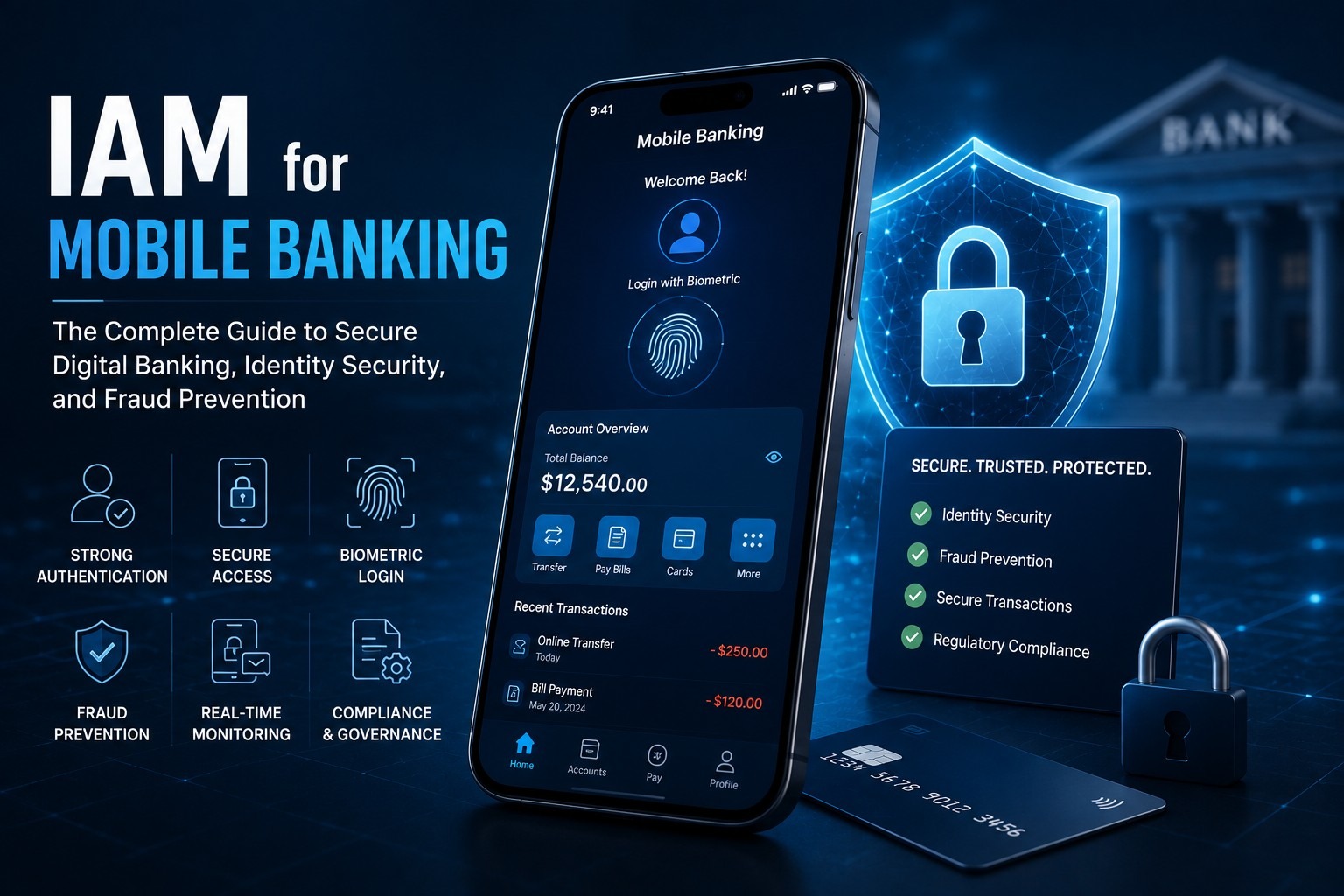
More than 2 billion people now manage their finances through mobile banking apps. In the United States alone, mobile banking usage surpassed in-branch visits years ago and the gap keeps widening. Across Asia, Africa, and Latin America, mobile-first banking is not a trend but a baseline expectation, especially among populations who never had access to traditional branch networks.
This shift has fundamentally changed what security means for financial institutions. When your customers carry their bank in their pocket, authentication is no longer a back-office concern. It is a customer experience decision, a compliance obligation, a fraud prevention strategy, and a brand differentiator all at once.
The problem is that the security perimeter financial institutions relied on for decades has collapsed. Network firewalls, VPNs, and perimeter defenses were designed for a world where banking happened inside branches and on desktop computers connected to managed corporate networks. Mobile banking destroyed that model. Your customers are authenticating from coffee shops in Chicago, hotel lobbies in Singapore, and rural villages in Nigeria. Your workforce is logging in from home offices, shared workspaces, and airport lounges.
In this environment, identity has become the new security perimeter. The question is no longer “is this request coming from inside our network?” but “is the entity making this request who they claim to be, and should they have access to what they are requesting?”
That is exactly what IAM for mobile banking answers.
Cyber threats have scaled alongside mobile adoption. Account takeover (ATO) attacks cost the financial services industry billions annually. Credential stuffing tools can automate millions of login attempts in hours. SIM swap fraud bypasses SMS-based authentication. Banking trojans hide inside legitimate-looking apps. The sophistication and volume of attacks targeting mobile banking users has grown faster than most institutions’ ability to respond with traditional security controls.
Modern Identity and Access Management gives financial institutions a structured, scalable, and intelligent framework to protect customers, employees, and systems while keeping the digital banking experience fast and frictionless.
IAM for mobile banking is no longer optional. It is the operational core of secure digital financial services.
What Is IAM for Mobile Banking?
Definition
IAM for mobile banking refers to the policies, processes, and technologies financial institutions use to manage digital identities, control access to banking systems and data, authenticate users across mobile channels, and protect against identity-based threats throughout the customer and employee lifecycle.

In plain terms, IAM ensures that the right person gets access to the right banking resource at the right time, and nobody else does.
How IAM Works in Banking
An IAM system in banking operates across three interconnected functions. First, it establishes and verifies identity by confirming that a user is who they claim to be through authentication. Second, it governs access by determining what that verified identity is permitted to do within the system. Third, it monitors and analyzes identity activity continuously to detect anomalies, flag potential fraud, and enforce policy in real time.
In a mobile banking context, this means that when a customer opens their banking app and logs in, the IAM platform evaluates dozens of risk signals simultaneously: device fingerprint, geolocation, login time, behavioral patterns, network characteristics, and more. It then decides whether to grant access seamlessly, prompt for additional verification, or block the request entirely.
For the bank’s workforce, IAM controls which employees can access customer data, which systems administrators can touch production environments, and how privileged access to core banking infrastructure is managed, monitored, and audited.
Why Identity Is Critical for Digital Banking
Identity is the only reliable anchor point in digital banking. You cannot physically see your customers. You cannot ask for ID. Every transaction, every login, every account change is mediated entirely through digital identity signals. If those signals are compromised or spoofed, everything downstream is at risk.
Financial institutions that treat identity as a point solution, just a login screen and a password policy, are operating with a fundamental security gap. Modern IAM treats identity as a continuous, dynamic, and intelligent layer that spans the entire digital banking experience.
Evolution from Traditional Banking Security to Identity-First Security
| Traditional Banking Security | Modern Identity-First Security |
|---|---|
| Perimeter-based network security | Identity as the security perimeter |
| Static username and password | Adaptive, risk-based authentication |
| Manual access provisioning | Automated identity lifecycle management |
| Periodic access reviews | Continuous monitoring and governance |
| Siloed on-premises systems | Cloud IAM and IDaaS platforms |
| Reactive fraud detection | AI-powered, real-time identity intelligence |
| Compliance as a checkbox | Compliance built into identity workflows |
Why Mobile Banking Requires a Modern IAM Strategy
Increasing Mobile Banking Adoption
The numbers are difficult to ignore. Global mobile banking users are projected to exceed 3.6 billion by 2026. In markets like India, Indonesia, and Brazil, mobile banking is the dominant financial access point for hundreds of millions of people. In developed markets, digital-native customers increasingly choose banks based on app quality and security reputation, not branch proximity.
This scale means that identity infrastructure designed for thousands of concurrent users must now support tens of millions, often across multiple time zones, languages, devices, and regulatory jurisdictions simultaneously.
Customer Experience Expectations
Modern banking customers have been conditioned by the speed and simplicity of consumer apps. They expect banking to be just as fast and frictionless. Any authentication friction that is not clearly necessary, a CAPTCHA that does not work, an SMS OTP that does not arrive, a password reset flow that takes five minutes, creates abandonment, complaints, and churn.
The IAM challenge is to maximize security without creating friction that pushes customers away. Risk-based authentication and passwordless authentication are specifically designed to solve this problem by making the authentication experience seamless for low-risk sessions while adding layers of verification only when genuinely needed.
Mobile Fraud
Mobile banking fraud has become one of the most damaging and fastest-growing categories of financial crime. Account takeover attacks, where fraudsters gain unauthorized access to existing customer accounts, cost financial institutions an estimated $11 billion annually. Synthetic identity fraud, new account fraud, and payment fraud through compromised mobile sessions add billions more.
The mobile channel introduces unique fraud vectors that traditional banking security was never designed to address: malicious apps, device cloning, SIM swap attacks, and real-time phishing designed specifically to intercept mobile authentication flows.
Regulatory Pressure
Regulators across every major financial market have sharpened their focus on digital banking security. PCI DSS, PSD2, GDPR, FFIEC guidelines, ISO 27001, and NIST frameworks all have direct implications for how financial institutions manage customer identities, authenticate users, protect data, and govern access. Non-compliance carries financial penalties, reputational damage, and in some jurisdictions, criminal liability for executives.
Modern IAM is not just a security tool. It is the technical infrastructure that makes regulatory compliance achievable and auditable.
Open Banking
Open Banking regulations, particularly under PSD2 in Europe and similar frameworks emerging globally, require financial institutions to share customer data securely with third-party providers through standardized APIs. This creates enormous identity and access management complexity. Who is authorized to access which customer data? How is that authorization granted, revoked, and audited? How do you verify the identity of third-party apps requesting access on behalf of customers?
OAuth 2.0, OpenID Connect (OIDC), and federated identity management are the technical backbone of secure Open Banking. Getting these right requires a mature IAM architecture.
Cloud Banking
Core banking modernization is accelerating. Legacy on-premises systems are giving way to cloud-native platforms, SaaS banking applications, and hybrid architectures. This shift requires identity infrastructure that works seamlessly across cloud and on-premises environments, supports modern identity protocols, and integrates with platforms like Microsoft Entra ID, Okta, Ping Identity, and IBM Security Verify.
FinTech Integration
Traditional banks are increasingly partnering with, acquiring, or competing with fintech companies. Each integration point creates new identity challenges: federated authentication across organizational boundaries, API security, B2B identity management, and consistent governance across heterogeneous technology stacks.
Biggest Mobile Banking Security Threats

Credential Theft
Compromised usernames and passwords remain the single most common starting point for banking fraud. Billions of credentials are available on the dark web from previous data breaches. Credential stuffing tools automate login attempts at scale, testing stolen credentials across thousands of banking apps simultaneously.
Phishing
Mobile phishing (smishing via SMS and vishing via voice calls) has grown dramatically. Attackers craft convincing fake banking notifications that direct customers to replica login pages designed to harvest credentials in real time. Mobile screens and shortened URLs make phishing harder for users to detect than on desktop.
SIM Swap Fraud
SIM swap attacks involve fraudsters convincing mobile carriers to transfer a victim’s phone number to a SIM card they control. Once they control the number, they can intercept SMS-based OTPs and completely bypass SMS two-factor authentication. This attack vector has been used to drain banking accounts and crypto wallets.
Account Takeover (ATO)
Account takeover combines credential theft, session hijacking, and social engineering to gain unauthorized control of customer accounts. ATO is frequently the precursor to high-value fraud: unauthorized wire transfers, loan applications in victims’ names, and identity theft.
Mobile Malware
Banking malware targeting Android and iOS devices can overlay fake login screens on top of legitimate banking apps, log keystrokes, intercept OTPs, and exfiltrate session tokens without the user’s knowledge. The OWASP Mobile Top 10 identifies malicious code injection and insecure authentication as critical mobile application security risks.
Banking Trojans
Sophisticated banking trojans like TrickBot, Emotet, and their successors operate as persistent threats specifically designed to compromise banking credentials. Modern variants are polymorphic, evading traditional signature-based detection tools.
Device Theft
Physical device theft gives attackers direct access to unlocked banking apps, saved credentials, and cached session tokens. Device-level security controls, app-level authentication requirements, and remote wipe capabilities are essential layers of defense.
Insider Threats
Bank employees with privileged access to customer data and core banking systems represent a significant insider threat risk. Whether malicious or accidental, insider incidents involving identity and access often have the highest per-incident costs of any security event category.
API Attacks
Open Banking and mobile app architectures rely heavily on APIs. Poorly secured APIs are a major attack surface. API attacks targeting banking apps include authentication bypass, broken object level authorization, excessive data exposure, and injection attacks. Secure API authentication using OAuth 2.0 and JWT (JSON Web Tokens) is essential.
Social Engineering
Social engineering attacks target the human layer of banking security. Fraudsters pose as bank employees, government officials, or trusted contacts to trick customers into revealing credentials, approving fraudulent transactions, or disabling security controls.
Fake Banking Apps
Counterfeit banking apps published on third-party app stores (and occasionally slipping through official marketplaces) mimic legitimate banking interfaces to harvest credentials. Mobile application security practices, combined with brand monitoring and takedown services, form the defensive layer here.
Core IAM Components for Mobile Banking
Identity Governance (IGA)
Identity Governance and Administration (IGA) provides the policy framework and technical controls that determine who has access to what across the organization. For banks, IGA covers employee access lifecycle management, role-based access control (RBAC), access certification campaigns, and separation of duties enforcement.
Platforms like SailPoint, Saviynt, and One Identity are widely deployed in financial services for enterprise IGA.
Customer Identity and Access Management (CIAM)
CIAM is the specialized discipline of managing customer-facing digital identities at scale. While enterprise IAM focuses on employee access, CIAM is designed for the high-volume, high-variability demands of consumer banking: millions of users, diverse devices, complex privacy requirements, and the need for frictionless registration, login, and account management.
CIAM platforms include Ping Identity, ForgeRock, Auth0, and Okta. Key capabilities include progressive profiling, consent management, self-service account recovery, and scalable authentication.
Identity Lifecycle Management
Identity lifecycle management covers the complete journey of a digital identity from creation to deactivation. In banking, this includes new customer onboarding (including digital KYC), account changes and access modifications, and offboarding when accounts are closed or employees leave. Automated lifecycle management reduces manual errors, accelerates provisioning, and ensures access is revoked promptly when it is no longer needed.
Single Sign-On (SSO)
Single Sign-On (SSO) allows users to authenticate once and access multiple connected banking applications without logging in again. For enterprise banking environments with dozens of internal applications, SSO dramatically reduces password fatigue, cuts helpdesk costs, and simplifies the authentication experience. Enterprise Single Sign-On (ESSO) extends this to desktop and legacy applications through credential injection.
Multi-Factor Authentication (MFA)
MFA requires users to verify their identity using two or more authentication factors: something they know (password), something they have (phone or hardware token), or something they are (biometric). MFA is one of the most effective controls against credential-based attacks.
Passwordless Authentication
Passwordless authentication eliminates the password entirely, replacing it with more secure and user-friendly factors like biometrics, FIDO2 passkeys, magic links, or device-bound cryptographic keys. Banking apps from major institutions are rapidly moving toward passwordless as the default authentication experience.
Adaptive Authentication
Adaptive authentication dynamically adjusts the authentication requirements based on real-time risk assessment. A customer logging in from their usual device, location, and time of day might be authenticated silently. The same customer logging in from an unfamiliar device in a new country would face step-up authentication. Adaptive authentication balances security with user experience.
Risk-Based Authentication
Risk-based authentication (RBA) evaluates dozens of contextual and behavioral signals to assign a risk score to each authentication attempt. High-risk attempts trigger additional verification; low-risk attempts proceed smoothly. RBA is the engine behind truly frictionless yet secure mobile banking.
Biometric Authentication
Biometric authentication uses unique physical or behavioral characteristics to verify identity. Apple Face ID, Android biometrics, fingerprint sensors, and voice recognition are all in active use across mobile banking apps today. The FIDO Alliance’s standards provide a secure, interoperable framework for biometric authentication on mobile devices.
Device Authentication
Device authentication establishes the trustworthiness of the device itself, separate from user identity. This includes device fingerprinting, certificate-based device authentication, and mobile device attestation frameworks. Trusting the device adds a critical layer of assurance in mobile banking security.
Identity Federation
Identity federation allows identity information to be shared securely across organizational boundaries using standards like SAML, OAuth 2.0, and OpenID Connect (OIDC). For banks, federation is essential for Open Banking integrations, partner access, and enterprise SSO across subsidiary brands.
Privileged Access Management (PAM)
Privileged Access Management (PAM) controls and monitors the access of privileged users, system administrators, database administrators, and IT staff who have elevated permissions to core banking infrastructure. PAM tools like CyberArk provide session recording, just-in-time access provisioning, and privileged credential vaulting.
Authentication Technologies Used in Mobile Banking

Password Authentication
Traditional static passwords are the weakest authentication method in active deployment. They are susceptible to phishing, credential stuffing, brute force, and reuse across services. Most banking security frameworks now treat passwords as a last-resort fallback rather than a primary authentication method.
One-Time Passwords (OTP)
OTPs, delivered via SMS or generated by authenticator apps, add a second factor to password-based authentication. SMS OTPs are vulnerable to SIM swap and interception attacks. TOTP (Time-based One-Time Password) apps like Google Authenticator and Microsoft Authenticator provide significantly better security than SMS.
Push Authentication
Push authentication sends a notification to the user’s registered device requesting approval of the login attempt. Users simply tap “approve” or “deny.” This is more phishing-resistant than OTPs and delivers a better user experience than manual code entry.
Biometrics
Biometric authentication verifies identity using unique biological characteristics. In mobile banking, fingerprint and facial recognition are the dominant biometric methods, leveraging the hardware sensors built into modern smartphones.
Face Recognition
Apple Face ID and Android’s face recognition frameworks provide device-level facial authentication that can be integrated into banking app login flows. Liveness detection prevents spoofing with photos or videos.
Fingerprint Authentication
Fingerprint sensors provide fast, accurate biometric authentication. Most banking apps now support fingerprint login as a primary or fallback authentication method.
Voice Biometrics
Voice biometrics authenticate users by analyzing unique vocal characteristics. This method is used in banking call centers and increasingly in voice-activated banking applications, though it requires careful anti-spoofing measures.
Behavioral Biometrics
Behavioral biometrics analyzes patterns in how users interact with their devices: typing rhythm, swipe speed, pressure, navigation patterns, and device handling. This enables continuous, passive authentication that detects account takeover even after successful initial login.
Passkeys
Passkeys are a modern passwordless credential based on public-key cryptography and the FIDO2/WebAuthn standard. They are phishing-resistant, device-bound, and provide a seamless user experience. Google, Apple, and Microsoft are driving passkey adoption across their ecosystems, and leading banks are integrating passkey support into their mobile apps.
FIDO2 Authentication
FIDO2, developed by the FIDO Alliance, is the open standard underlying passkeys and hardware security keys. FIDO2 authentication is phishing-resistant, cryptographically secure, and supported by all major platforms and browsers. It represents the gold standard for mobile banking authentication.
Authentication Method Comparison Table
| Method | Security Level | User Experience | Phishing Resistance | Implementation Complexity |
|---|---|---|---|---|
| Password only | Low | Medium | None | Low |
| SMS OTP | Medium | Medium | Low | Low |
| TOTP App | Medium-High | Medium | Low | Low |
| Push Notification | High | High | Medium | Medium |
| Fingerprint Biometric | High | Very High | High | Medium |
| Face Recognition | High | Very High | High | Medium |
| Behavioral Biometrics | Very High | Seamless | Very High | High |
| FIDO2 / Passkeys | Very High | Very High | Very High | Medium-High |
| Hardware Security Key | Very High | Medium | Very High | High |
Identity Intelligence and Fraud Prevention
Security User Behavior Analytics (SUBA)
Security User Behavior Analytics (SUBA) applies machine learning to user activity data to establish behavioral baselines and detect deviations that may indicate fraud or account compromise. In mobile banking, SUBA continuously analyzes login patterns, transaction behaviors, navigation sequences, and device interactions.
User Behavior Analytics (UBA)
User Behavior Analytics (UBA) provides the data foundation for fraud detection and insider threat identification. By building rich behavioral profiles of both customers and employees, UBA systems can identify anomalies like a customer suddenly initiating international wire transfers, or an employee accessing thousands of customer records outside normal working hours.
AI-Based Fraud Detection
Modern AI and machine learning fraud detection models process real-time event streams across millions of banking sessions simultaneously. These models evaluate combinations of signals that no human analyst could process at speed: device fingerprint, geolocation trajectory, transaction velocity, network characteristics, and behavioral patterns.
AI-based fraud detection dramatically reduces false positive rates compared to rule-based systems, which is critical because false positives (legitimate transactions flagged as fraud) have a direct impact on customer experience and operational costs.
Identity Analytics
Identity analytics provides visibility into access patterns, entitlement concentrations, orphaned accounts, excessive privileges, and policy violations across the identity ecosystem. For banks managing thousands of employees and millions of customers, identity analytics turns raw access data into actionable governance intelligence.
Device Trust
Device trust evaluates the security posture of a device before granting access to banking systems. This includes checking whether the device is enrolled in Mobile Device Management (MDM), whether the operating system is up to date, whether the device has been jailbroken or rooted, and whether the banking app has been tampered with.
Risk Scoring
Dynamic risk scoring aggregates signals from identity, device, network, behavior, and transaction context to generate a real-time risk score for each session or transaction. Risk scores drive adaptive authentication decisions, transaction limits, and fraud alerts.
Continuous Authentication
Continuous authentication moves beyond the single point of entry to monitor and verify user identity throughout the entire banking session. Behavioral biometrics enable silent, passive continuous authentication that can detect session hijacking and account takeover mid-session without disrupting legitimate users.
BYOD, Mobile Devices, and Workforce Identity

BYOD Policies
Bring Your Own Device (BYOD) policies govern how employees use personal mobile devices for work purposes, including access to banking systems and customer data. A well-designed BYOD policy balances employee privacy with the institution’s security requirements, defining acceptable use, required security controls, and consequences for policy violations.
Mobile Device Management (MDM)
MDM platforms allow IT teams to remotely manage and secure mobile devices that access corporate resources. For banking institutions, MDM capabilities include remote wipe, device encryption enforcement, app management, and compliance monitoring. Jamf, Microsoft Intune, and VMware Workspace ONE are widely deployed in financial services.
Enterprise Mobility Management (EMM)
Enterprise Mobility Management extends MDM with mobile application management (MAM), mobile content management (MCM), and identity-aware access controls. EMM platforms provide a unified framework for securing the mobile workforce while maintaining productivity.
Unified Endpoint Management (UEM)
UEM platforms consolidate management of all endpoint types, desktops, laptops, mobile devices, and even IoT devices, into a single management framework. For banks managing heterogeneous device fleets across thousands of employees, UEM significantly reduces operational complexity and security blind spots.
Secure Remote Access
Remote access to core banking systems requires strong authentication, encrypted connections, and continuous monitoring. Zero Trust Network Access (ZTNA) is replacing legacy VPN as the preferred remote access architecture for financial institutions, providing identity-aware, least-privilege access to specific applications rather than broad network access.
Mobile Workforce Security
Banks with large field workforces, branch staff, and remote operations teams need mobile identity solutions that work reliably in low-bandwidth, high-mobility environments. Offline authentication, certificate-based device authentication, and app-level security controls are important capabilities.
Cloud Identity and Mobile Banking
Identity as a Service (IDaaS)
Identity as a Service (IDaaS) delivers IAM capabilities through cloud-hosted platforms, eliminating the operational overhead of on-premises identity infrastructure. Platforms like Okta, Microsoft Entra ID, and Ping Identity offer IDaaS solutions specifically suited to the scale and security requirements of financial services.
For banks modernizing their technology stack, IDaaS provides faster deployment, automatic updates, elastic scalability, and built-in compliance features that would take years and significant capital to build on-premises.
Hybrid Identity
Most banks operate in a hybrid environment, with some systems on-premises and others in the cloud. Hybrid identity architecture bridges these environments through directory synchronization, federated authentication, and consistent policy enforcement across both domains. Microsoft Entra ID’s hybrid identity capabilities are widely used in banking for exactly this purpose.
Cloud IAM
Cloud IAM governs access to cloud infrastructure, SaaS applications, and cloud-native banking services. Cloud IAM platforms like AWS IAM, Azure RBAC, and Google Cloud IAM provide fine-grained access controls for cloud resources. For banks running workloads across multiple cloud providers, a unified Cloud IAM strategy is essential.
Identity Federation
In cloud environments, identity federation allows bank employees and partners to authenticate using existing corporate credentials when accessing cloud services and partner systems. SAML and OIDC are the dominant federation protocols in banking cloud environments.
API Security
APIs are the connective tissue of modern digital banking. API security encompasses authentication (OAuth 2.0, API keys), authorization (scopes, claims), rate limiting, input validation, and continuous monitoring. Poor API security is one of the most common and costly security failures in mobile banking.
Open Banking Security
Open Banking security requires financial institutions to implement secure, standards-based API access for third-party providers while protecting customer data and preventing unauthorized access. OAuth 2.0 with PKCE (Proof Key for Code Exchange), strong customer authentication requirements, and robust consent management are foundational elements of Open Banking security architecture.
Banking Compliance and Regulatory Requirements
PCI DSS
The Payment Card Industry Data Security Standard (PCI DSS) establishes security requirements for organizations that handle cardholder data. For mobile banking apps that process card transactions, PCI DSS requirements directly govern authentication controls, access management, and audit logging.
PSD2
The EU’s Revised Payment Services Directive (PSD2) mandates Strong Customer Authentication (SCA) for electronic payments and online banking access. SCA requires authentication using at least two independent factors. PSD2 has been a major driver of MFA adoption and FIDO2 deployment across European banking.
Strong Customer Authentication (SCA)
SCA under PSD2 requires that electronic payment authentication must involve at least two of three independent factors: something the customer knows, something the customer possesses, or something the customer is. This requirement directly mandates MFA and has driven widespread biometric authentication deployment in banking apps.
GDPR
The General Data Protection Regulation (GDPR) governs how financial institutions collect, process, store, and protect personal data of EU residents. IAM is central to GDPR compliance: managing customer consent, enforcing data access controls, enabling data subject rights requests, and maintaining audit trails.
ISO 27001
ISO 27001 provides the international framework for information security management systems (ISMS). Access control and identity management are core control domains within ISO 27001. Banks pursuing or maintaining ISO 27001 certification need mature IAM practices.
NIST Cybersecurity Framework
The NIST Cybersecurity Framework (CSF) provides a structured approach to managing cybersecurity risk across five functions: Identify, Protect, Detect, Respond, and Recover. Identity management and access control are addressed across multiple CSF control categories. The NIST Digital Identity Guidelines (SP 800-63) provide specific technical requirements for authentication assurance levels.
FFIEC Guidelines
The Federal Financial Institutions Examination Council (FFIEC) provides authentication and access management guidance specifically for US financial institutions. FFIEC guidelines have been progressively updated to address mobile banking, risk-based authentication, and layered security architectures.
Regulatory Compliance and IAM Mapping
| Regulation | Key IAM Requirement | How IAM Supports Compliance |
|---|---|---|
| PCI DSS | Access control, MFA for privileged access, audit logging | Automated provisioning, PAM, SIEM integration |
| PSD2 / SCA | Strong Customer Authentication for payments | MFA, FIDO2, adaptive authentication |
| GDPR | Data access controls, consent management, audit trails | CIAM consent management, identity analytics |
| ISO 27001 | Access control policy, user registration, privilege management | IGA, RBAC, access certification |
| NIST SP 800-63 | Authentication assurance levels, identity proofing | Tiered MFA, digital identity verification |
| FFIEC | Layered security, risk-based authentication | Adaptive authentication, fraud detection |
IAM Best Practices for Mobile Banking

Least Privilege Access
Every user, whether a customer, employee, or system account, should have access only to what they need to perform their specific function, and nothing more. Least privilege access is a foundational Zero Trust principle that limits the blast radius of any compromise.
Zero Trust Security
Zero Trust operates on the principle of “never trust, always verify.” Every access request, regardless of whether it comes from inside or outside the network, is authenticated, authorized, and continuously validated against policy. For mobile banking, Zero Trust means treating every session as potentially hostile and making access decisions based on verified identity, device health, and contextual risk.
Continuous Monitoring
Security monitoring in banking cannot stop at the perimeter or at the authentication gate. Continuous monitoring of identity activity, access patterns, and behavioral signals is necessary to detect threats that successfully bypass initial controls.
Identity Governance
Ongoing identity governance ensures that access rights remain appropriate as roles change, employees leave, and business requirements evolve. Regular access certification campaigns, automated orphaned account detection, and role mining are key governance practices.
Automated Provisioning
Manual access provisioning is slow, error-prone, and hard to audit. Automated provisioning, driven by HR system events and role definitions, ensures that new employees get the right access immediately, access is modified promptly when roles change, and access is revoked completely when employees leave.
Access Reviews
Periodic access reviews, often called access certifications or attestations, require managers and data owners to confirm that existing access assignments are still appropriate. Automated access review workflows significantly reduce the burden of certification campaigns.
Privileged Access Management
Privileged accounts represent the highest-value targets in any banking environment. PAM controls include privileged credential vaulting, just-in-time access provisioning, session monitoring and recording, and privileged access analytics.
Secure API Authentication
Every API endpoint in a mobile banking architecture should be protected with strong authentication using OAuth 2.0 and JWT. API access should be scoped to minimum necessary permissions, time-limited, and continuously monitored for abuse.
Customer Identity Protection
Protecting customer identities requires a layered approach: strong authentication at login, behavioral monitoring throughout the session, anomaly detection on transactions, and rapid response capabilities when fraud is detected.
AI-Based Threat Detection
AI-powered threat detection continuously analyzes identity and access data for patterns that indicate compromise, fraud, or policy violations. Machine learning models trained on banking-specific fraud patterns deliver significantly better detection rates than rule-based systems alone.
Mobile Banking IAM Implementation Checklist
Authentication and Access Control
- Deploy Multi-Factor Authentication (MFA) for all customer-facing applications
- Implement risk-based and adaptive authentication
- Enable biometric authentication (fingerprint, Face ID) in mobile apps
- Evaluate and begin migration to FIDO2 passkeys
- Enforce strong password policies where passwords remain in use
- Implement device trust and device fingerprinting
Customer Identity Management
- Deploy a dedicated CIAM platform scaled for customer volumes
- Implement progressive profiling and consent management
- Enable self-service account recovery with strong identity verification
- Configure session management with appropriate timeout and re-authentication policies
- Implement behavioral biometrics for continuous authentication
Identity Governance and Workforce Access
- Implement role-based access control (RBAC) across all banking systems
- Automate employee provisioning and deprovisioning with HR system integration
- Deploy regular access certification campaigns
- Enforce separation of duties for sensitive financial operations
- Implement Privileged Access Management (PAM) for all admin accounts
Fraud Prevention and Monitoring
- Deploy User Behavior Analytics (UBA) for both customers and employees
- Integrate AI-based fraud detection with real-time risk scoring
- Monitor for account takeover indicators continuously
- Implement transaction anomaly detection
- Establish incident response playbooks for identity-related fraud
Compliance and Governance
- Map IAM controls to PCI DSS, PSD2, GDPR, and applicable local regulations
- Maintain comprehensive audit logs for all identity and access events
- Implement data access governance for customer PII
- Establish regular compliance reporting from IAM systems
- Conduct annual IAM control assessments
API and Cloud Security
- Secure all API endpoints with OAuth 2.0 authentication
- Implement API gateway with identity-aware access controls
- Deploy hybrid identity management for cloud and on-premises environments
- Enforce Zero Trust Network Access for remote workforce
- Integrate cloud IAM with enterprise identity directory
Future Trends in Mobile Banking IAM

Passwordless Banking
The transition away from passwords is accelerating. Apple, Google, and Microsoft have all committed to passkey support at the platform level. Major banks are rolling out passkey-based authentication in their mobile apps. Within five years, passwords are likely to become a legacy authentication method in banking, replaced by biometrics and FIDO2 credentials.
AI-Powered Identity Security
AI is transforming every dimension of identity security. From adaptive authentication models that learn individual user behavior patterns, to natural language processing models that detect social engineering in real time, to generative AI tools that help security teams build better identity policies, AI is becoming embedded throughout the IAM stack.
Behavioral Biometrics
Behavioral biometrics is moving from emerging technology to mainstream deployment. The ability to continuously authenticate users based on how they interact with their devices, without any active user participation, makes it one of the most powerful tools available for preventing account takeover and fraud.
Digital Identity Wallets
Government-issued digital identity wallets, like the EU Digital Identity (EUDI) Wallet, are creating new infrastructure for verified digital identity in banking. Digital wallets allow customers to present verified identity credentials to banking apps without sharing underlying personal data, improving privacy while strengthening identity assurance simultaneously.
Decentralized Identity
Decentralized identity (DID) gives individuals control over their own digital credentials without relying on a central identity provider. Built on blockchain and distributed ledger technology, decentralized identity enables self-sovereign identity models where customers can prove who they are to a bank without the bank needing to store or manage that identity data directly. While still maturing, decentralized identity has significant implications for KYC, cross-border identity verification, and privacy-preserving authentication in banking.
Identity Threat Detection and Response (ITDR)
Identity Threat Detection and Response (ITDR) is an emerging security discipline specifically focused on detecting and responding to identity-based attacks. ITDR platforms monitor identity infrastructure, including Active Directory, cloud directories, and IAM platforms, for signs of compromise, privilege escalation, and lateral movement. As identity has become the primary attack vector in financial services, ITDR is becoming an essential layer in the banking security stack alongside endpoint detection and SIEM.
Autonomous IAM
Autonomous IAM applies AI and machine learning to automate identity governance decisions that currently require human review. This includes AI-driven access recommendations during provisioning, automated anomaly-driven access revocation, and machine learning models that continuously refine role definitions based on actual usage patterns. For large banks managing millions of identities, autonomous IAM reduces operational costs and governance gaps simultaneously.
Zero Trust Banking
Zero Trust is evolving from a network security model into a comprehensive banking security architecture. Future Zero Trust implementations in banking will incorporate continuous identity verification, device health attestation, workload identity, and real-time policy enforcement across every layer of the technology stack, from mobile apps to core banking APIs to cloud infrastructure.
How Avancer Corporation Helps Financial Institutions Secure Mobile Banking
Financial institutions face a genuinely difficult challenge: they need to deliver digital banking experiences that are fast, intuitive, and frictionless for customers, while simultaneously satisfying some of the most demanding security and compliance requirements of any industry. Getting that balance right requires deep expertise in identity architecture, security engineering, and financial services compliance.
Avancer Corporation brings that expertise as a specialist Identity and Access Management partner for banks, NBFCs, fintech companies, insurance providers, and financial institutions across global markets. Here is how Avancer helps institutions build and modernize their mobile banking identity infrastructure.
Identity and Access Management (IAM)
Avancer designs and implements comprehensive IAM architectures tailored to the complexity of financial services environments. Whether an institution is starting from scratch, modernizing a legacy identity infrastructure, or integrating a new digital banking platform, Avancer’s IAM consulting services provide the architecture, implementation, and operational expertise to get it right.
From Microsoft Entra ID and Okta to Ping Identity, ForgeRock, and IBM Security Verify, Avancer’s engineers have deep hands-on experience with the leading IAM platforms used in banking today.
Identity Governance and Administration (IGA)
For banks managing thousands of employees, contractors, and privileged users across complex application portfolios, identity governance is a continuous operational challenge. Avancer implements IGA solutions on platforms including SailPoint, Saviynt, and One Identity, delivering automated provisioning and deprovisioning, role management, access certification, separation of duties enforcement, and identity analytics.
The result is a governance posture that satisfies auditors, reduces operational risk, and dramatically cuts the time required to complete access reviews.
Customer Identity and Access Management (CIAM)
Customer identity is arguably the most critical IAM domain in banking, and also the most demanding in terms of scale, performance, and user experience requirements. Avancer’s CIAM practice helps financial institutions design and deploy customer identity platforms that support tens of millions of users, deliver sub-second authentication experiences, and provide the consent management, privacy controls, and self-service capabilities that modern banking customers expect.
Avancer works with leading CIAM platforms including Ping Identity, ForgeRock, Auth0, and Okta to deliver implementations that are production-ready, scalable, and built for the specific requirements of financial services.
Privileged Access Management (PAM)
Privileged accounts are the highest-value targets in any banking environment. A compromised privileged account can mean access to core banking systems, customer databases, payment infrastructure, and security controls. Avancer implements PAM solutions using CyberArk and complementary technologies, providing privileged credential vaulting, just-in-time access, session monitoring and recording, and privileged access analytics that give security teams complete visibility and control over their most sensitive access paths.
Single Sign-On (SSO)
Avancer deploys Single Sign-On solutions that simplify access across the complex application portfolios typical of large financial institutions. By centralizing authentication through a standards-based SSO architecture, banks reduce password fatigue, lower helpdesk costs, accelerate user productivity, and enforce consistent authentication policy across every application.
Multi-Factor Authentication (MFA)
Avancer’s MFA implementations go beyond simply enabling a second factor. Avancer architects MFA solutions that are right-sized to risk, integrated with risk-based authentication engines, and designed to deliver a seamless user experience while providing meaningful security uplift. This includes push authentication, TOTP, biometric authentication, FIDO2, and hardware token support across both customer-facing and workforce-facing applications.
Passwordless Authentication
Avancer helps financial institutions design and execute passwordless authentication strategies that eliminate the password as an attack surface. This includes FIDO2 passkey implementations, biometric-first authentication flows, and magic link solutions that deliver a better user experience alongside significantly stronger security.
Zero Trust Implementation
Avancer’s Zero Trust consulting services help financial institutions move from perimeter-based security models to identity-centric Zero Trust architectures. This includes Zero Trust Network Access (ZTNA) for workforce remote access, micro-segmentation, continuous verification, and the identity governance foundations that make Zero Trust operationally sustainable.
Mobile Banking Security Consulting
Avancer’s mobile banking security consulting practice brings together identity architecture, application security, fraud prevention, and compliance expertise into a unified advisory engagement. Whether an institution is building a new mobile banking app, responding to a fraud incident, or preparing for a regulatory examination, Avancer provides the specialized expertise that general cybersecurity consultants often lack in the identity and mobile banking space.
Cloud Identity
As banks migrate workloads to AWS, Azure, and Google Cloud, identity infrastructure needs to evolve alongside. Avancer implements cloud IAM architectures that provide consistent identity governance across hybrid and multi-cloud environments, integrate with existing on-premises directories, and meet the specific compliance requirements of financial services cloud deployments.
Regulatory Compliance
Avancer’s compliance practice helps financial institutions map IAM controls to PCI DSS, PSD2, GDPR, ISO 27001, NIST, FFIEC, and applicable local regulations. This includes control gap assessments, remediation roadmaps, audit preparation support, and ongoing compliance monitoring capabilities built into the identity infrastructure itself.
Managed IAM Services
For financial institutions that want the capabilities of a mature IAM program without the overhead of building and operating it entirely in-house, Avancer’s Managed IAM Services provide ongoing platform management, user support, governance operations, and security monitoring delivered by a team of dedicated IAM specialists.
Managed IAM Services are particularly valuable for mid-sized banks, credit unions, and fintech companies that need enterprise-grade identity security but do not have the internal resources to staff a full IAM team.
Digital Identity Modernization
Many financial institutions are operating on identity infrastructure that was built a decade or more ago. Legacy identity systems create security gaps, compliance risks, integration challenges, and poor user experiences that undermine digital banking competitiveness.
Avancer’s Digital Identity Modernization service provides a structured path from legacy identity infrastructure to modern, cloud-capable, standards-based identity platforms. This includes current-state assessment, target architecture design, migration planning, phased implementation, and staff enablement.
Conclusion:
Mobile banking has moved from a convenient alternative to the primary banking channel for billions of people worldwide. With that shift comes a security responsibility that no financial institution can afford to treat lightly. Traditional username-and-password authentication was never adequate for the threat environment banks operate in today, and that inadequacy is now impossible to ignore.
Modern Identity and Access Management gives financial institutions the tools to meet that responsibility without sacrificing the seamless, frictionless experiences customers demand. From Multi-Factor Authentication and biometric login to AI-powered fraud detection, behavioral biometrics, Customer Identity and Access Management, Zero Trust architecture, and Identity Governance, a mature IAM program is what separates banks that lead in digital security from those that headline breach notifications.
The technology landscape is moving fast. Passkeys are replacing passwords. AI is transforming fraud detection. Decentralized identity is changing the relationship between banks and customer data. Identity Threat Detection and Response is becoming a standard security capability. Financial institutions that build their IAM foundation now, on modern, cloud-capable, standards-based platforms, will be positioned to adopt these advances as they mature. Those that delay will face growing gaps in security, compliance, and customer trust.
Avancer Corporation works with banks, NBFCs, fintech companies, insurance providers, and financial institutions to design, implement, and manage the identity security programs that modern mobile banking requires. Whether your institution needs to modernize legacy identity infrastructure, deploy CIAM at customer scale, implement Zero Trust for a remote workforce, achieve PCI DSS or PSD2 compliance, or build a Managed IAM Services partnership that delivers enterprise-grade identity security with operational efficiency, Avancer brings the expertise, platform knowledge, and financial services experience to get the job done.
The future of banking security is identity-first. The institutions that recognize that reality and act on it now will be the ones that earn lasting customer trust in an era when that trust is harder to win, and easier to lose, than ever before.
Frequently Asked Questions:
What is IAM for Mobile Banking?
IAM for mobile banking is the framework of technologies, policies, and processes that financial institutions use to verify customer and employee identities, control access to banking systems, authenticate users across mobile channels, and protect against identity-based fraud and cybersecurity threats.
Why is IAM important in banking?
Banking institutions are among the most targeted organizations for cybercrime globally. IAM is important in banking because it protects customer accounts from unauthorized access, prevents fraud, ensures that only authorized personnel access sensitive financial data, and provides the audit trails and access controls required by banking regulators. Without strong IAM, banks are exposed to account takeover, data breaches, insider threats, and regulatory penalties.
How does IAM improve mobile banking security?
IAM improves mobile banking security by implementing strong authentication controls like MFA and biometrics, continuously monitoring user behavior for anomalies, enforcing least privilege access across banking systems, enabling real-time risk-based access decisions, and providing rapid detection and response capabilities when threats are identified. IAM replaces the failed model of static passwords with a dynamic, intelligent, and layered approach to identity security.
What is CIAM in banking?
CIAM, or Customer Identity and Access Management, is the specialized discipline of managing digital identities for banking customers at scale. CIAM platforms handle customer registration, authentication, profile management, consent, and self-service account recovery across web and mobile banking channels. Unlike enterprise IAM, which focuses on employee access, CIAM is designed for the performance, scale, and user experience demands of consumer banking applications serving millions of users.
What are the biggest mobile banking security threats?
The biggest mobile banking security threats include credential theft and credential stuffing attacks, account takeover (ATO), SIM swap fraud, mobile malware and banking trojans, phishing and smishing attacks, fake banking apps, API attacks, and insider threats from privileged users. These threats have grown significantly in sophistication and scale alongside the adoption of mobile banking.
What is adaptive authentication?
Adaptive authentication is an approach to user verification that dynamically adjusts the authentication requirements based on real-time risk assessment. Instead of applying the same authentication challenge to every login, adaptive authentication evaluates contextual signals, including device, location, behavior, and transaction type, to determine the appropriate level of verification for each specific access attempt. Low-risk sessions proceed with minimal friction; high-risk sessions trigger step-up authentication.
What is passwordless authentication?
Passwordless authentication is a method of verifying user identity that eliminates the traditional password entirely. Instead, users authenticate using factors like biometrics (fingerprint, face recognition), FIDO2 passkeys, push notifications, or hardware security keys. Passwordless authentication is more secure than passwords because it removes the attack surface associated with credential theft, phishing, and password reuse. It also delivers a significantly better user experience.
What is behavioral biometrics?
Behavioral biometrics is a continuous authentication technique that analyzes patterns in how users physically interact with their devices, including typing rhythm, swipe speed and pressure, touch patterns, navigation behavior, and device orientation. These patterns create a unique behavioral fingerprint for each user. Behavioral biometrics enables passive, continuous authentication throughout a banking session, making it highly effective at detecting account takeover even after a successful initial login.
