
The way enterprises manage digital identity has fundamentally changed. Ten years ago, most organizations ran their applications inside a corporate data center, with a single Active Directory managing user credentials behind a firewall. That world no longer exists for most enterprises.
Today, the average organization uses over 100 SaaS applications. Employees work from home, from client sites, from coffee shops, and from multiple devices. Partners and suppliers need access to shared systems. Customers expect seamless digital experiences. And IT teams are expected to secure all of it without creating friction that slows business down.
This is exactly where identity becomes the new security perimeter.
Traditional network-based security models assumed that everything inside the corporate network was trusted. That assumption broke down years ago, accelerated by cloud adoption, remote work, and an explosion of third-party integrations. Attackers discovered that compromising identities was far easier than breaking through firewalls, and the numbers reflect it. Identity-based attacks now represent one of the most common entry points in enterprise breaches.
Zero Trust architecture addresses this directly. The principle is straightforward: never trust, always verify. Every user, every device, and every request must be authenticated and authorized regardless of where it originates. But Zero Trust is not possible without a strong identity foundation, and that is precisely where Federated Access Management becomes critical.
Federated Access Management gives enterprises the ability to establish secure, verifiable trust across organizational and technology boundaries. It enables seamless authentication without duplicating credentials, maintaining separate directories, or asking users to log in repeatedly. For organizations running hybrid environments, working with external partners, or managing customer-facing applications, federated identity is not optional. It is foundational infrastructure.
This guide covers everything you need to know: what Federated Access Management is, how it works, which protocols it relies on, how it compares to related concepts, and how to implement it successfully in an enterprise environment.
What is Federated Access Management?
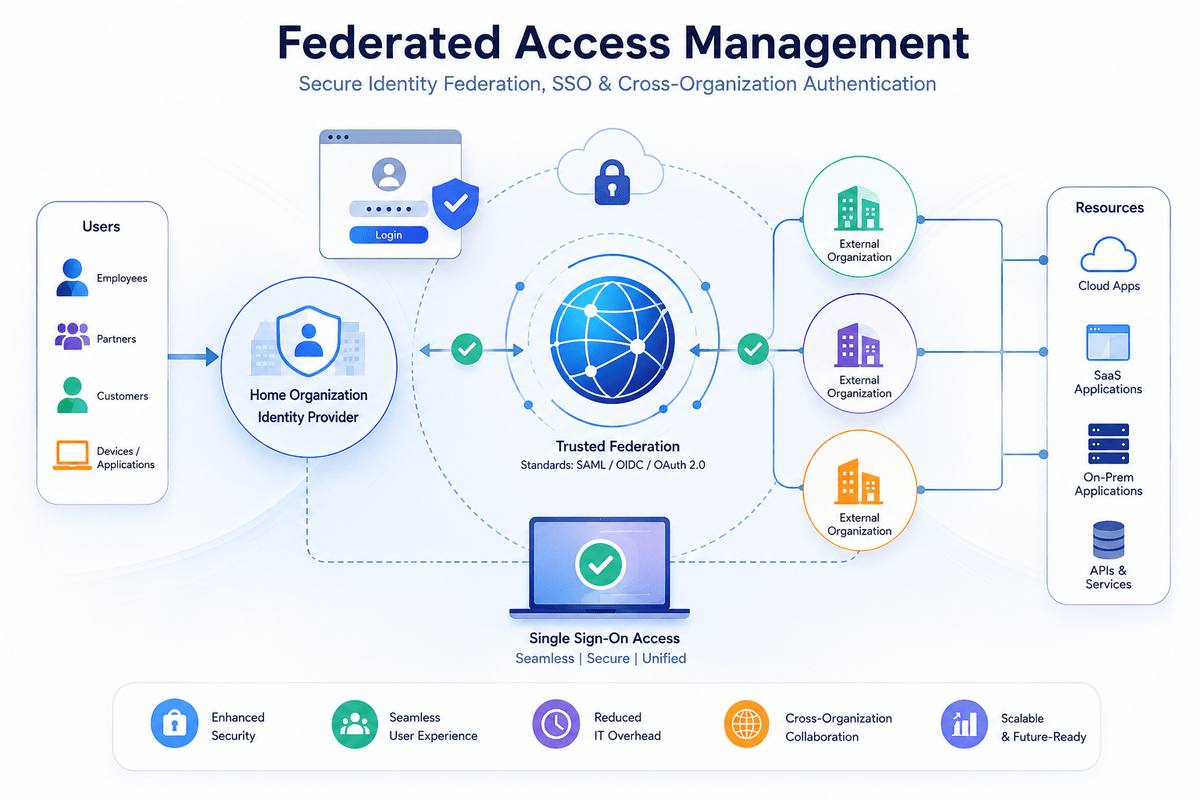
Federated Access Management is a security and identity architecture that allows an organization to trust the identity assertions of another organization or identity provider, enabling users to access resources across different systems, domains, or organizations using a single authenticated identity.
In simple terms: a user proves who they are once, and that proof is accepted by multiple systems, applications, or organizations, without the user needing to log in again or maintain a separate account in each place.
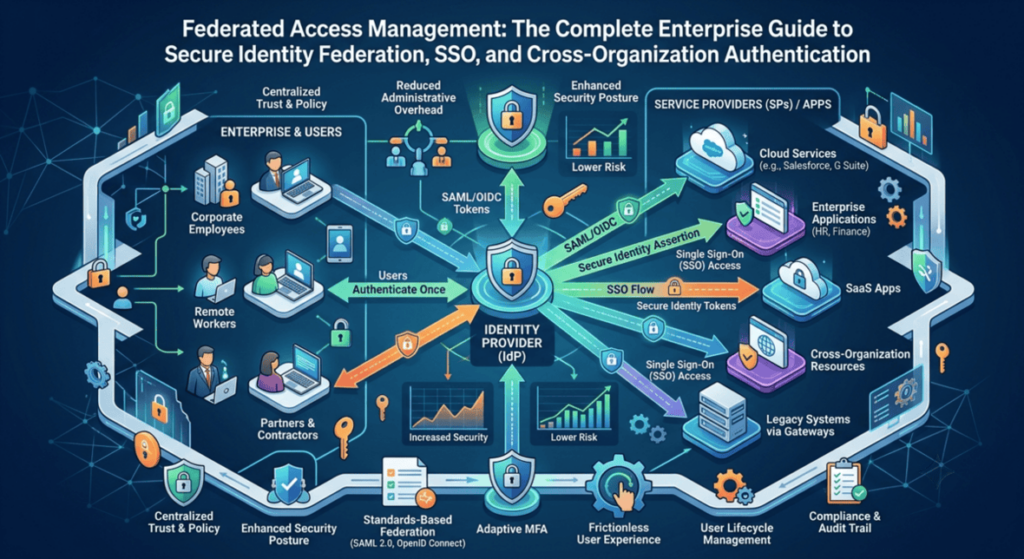
This works through a system of trust relationships. One organization acts as the Identity Provider (IdP), which authenticates the user and issues a digital assertion or token confirming their identity. Other systems, called Service Providers (SPs), receive and accept that token, granting or denying access based on the attributes included.
Key concepts within Federated Access Management include:
- Identity Federation: The process of linking digital identities across separate domains or organizations so they can be used interchangeably under an agreed trust framework.
- Authentication: The process of verifying that a user is who they claim to be.
- Authorization: The process of determining what a verified user is allowed to access or do.
- Trust Relationships: Formal agreements between identity providers and service providers that define how identity assertions will be accepted.
- Cross-Domain Access: The ability for a user authenticated in one domain (e.g., a corporate Active Directory) to access resources in a different domain (e.g., a partner’s cloud application) without re-authenticating.
- Identity Sharing: Passing verified identity attributes between organizations in a secure, standards-based way.
What is Federated Identity Management?
Federated Identity Management (FIM) is the broader discipline of managing how digital identities are created, maintained, federated, and governed across multiple systems and organizational boundaries.
It is worth clarifying how related terms differ:
| Term | Definition |
|---|---|
| Federated Identity | A user’s digital identity that is recognized and trusted across multiple organizations or systems |
| Identity Management | The processes and technologies used to manage the full lifecycle of a user’s identity within an organization |
| Identity Federation | The technical mechanism that links and shares identity information between separate systems or organizations |
| Access Management | Controlling which resources users can access and under what conditions |
| Identity Governance | Policies and processes that ensure identities and access rights comply with business rules and regulations |
Federated Identity Management combines all of these. It is not just about letting users log in once. It covers how identities are provisioned, how access rights are assigned and reviewed, how compliance is demonstrated, and how identity data is protected across organizational boundaries.
How Federated Access Management Works
Understanding the mechanics of federated authentication helps enterprises make better architecture decisions and troubleshoot integration challenges. Here is a step-by-step breakdown.
Identity Provider (IdP)
The Identity Provider is the system that owns and authenticates the user’s identity. It is the authoritative source of truth for who a user is. When a user attempts to access a resource, the IdP verifies their credentials (username/password, MFA, certificate, biometric, etc.) and issues a security token or assertion confirming successful authentication.
Common Identity Providers include Microsoft Entra ID (formerly Azure AD), Okta, Ping Identity, and ForgeRock. Enterprise directories like Active Directory also act as identity sources that feed into IdPs through federation services like ADFS.
Service Provider (SP)
The Service Provider is the application, system, or resource the user wants to access. Rather than managing its own authentication, the SP relies on the IdP’s assertion to grant access. The SP trusts the IdP, accepts the token, and enforces its own access policies based on the attributes included in the token.

Examples include a cloud SaaS application, an internal HR portal, a partner-facing API, or a customer self-service platform.
Authentication Flow
A typical federated authentication flow works like this:
- User attempts to access a protected resource hosted by the Service Provider.
- The SP redirects the user to the Identity Provider.
- The IdP presents a login screen and the user authenticates.
- The IdP generates a security token (SAML assertion, JWT, or OpenID Connect token) containing the user’s identity attributes.
- The token is sent back to the SP (directly or through the user’s browser).
- The SP validates the token’s signature against the IdP’s public key.
- If valid, the SP grants access based on the roles and attributes in the token.
Trust Relationships
Before any of this works, the IdP and SP must establish a formal trust relationship. This typically involves:
- Exchanging metadata (public keys, endpoint URLs, supported protocols)
- Signing a technical federation agreement or configuring trust in both systems
- Defining which attributes will be shared in assertions (email, role, department, group membership)
Trust relationships are usually bilateral (IdP trusts SP, SP trusts IdP), but in larger deployments an Identity Broker can manage trust relationships between many IdPs and SPs simultaneously.
Token Exchange
Security tokens carry the proof of identity. The format depends on the protocol:
- SAML 2.0 uses XML-based assertions digitally signed by the IdP.
- JWT (JSON Web Token) is a compact, URL-safe format used by OAuth 2.0 and OIDC.
- OpenID Connect ID Tokens are JWTs that contain user identity information.
Tokens are time-limited and signed to prevent tampering and replay attacks.
Session Management
Once authenticated, the user’s session is managed either by the IdP, the SP, or both. Single Logout (SLO) protocols allow a user to terminate sessions across all federated systems when they sign out. This is critical for security, particularly on shared or unmanaged devices.
Authorization Decisions
Authentication confirms identity. Authorization determines access. After a user is authenticated via federation, the SP applies its own authorization rules. These rules may be attribute-based (ABAC), role-based (RBAC), or policy-based. Modern implementations incorporate risk-based and adaptive authorization, where access decisions factor in device posture, location, time of day, and behavioral signals.
Federated Authentication Workflow Table
| Step | Actor | Action |
|---|---|---|
| 1 | User | Requests access to a protected resource |
| 2 | Service Provider | Redirects user to the IdP for authentication |
| 3 | Identity Provider | Authenticates user (password, MFA, certificate) |
| 4 | Identity Provider | Issues signed security token with identity attributes |
| 5 | Browser / Client | Delivers token to the Service Provider |
| 6 | Service Provider | Validates token signature and attributes |
| 7 | Service Provider | Grants or denies access based on authorization policy |
Federated Access Management vs Single Sign-On (SSO)
These terms are often used interchangeably, but they are not the same thing. Understanding the distinction helps organizations make the right architecture choices.
Single Sign-On is the user experience outcome: a user logs in once and accesses multiple applications without logging in again. Federation is the technical mechanism that can make SSO work across organizational boundaries.

You can have SSO without federation. For example, an organization might deploy an internal SSO solution that lets employees access all internal applications using one login. This works within a single identity domain and does not require trust relationships with external organizations.
You can also have federation without classic SSO in the consumer sense. For example, a B2B federation between two companies allows employees of Company A to access Company B’s portal using Company A’s credentials, but they are still authenticating to Company A’s IdP.
| Feature | Single Sign-On (SSO) | Federated Access Management |
|---|---|---|
| Authentication scope | Typically within one organization | Across organizations or domains |
| Trust model | Single identity domain | Cross-domain trust relationships |
| User experience | One login for internal apps | One login across partner/cloud apps |
| Protocol dependency | May or may not use SAML/OIDC | Requires federation protocols (SAML, OIDC) |
| Use case | Internal workforce access | Partner portals, cloud apps, B2B/B2C |
| Credential management | Centralized in one directory | Credentials stay with originating IdP |
| Complexity | Lower | Higher (multi-party trust management) |
In practice, enterprise federated access management typically delivers SSO as a key user experience benefit, but the underlying architecture is designed to handle cross-domain complexity that basic SSO solutions cannot address.
Federated Access Management vs Identity Management
Identity Management focuses on the full lifecycle of user identities within an organization: creating accounts, assigning roles, updating attributes, and deprovisioning access when employees leave.
Federated Access Management extends beyond the organization’s boundaries to handle cross-domain authentication and trust.
| Capability | Identity Management | Federated Access Management |
|---|---|---|
| User provisioning and deprovisioning | Yes | Limited (may trigger via federation) |
| Authentication across organizations | No | Yes |
| Access policy enforcement | Yes | Yes (at SP level) |
| Identity attribute management | Yes | Partial (shared attributes in tokens) |
| Cross-domain trust | No | Yes |
| Protocol standards (SAML, OIDC) | Not always | Core requirement |
| Partner/supplier access | Not typical | Primary use case |
| Identity governance | Yes | Complementary |
In a complete enterprise IAM architecture, Identity Management and Federated Access Management work together. Identity governance ensures that federated access rights are periodically reviewed and remain appropriate, while federation handles the mechanics of cross-domain authentication.
Federated Access Management vs OAuth vs SAML vs OpenID Connect
One of the most common sources of confusion in identity architecture is understanding how the major protocols relate to each other and when to use each one.

SAML (Security Assertion Markup Language)
SAML 2.0 is an XML-based protocol widely used in enterprise environments for federated authentication. It was designed for browser-based SSO scenarios and is the dominant standard for enterprise-to-enterprise federation. SAML carries identity assertions in XML documents that are signed and optionally encrypted by the IdP.
Best for: Enterprise SSO, legacy application integration, government systems, healthcare, and any environment with strict XML-based security requirements.
OAuth 2.0
OAuth 2.0 is an authorization framework, not an authentication protocol. It allows applications to obtain limited access to user accounts on a third-party service without exposing the user’s credentials. OAuth issues access tokens that allow clients to call APIs on the user’s behalf.
A common misconception: OAuth 2.0 on its own does not tell the application who the user is. It only authorizes access to resources.
Best for: API authorization, mobile applications, delegated access scenarios, microservices.
OpenID Connect (OIDC)
OpenID Connect is an authentication layer built on top of OAuth 2.0. It adds a standardized way to verify user identity by introducing the ID Token, a JWT that contains claims about the authenticated user (name, email, subject identifier, etc.). OIDC is the modern successor to older federation protocols and is now the standard for consumer-facing and many enterprise cloud deployments.
Best for: Modern cloud applications, SaaS integrations, B2C and CIAM scenarios, mobile-first environments.
JWT (JSON Web Token)
JWT is a token format used by both OAuth 2.0 and OIDC. It is compact, self-contained, and digitally signed. JWTs carry claims about the user and are validated by the receiving party using the issuer’s public key.
Protocol Comparison Table
| Protocol | Type | Token Format | Primary Use Case | Enterprise Adoption |
|---|---|---|---|---|
| SAML 2.0 | Authentication + Authorization | XML Assertion | Enterprise SSO, legacy apps | Very High |
| OAuth 2.0 | Authorization only | Access Token (JWT) | API access, delegated auth | Very High |
| OpenID Connect | Authentication | ID Token (JWT) | Modern apps, B2C, SaaS | High and growing |
| WS-Federation | Authentication | XML Token | Microsoft ecosystem, ADFS | Moderate (enterprise) |
OAuth vs SAML: Use SAML for enterprise SSO where XML-based assertions are expected. Use OAuth/OIDC for modern API-driven applications, mobile clients, and cloud-native environments.
OIDC vs OAuth: Use OAuth alone when you only need to authorize API access. Use OIDC when you need to authenticate the user and know who they are.
Benefits of Federated Access Management
Improved Security
Federation reduces the attack surface by eliminating redundant credential stores. When users do not maintain separate passwords across dozens of systems, there are fewer credentials to steal, fewer password reuse vulnerabilities, and fewer weak passwords stored in third-party applications.
Federated systems also enforce consistent authentication policies. When an organization requires MFA through its IdP, that requirement applies to all federated applications, regardless of whether those applications natively support MFA.
Better User Experience
Users authenticate once and move freely across applications. No repeated logins, no password reset requests for applications they only use occasionally, no friction during partner collaboration. For customer-facing applications, seamless federated login is a competitive advantage.
Reduced Password Fatigue
Password fatigue is real and dangerous. When users maintain too many passwords, they reuse them, simplify them, or write them down. Federation eliminates the need for multiple passwords across federated systems, directly reducing this risk.
Centralized Authentication
With federation, authentication policy is enforced at the IdP, giving security teams a single control point. Conditional access policies, MFA requirements, risk-based authentication, and device compliance checks are configured once and applied everywhere.
Enhanced Compliance
Regulations like HIPAA, SOC 2, PCI DSS, ISO 27001, and GDPR require organizations to demonstrate controlled access to sensitive data. Federated access management provides centralized audit logs, enforces consistent access policies, and supports access reviews, making compliance evidence far easier to produce.
Scalability
Adding new applications, partners, or users to a federated environment is far simpler than provisioning accounts in each system independently. New SPs can be onboarded by establishing a trust relationship with the existing IdP.
Cloud Readiness
Modern cloud platforms including AWS, Azure, Google Cloud, Microsoft 365, and hundreds of SaaS applications natively support SAML and OIDC. Federated access management integrates directly with cloud IAM services, enabling consistent identity governance across on-premises and cloud environments.
Reduced IT Costs
Fewer helpdesk calls for password resets, faster application onboarding, and reduced overhead for managing separate user directories translate directly into lower operational costs. Research consistently shows that password resets represent a significant share of IT helpdesk volume.
Faster Partner Onboarding
Establishing a B2B federation with a new partner can be done in days rather than weeks. Instead of provisioning individual accounts, the partner’s IdP is trusted, and their users authenticate through their own system.
Identity Governance
Federated access management integrates with Identity Governance and Administration (IGA) tools to enforce periodic access reviews, segregation of duties, and role lifecycle management across all federated systems.
Zero Trust Support
Zero Trust architecture requires that every access request be verified, regardless of origin. Federated access management provides the identity verification layer that Zero Trust depends on, combined with continuous risk assessment and adaptive authentication.
Risk Reduction
Centralizing authentication reduces the likelihood that a compromised credential in one system will cascade across others. Federated systems can also respond to threats dynamically. If a user’s session is flagged as suspicious, the IdP can terminate all federated sessions simultaneously.
Operational Efficiency
IT teams spend less time managing user accounts across multiple systems. Automated provisioning and deprovisioning through federation-aware workflows reduces manual effort and the risk of orphaned accounts.
Business Continuity
Federated access management supports disaster recovery scenarios. When systems are designed to authenticate through a resilient, highly available IdP, application access continues even during infrastructure disruptions.
Audit Readiness
Centralized authentication logs from the IdP provide a complete audit trail of who authenticated, when, from where, and using what method. This is essential for forensic investigation, compliance reporting, and security operations.
Common Enterprise Use Cases
Employee Access Management: Large enterprises with thousands of employees use federation to provide seamless access to corporate applications, cloud productivity suites like Microsoft 365, HR systems, ERP platforms, and collaboration tools. New employees receive access on day one through provisioning workflows connected to the IdP.
B2B Partner Access: Manufacturers, financial services firms, and logistics companies routinely collaborate with hundreds of suppliers and partners. Federation allows partner employees to access shared portals using their own organization’s credentials, eliminating the need to manage guest accounts.
Supplier Portals: Organizations in retail, manufacturing, and healthcare use federated supplier portals to share inventory data, procurement systems, and logistics information with external vendors without creating internal accounts for every external user.

Vendor Management: IT and security teams grant technology vendors limited, time-bound access to support systems through federated authentication, maintaining full visibility and control without exposing internal credentials.
Customer Portals (CIAM): Customer Identity and Access Management uses federation to allow customers to log in using existing accounts from Google, Microsoft, Apple, or other trusted providers. This reduces registration friction and improves conversion rates.
Healthcare: Hospitals and health systems use federated identity to allow physicians, nurses, and administrative staff to move between clinical applications without repeated authentication. Cross-organization federation enables secure data sharing in compliance with HIPAA.
Banking and Financial Services: Banks and insurers use federation to support regulatory compliance, customer portals, partner integrations, and internal workforce access across complex multi-system environments.
Government: Federal and state agencies implement identity federation to support citizen services portals, interagency data sharing, and contractor access management within frameworks like FedRAMP and FICAM.
Education: Universities and research institutions use federation networks like InCommon to allow students, faculty, and researchers to access library resources, research databases, and shared computing environments.
Multi-Cloud and Hybrid Cloud: Organizations running workloads across AWS, Azure, and Google Cloud use federation to unify identity across cloud platforms, avoiding siloed IAM configurations in each environment.
Core Components of Federated Access Management
| Component | Function |
|---|---|
| Identity Provider (IdP) | Authenticates users and issues identity assertions |
| Service Provider (SP) | Accepts identity assertions and enforces access policy |
| Identity Broker | Mediates trust between multiple IdPs and SPs |
| Directory Services | Stores identity attributes (Active Directory, LDAP) |
| Authentication Server | Handles credential verification and MFA |
| Authorization Engine | Evaluates access policies and makes permit/deny decisions |
| Policy Server | Stores and distributes access control policies |
| Token Service | Issues, validates, and manages security tokens |
| Session Manager | Tracks active sessions and handles logout |
| Audit Logs | Records all authentication and authorization events |
| Identity Governance | Manages access reviews, role certification, and compliance |
| Access Reviews | Periodic verification that user access remains appropriate |
Security Best Practices for Federated Access Management
Least Privilege: Ensure that identity tokens carry only the attributes and roles needed for the specific application. Avoid including broad organizational roles in assertions that travel to external systems.
Zero Trust Integration: Treat federation as the identity verification layer of your Zero Trust architecture. Combine federated authentication with device compliance checks, network posture assessment, and continuous access evaluation.
Adaptive Authentication: Configure your IdP to assess risk signals at login. Require step-up authentication (additional MFA, re-authentication) when users access sensitive resources, authenticate from unusual locations, or exhibit anomalous behavior.
Multi-Factor Authentication (MFA): Enforce MFA for all federated authentication flows. A compromised password should not be sufficient to gain access to any federated system.
Passwordless Authentication: Where possible, replace passwords with FIDO2/WebAuthn passkeys, certificate-based authentication, or biometrics. Passwordless authentication eliminates the most common credential-based attack vectors.
Continuous Authentication: Implement session re-evaluation that periodically checks whether the user’s risk posture has changed during an active session. Continuous Access Evaluation Protocol (CAEP) enables real-time session revocation based on risk events.
Conditional Access Policies: Define granular conditions under which access is granted or denied: device compliance, location, time of day, application sensitivity, and user risk level.
Identity Monitoring and Analytics: Deploy identity threat detection and response (ITDR) capabilities that analyze authentication patterns and alert on anomalies such as impossible travel, credential stuffing, and token theft.
Access Reviews: Conduct periodic access reviews for federated relationships, especially for B2B partner federations. Review trust configurations, attribute mappings, and session lifetimes regularly.
Privileged Access Management: Apply stricter controls to privileged user federation. Federated access to administrative interfaces should require dedicated privileged identity workflows and shorter session lifetimes.
Identity Lifecycle Management: Ensure that federated access is terminated promptly when employees leave or change roles. Automate deprovisioning through HR system integration with the IdP.
Common Challenges in Federated Access Management
Legacy Application Integration: Many business-critical applications were built before modern federation protocols existed. Integrating them with SAML or OIDC requires middleware, application gateways, or reverse proxies.
Protocol Compatibility: Not all partners use the same protocols or versions. Supporting both SAML 2.0 and OIDC simultaneously, or handling older WS-Federation implementations, requires flexible IdP configurations.
Trust Management at Scale: Large enterprises may maintain federation agreements with hundreds of partners and thousands of SPs. Managing trust configurations, certificate rotations, and metadata updates at scale requires robust federation management tooling.
Identity Synchronization: When identity attributes in the source directory change (role updates, department changes, terminations), those changes must propagate to federated sessions and SP-side user profiles. Synchronization delays can create access policy gaps.
Compliance Across Jurisdictions: Cross-border federation introduces data sovereignty and privacy compliance challenges. Sharing identity attributes internationally must comply with GDPR, data localization laws, and sector-specific regulations.

Cloud Migration Complexity: Organizations migrating from on-premises ADFS to cloud identity providers must re-establish federation configurations for hundreds of applications while maintaining service continuity.
Third-Party Integration Variability: Partner organizations may use a wide range of IdPs, some with non-standard configurations. Testing and validating federated authentication across diverse partner environments is time-consuming.
User Lifecycle Across Organizations: When a partner employee leaves, their organization should deprovision them immediately. But there is no guarantee that deprovisioning events will be communicated in real time across federated boundaries, creating orphaned access risks.
Scalability of Session Management: High-volume federated environments with millions of users require session management infrastructure that can scale without introducing latency or availability bottlenecks.
How to Successfully Implement Federated Access Management
Step 1: Assessment
Map your current identity landscape. Identify all applications, directories, and authentication systems in scope. Document which user populations (employees, partners, customers) need access to which resources. Identify existing federation configurations and gaps.
Step 2: Planning
Define your federation strategy. Determine which protocols to support (SAML 2.0, OIDC, OAuth 2.0). Establish governance processes for onboarding new SPs and IdPs. Define attribute schemas and token content standards.
Step 3: Architecture Design
Design your IdP topology. Decide whether to use a single centralized IdP, a hub-and-spoke model with an identity broker, or a distributed federation mesh. Plan for high availability, disaster recovery, and geographic distribution.
Step 4: Technology Selection
Evaluate identity platforms based on protocol support, scalability, integration ecosystem, and total cost of ownership. Consider Microsoft Entra ID, Okta, Ping Identity, ForgeRock, or IBM Security Verify based on your environment and requirements.
Step 5: Pilot Deployment
Select a low-risk application and user group for the initial federation deployment. Test end-to-end authentication flows, attribute mapping, MFA enforcement, and Single Logout. Validate user experience and collect feedback.
Step 6: Production Deployment
Migrate applications in prioritized waves. Start with high-usage internal applications, then extend to cloud SaaS, then to partner-facing systems. Maintain fallback authentication options during transition.
Step 7: Monitoring and Operations
Implement real-time monitoring of authentication events, token validation failures, and session anomalies. Establish alerting thresholds and incident response procedures for identity-related events.
Step 8: Optimization
Review authentication policies periodically. Tune conditional access rules based on observed behavior. Evaluate passwordless authentication adoption opportunities.
Step 9: Continuous Governance
Establish a regular cadence of access reviews, trust configuration audits, and certificate renewals. Integrate federation governance into your broader Identity Governance and Administration program.
Top Federated Identity Platforms
Microsoft Entra ID (formerly Azure AD)
Microsoft Entra ID is the dominant cloud identity platform for enterprises running Microsoft 365, Azure, and hybrid Windows environments. It provides native SAML, OIDC, and OAuth 2.0 federation, conditional access policies, and deep integration with Active Directory through Azure AD Connect. Entra ID External Identities supports B2B and B2C federation scenarios.
Best fit for: Microsoft-centric enterprises, hybrid cloud environments, organizations with large Active Directory deployments.
Okta
Okta is a cloud-native identity platform purpose-built for enterprise IAM. It offers broad application integration (7,000+ pre-built connectors), strong adaptive MFA, universal directory services, and customer identity (CIAM) capabilities. Okta’s federation capabilities cover both workforce and customer identity use cases.
Best fit for: Cloud-first enterprises, organizations with diverse SaaS portfolios, B2C and CIAM deployments.
Ping Identity
Ping Identity specializes in enterprise-grade federated identity, particularly for organizations with complex hybrid environments and high-volume, high-availability requirements. PingFederate is widely deployed in financial services, healthcare, and government sectors.
Best fit for: Large regulated enterprises, hybrid environments, organizations needing high-volume federation performance.
ForgeRock (now part of Ping Identity)
ForgeRock offers an open-standards-based identity platform with strong support for identity federation, adaptive authentication, and customer identity management. It is widely used in telecommunications, government, and financial services.
Best fit for: Complex enterprise identity deployments, organizations requiring high customization.
OneLogin
OneLogin provides cloud-based SSO, MFA, and identity federation with a strong focus on ease of deployment. It supports SAML, OIDC, and has a broad catalog of pre-built application integrations.
Best fit for: Mid-market and enterprise organizations looking for quick deployment of cloud SSO and federation.
IBM Security Verify
IBM Security Verify delivers federated access management as part of a broader identity security platform. It supports SAML, OIDC, and OAuth, and integrates with IBM’s broader security ecosystem including SIEM and threat intelligence.
Best fit for: Large enterprises with existing IBM security investments, regulated industries.
Oracle Identity Manager
Oracle Identity Manager and Oracle Access Manager provide enterprise identity governance and federated access management. It is commonly deployed in organizations running Oracle ERP and database environments.
Best fit for: Enterprises with heavy Oracle technology investments, large-scale identity governance requirements.
CyberArk
CyberArk is primarily known for Privileged Access Management but offers federated SSO and adaptive MFA through its Workforce Identity platform. It is particularly strong in environments where privileged user federation is a security priority.
Best fit for: Organizations prioritizing privileged access security, security-first enterprises.
SailPoint
SailPoint focuses on Identity Governance and Administration (IGA) and integrates with federation platforms to provide access certification, role management, and compliance reporting across federated environments.
Best fit for: Organizations with mature IGA requirements, compliance-heavy industries.
Future Trends in Federated Access Management
Passwordless Authentication and Passkeys: FIDO2/WebAuthn passkeys are emerging as the replacement for passwords in enterprise environments. When combined with federation, passkeys eliminate the most common attack vector in identity-based breaches. Major platforms including Microsoft, Apple, and Google now support passkeys, and enterprise adoption is accelerating.
AI-Powered Identity Security: Machine learning models are being applied to identity analytics to detect anomalous authentication patterns, predict credential compromise, and automate risk-based access decisions. AI-driven identity threat detection and response (ITDR) is becoming a standard enterprise capability.
Behavioral Analytics and Continuous Authentication: Rather than authenticating once per session, continuous authentication systems evaluate user behavior throughout a session. Typing patterns, mouse movement, navigation behavior, and device signals are used to build a continuous risk score.

Continuous Access Evaluation Protocol (CAEP): CAEP is an emerging standard that enables real-time communication between IdPs and SPs about security events affecting active sessions. If a user’s account is compromised or their device fails a compliance check mid-session, CAEP allows the IdP to immediately revoke access rather than waiting for session expiry.
Decentralized Identity and Verifiable Credentials: Self-Sovereign Identity (SSI) models and W3C Verifiable Credentials allow users to control their own identity credentials without relying on a centralized identity provider. Verifiable Credentials issued by trusted authorities (governments, universities, employers) can be presented to service providers as cryptographically verifiable proof of identity or attributes. While still maturing, decentralized identity is gaining traction in government, healthcare, and cross-border authentication scenarios.
Blockchain-Based Identity: Distributed ledger technologies are being explored as a foundation for immutable identity records and audit trails. Blockchain identity solutions are particularly relevant in scenarios requiring cross-organizational trust without a central authority.
Identity Threat Detection and Response (ITDR): ITDR is a fast-growing security discipline focused on detecting and responding to identity-based attacks. It combines identity analytics, threat intelligence, and automated response to address account takeovers, privilege escalation, and lateral movement. Gartner recognized ITDR as a top security trend, and major identity vendors are building ITDR capabilities directly into their platforms.
Machine Identity Management: As enterprises deploy more APIs, microservices, containers, and IoT devices, machine identities now outnumber human identities by a significant margin. Federation frameworks are expanding to cover machine-to-machine authentication, service accounts, and workload identities.
Identity Fabric: The concept of an identity fabric describes a unified, policy-consistent identity layer that spans all users, devices, applications, and environments across an organization. Rather than managing separate IAM systems for workforce, partners, and customers, an identity fabric provides a coherent architecture that federated access management sits at the center of.
How Avancer Corporation Helps Enterprises Implement Federated Access Management
Implementing Federated Access Management successfully requires more than selecting the right platform. It demands deep expertise in identity architecture, protocol integration, enterprise directory services, and the governance frameworks that make federated identity sustainable over time.
Avancer Corporation has spent years helping enterprises design, build, and operate identity and access management programs across industries including financial services, healthcare, manufacturing, retail, and government. The team brings hands-on experience with the full spectrum of enterprise IAM challenges, from modernizing legacy ADFS deployments to building cloud-native federated identity architectures from the ground up.
Here is what Avancer’s enterprise IAM practice covers:
Federated Access Management Implementation: Avancer designs and deploys federated authentication architectures using industry-standard protocols including SAML 2.0, OAuth 2.0, and OpenID Connect. This covers workforce federation, B2B partner integration, and customer identity scenarios.
Identity and Access Management (IAM): End-to-end IAM program design and implementation, covering strategy, architecture, technology selection, deployment, and ongoing management.
Identity Governance and Administration (IGA): Access certification campaigns, role lifecycle management, segregation of duties enforcement, and compliance reporting aligned to regulatory requirements.
Single Sign-On (SSO): Enterprise SSO implementation across on-premises, cloud, and hybrid application portfolios, reducing authentication friction while strengthening security controls.
Multi-Factor Authentication (MFA): MFA strategy and deployment across workforce and customer-facing environments, including adaptive MFA policies that balance security with user experience.
Privileged Access Management (PAM): Securing privileged accounts through vaulting, session monitoring, just-in-time access, and federated privileged identity workflows.
Identity Lifecycle Management: Automated provisioning and deprovisioning workflows that connect HR systems, Active Directory, and cloud applications, ensuring access rights stay current and accurate.
Cloud IAM and Hybrid IAM: Identity architecture for multi-cloud and hybrid environments, including Microsoft Entra ID, AWS IAM, and Google Cloud Identity integration.
Microsoft Entra ID and Active Directory Integration: Migration from legacy ADFS deployments, Active Directory modernization, and hybrid identity configuration using Microsoft’s cloud-native identity platform.
Directory Services: LDAP directory design, Active Directory architecture, and cloud directory integration for complex enterprise environments.
Access Governance: Policy design, access request workflows, and governance program management that ensures appropriate access across the organization.
Compliance Support: Identity controls mapping to HIPAA, SOC 2, PCI DSS, ISO 27001, NIST, and other regulatory frameworks, supporting audit readiness and evidence collection.
Zero Trust Architecture: Identity-centric Zero Trust implementation that combines federated authentication, device compliance, and continuous risk assessment to protect enterprise resources.
IAM Consulting and Managed Services: Strategic advisory services, program assessments, technology roadmaps, and ongoing managed IAM services for organizations that want expert support without building large in-house teams.
Enterprise Identity Modernization: Helping organizations move from outdated, fragmented identity systems to modern, cloud-integrated platforms that support the scale and flexibility digital transformation demands.
Whether an organization is starting its identity federation journey, modernizing an existing deployment, or tackling a specific challenge like cloud migration or partner onboarding, Avancer brings the experience, methodology, and technical depth to get it done right.
Key Takeaways:
- Federated Access Management is foundational infrastructure for any enterprise operating across cloud platforms, hybrid environments, or organizational boundaries.
- It relies on trust relationships and standards-based protocols (SAML 2.0, OAuth 2.0, OpenID Connect) to enable secure cross-domain authentication.
- The difference between SSO and federation matters: SSO is the user experience, federation is the cross-domain architecture that makes it possible at scale.
- Security benefits are significant: fewer credential stores, consistent MFA enforcement, centralized audit logging, and real-time session management.
- Implementation success depends on careful planning, architecture design, phased deployment, and ongoing governance.
- Emerging trends including passkeys, AI-powered ITDR, continuous access evaluation, and decentralized identity are reshaping the future of federated access.
Conclusion:
Identity has become the security perimeter. The network boundary that enterprises once relied on to separate trusted insiders from untrusted outsiders no longer serves that purpose in a world of cloud applications, remote workers, and third-party collaborations.
Federated Access Management is how modern enterprises maintain control over who accesses what, across every environment and every organizational boundary. It simplifies the user experience while strengthening security. It reduces operational overhead while improving compliance posture. It enables the kind of seamless collaboration with partners, suppliers, and customers that drives business outcomes.
Organizations that have not yet invested in a mature federated identity architecture are carrying risk. Fragmented credential stores, inconsistent authentication policies, and manual partner onboarding processes all create exposure. And as Zero Trust adoption accelerates and regulatory requirements tighten, the pressure to get identity right will only grow.
The path forward is clear: build a strong identity foundation, federate securely, govern continuously, and modernize as the technology landscape evolves.
Avancer Corporation works with enterprises at every stage of that journey. Whether you are designing a federated access architecture from scratch, modernizing a legacy ADFS deployment, extending identity federation to cloud and SaaS environments, or building an identity governance program that keeps access rights current and compliant, Avancer has the expertise to guide the work.
Our practice covers the full spectrum of Identity and Access Management: Federated Access Management, Single Sign-On, Multi-Factor Authentication, Privileged Access Management, Identity Governance and Administration, Cloud IAM, Microsoft Entra ID integration, Zero Trust identity architecture, IAM consulting, and managed IAM services.
Identity security is not a one-time project. It is an ongoing program that evolves with your organization. Avancer is the partner that helps enterprises build identity programs that scale, adapt, and remain secure over the long term.
Frequently Asked Questions About Federated Access Management:
What is Federated Access Management?
Federated Access Management is a security framework that allows users to authenticate once through a trusted Identity Provider and access resources across multiple organizations, systems, or applications without needing separate credentials for each. It relies on formal trust relationships and standards-based protocols like SAML, OAuth, and OpenID Connect.
What is Federated Identity Management?
Federated Identity Management (FIM) is the broader discipline of managing how digital identities are created, shared, governed, and used across organizational boundaries. It encompasses identity federation, access management, identity governance, and the policies and technologies that make cross-domain authentication secure and reliable.
How does Federated Authentication work?
Federated authentication works through a flow in which a user requests access to a resource, the Service Provider redirects them to an Identity Provider for authentication, the IdP verifies the user’s credentials and issues a signed security token, and the SP validates the token and grants access based on its authorization policies. The user never shares their credentials with the SP.
What is the difference between Federated Access Management and SSO?
Single Sign-On (SSO) is the user experience of logging in once and accessing multiple applications without re-authenticating. Federated Access Management is the underlying architecture that enables SSO to work across organizational boundaries and separate identity domains. SSO can exist within a single organization without federation, but federation is required to extend SSO across organizations or cloud environments.
What is SAML?
SAML (Security Assertion Markup Language) is an XML-based open standard used to exchange authentication and authorization data between Identity Providers and Service Providers. SAML 2.0 is the most widely deployed federation protocol in enterprise environments and is the basis for most enterprise SSO deployments with SaaS applications.
What is OAuth?
OAuth 2.0 is an authorization framework that allows applications to obtain limited access to user accounts on a third-party service without exposing credentials. It is widely used for API authorization, mobile applications, and delegated access scenarios. OAuth 2.0 on its own does not authenticate users, it authorizes access to resources.
What is OpenID Connect?
OpenID Connect (OIDC) is an identity authentication protocol built on top of OAuth 2.0. It adds a standardized mechanism to verify user identity by issuing an ID Token (a JWT) that contains claims about the authenticated user. OIDC is the modern standard for cloud application authentication and is increasingly replacing SAML in new deployments.
What is an Identity Provider?
An Identity Provider (IdP) is the system that authenticates users and issues identity assertions or tokens that other systems trust. Examples include Microsoft Entra ID, Okta, Ping Identity, and Active Directory Federation Services. The IdP is the authoritative source of truth for user identity in a federated architecture.
What is a Service Provider?
A Service Provider (SP) is the application or system that users want to access. Rather than authenticating users itself, the SP trusts identity assertions from a federated IdP. The SP validates the token and applies its own authorization rules to determine what the user can do.
