

Ten years ago, most organizations protected their networks with firewalls and VPNs, treating the perimeter as the boundary between trusted and untrusted. That model no longer holds up.
Today, employees work from home, from airports, and from client offices. Applications run across AWS, Azure, Google Cloud, and on-premise data centers simultaneously. Third-party contractors need access to internal systems. Customers expect frictionless digital experiences. And threat actors are increasingly targeting identity systems directly, because compromising an identity is far easier than breaking through a hardened network perimeter.
According to the Verizon Data Breach Investigations Report, stolen credentials are involved in over 80% of web application breaches. IBM’s Cost of a Data Breach Report consistently shows that breaches involving identity compromise take longer to detect and cost significantly more to remediate.
This is the environment where IAM architecture best practices matter most. A well-designed identity and access management architecture does more than manage usernames and passwords. It defines how every user, application, service, and device is identified, authenticated, authorized, and monitored across the entire enterprise ecosystem.
For organizations going through cloud transformation, digital modernization, mergers, or regulatory audits, IAM architecture is often the difference between controlled, defensible access and chaotic, exploitable sprawl.
This guide breaks down everything you need to know, from foundational concepts to implementation roadmaps, technology stacks, industry-specific considerations, and the future of identity security.
What Is IAM Architecture?
IAM architecture is the structured framework that defines how an organization manages digital identities and controls access to systems, data, and services. It encompasses the policies, processes, technologies, and integrations that govern the entire identity lifecycle from user onboarding to offboarding.
At its core, IAM architecture addresses several interconnected functions:
Identity Architecture refers to how identities are created, stored, synchronized, and maintained across the organization. This includes employee identities, service accounts, machine identities, and partner or customer identities.
Authentication is the process of verifying that a user or system is who they claim to be. Modern authentication architecture includes multi-factor authentication (MFA), passwordless methods, biometrics, and risk-based adaptive authentication.
Authorization determines what an authenticated identity is allowed to do. Authorization architecture typically uses role-based access control (RBAC), attribute-based access control (ABAC), or policy-based access control to enforce least privilege.
Identity Governance provides the oversight layer, ensuring that access rights are appropriate, reviewed regularly, certified, and aligned with compliance requirements. This is often called Identity Governance and Administration (IGA).
Lifecycle Management covers how identities are provisioned when someone joins the organization, modified as roles change, and deprovisioned when they leave.
Provisioning Architecture defines automated workflows that create, update, and remove access rights across connected systems based on HR events or policy triggers.
Directory Services are the foundational repositories, like Microsoft Active Directory, Azure Active Directory (now Microsoft Entra ID), or LDAP-based directories, that store identity data.
Policy Engine and Risk Engine evaluate contextual signals such as location, device posture, and behavioral patterns to make dynamic access decisions.
Identity Analytics uses data from across the IAM environment to detect anomalies, surface access risks, and support decision-making.
Session Management controls active sessions, enforces timeouts, and provides visibility into what authenticated users are doing in real time.
Identity Federation enables secure identity sharing across organizational boundaries using standards like SAML, OAuth 2.0, and OpenID Connect (OIDC).
Together, these components form a cohesive IAM architecture that supports security, compliance, and operational efficiency.
Why IAM Architecture Matters for Modern Enterprises
The business case for a well-designed IAM architecture is both strategic and operational.
Cloud Adoption has fundamentally changed the access landscape. Applications are no longer hosted in a single data center where network controls can enforce boundaries. Cloud-native services, SaaS platforms, and infrastructure-as-code environments require identity to be the primary enforcement mechanism.
Digital Transformation initiatives introduce new users, new applications, and new integration requirements constantly. Without a scalable IAM architecture, every new application becomes a new security and compliance risk.
Regulatory Compliance is increasingly demanding. SOX, HIPAA, GDPR, PCI DSS, CMMC, and countless other frameworks require organizations to demonstrate that access is controlled, monitored, reviewed, and auditable. A mature IAM architecture makes compliance significantly more manageable.
Remote Workforce expansion means that users access corporate resources from devices and locations that cannot be assumed to be secure. Identity verification and continuous authentication become critical.
Third-Party Access introduces external contractors, vendors, and partners who need controlled access without the overhead of full employee provisioning. IAM architecture must accommodate these identities securely.
Customer Identity (CIAM) is now a competitive differentiator. Organizations that deliver secure, low-friction authentication for customers build trust and reduce abandonment rates.
Business Continuity depends on IAM. When a major authentication system goes down, it doesn’t just create a security incident, it halts business operations. High availability and disaster recovery planning must be built into IAM architecture from the start.
Operational Efficiency is another major driver. Manual access provisioning and deprovisioning is slow, error-prone, and expensive. Automated IAM architecture reduces IT help desk load and accelerates onboarding.
Core Components of IAM Architecture
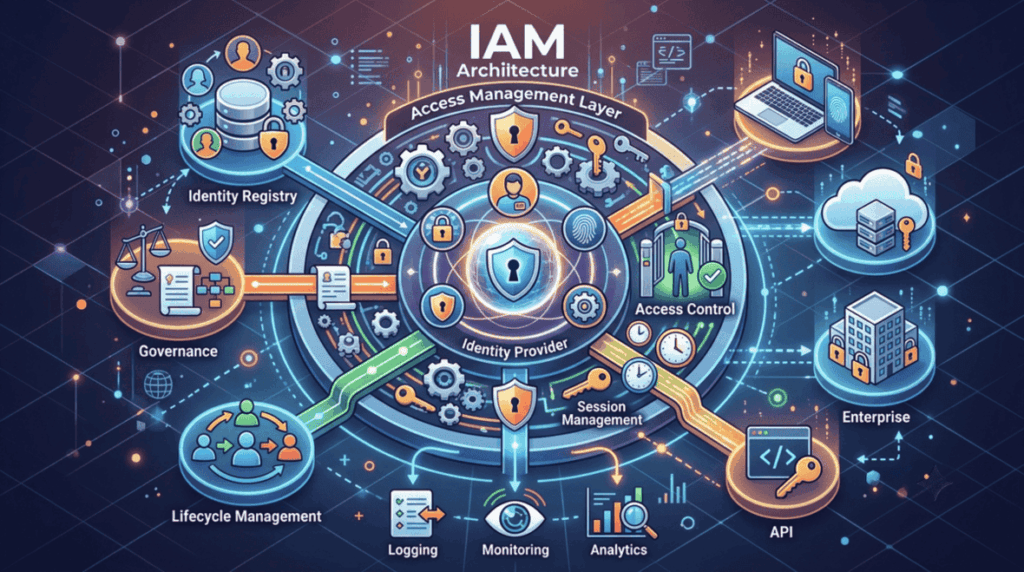
Identity Repository
The identity repository is the authoritative source of truth for all identity data. In most enterprises, this is a directory service such as Microsoft Active Directory, Azure Active Directory (Microsoft Entra ID), or an LDAP directory. The repository stores attributes like user profiles, group memberships, roles, and entitlements. In modern architectures, identity data may be federated across multiple repositories with synchronization tools maintaining consistency.
Authentication Layer
The authentication layer verifies identity claims. It includes:
- Username and password (baseline)
- Multi-factor authentication (MFA) using TOTP, hardware tokens, or push notifications
- Passwordless authentication using FIDO2/WebAuthn, passkeys, or biometrics
- Adaptive and risk-based authentication that evaluates contextual signals
Authorization Layer
The authorization layer enforces what authenticated users can access. Enterprise architectures commonly use:
- RBAC (Role-Based Access Control): Permissions assigned based on job roles
- ABAC (Attribute-Based Access Control): Permissions derived from user, resource, and environmental attributes
- Policy-Based Access Control: Centralized policy engines evaluate rules in real time
Provisioning Engine
The provisioning engine automates the creation, modification, and removal of access rights across connected systems. It typically integrates with HR systems (Workday, SAP SuccessFactors, etc.) as the authoritative source for joiner-mover-leaver events.
Access Governance
Access governance provides the oversight and control layer. It includes access certification campaigns, role mining and management, separation of duties (SoD) enforcement, and access request workflows. SailPoint, Saviynt, and One Identity are common platforms in this space.
Identity Federation
Identity federation allows organizations to share identity assertions across trust boundaries. Using SAML 2.0, OAuth 2.0, and OIDC, federated architecture enables SSO across SaaS applications, cloud platforms, and partner organizations without sharing credentials.
Directory Services
Directory services (Active Directory, LDAP, Azure AD/Entra ID) serve as the backbone of enterprise identity infrastructure. They store identity objects, group policies, and schema definitions that downstream IAM systems depend on.
Single Sign-On (SSO)
SSO architecture reduces authentication friction by allowing users to authenticate once and gain access to multiple applications without re-authenticating. Modern SSO leverages identity providers (IdPs) like Okta, Ping Identity, or Microsoft Entra to broker authentication across cloud and on-premise applications.
Multi-Factor Authentication (MFA)
MFA is a mandatory control in any mature IAM architecture. It requires users to provide at least two verification factors, substantially reducing the risk of credential compromise. Enterprise MFA should support a range of authenticator types and integrate with adaptive authentication policies.
Privileged Access Management (PAM)
PAM architecture secures the most sensitive access in the enterprise: administrator accounts, service accounts, shared credentials, and emergency access. PAM platforms like CyberArk, BeyondTrust, and Delinea provide credential vaulting, session recording, just-in-time access, and least privilege enforcement for privileged users.
Identity Analytics
Identity analytics uses behavioral data, access patterns, and risk signals to detect anomalies, surface access risks, and support intelligent access decisions. It underpins identity threat detection and response (ITDR) capabilities.
Audit and Compliance
Every IAM component must generate audit-ready logs. The audit and compliance layer aggregates identity events, access decisions, provisioning changes, and policy violations into a central repository that supports regulatory reporting and forensic investigations.
Understanding Service-Oriented Architecture (SOA) Security
Service-Oriented Architecture (SOA) refers to a design approach where enterprise applications are built as a collection of interoperable services that communicate over a network. As organizations modernize, SOA has evolved into microservices architecture, but the core security challenges remain highly relevant.
In an SOA environment, services communicate with each other constantly. Securing that communication requires identity-based controls at the service level, not just at the user level. This is where IAM architecture intersects directly with SOA security.

Key elements of SOA security in modern IAM architecture include:
Service Identity: Every service, microservice, or API must have a verified identity. Machine identities and service accounts require the same lifecycle management as human identities.
OAuth 2.0 and OpenID Connect (OIDC): These are the standard protocols for securing API access and delegated authorization in modern SOA environments. OAuth tokens allow services to request and grant scoped access without sharing credentials.
SAML: Still widely used for enterprise SSO and federated identity, particularly in legacy and hybrid environments.
Security Tokens (JWTs): JSON Web Tokens carry identity claims between services, enabling stateless authentication and authorization in distributed architectures.
API Security: API gateways enforce authentication and authorization policies at the service communication layer. Integration with the IAM platform ensures consistent policy enforcement across all API endpoints.
REST API Identity: RESTful services must validate identity tokens on every request, not just at session initiation. Token validation, expiry management, and revocation are critical controls.
For enterprises running both legacy SOA and modern microservices environments, IAM architecture must bridge these two worlds, providing consistent identity enforcement across heterogeneous integration landscapes.
10 IAM Architecture Best Practices
1. Design Identity-First from the Start
The most common and costly IAM mistake is treating identity as an afterthought. When IAM is bolted on after applications are built and deployed, integration becomes expensive, coverage gaps appear, and governance becomes nearly impossible. Identity-first architecture means that every application, service, and infrastructure component is designed with identity integration built in from day one.
2. Centralize Identity Across All Systems
Siloed identity repositories are a governance nightmare. Multiple authoritative directories with no synchronization lead to orphaned accounts, inconsistent access controls, and audit failures. Centralizing identity through a single identity platform, or federating multiple directories under a unified governance layer, ensures consistent policy enforcement and complete visibility.
3. Enforce Least Privilege at Every Layer
Least privilege is one of the most effective access control principles available. Every user, application, and service should have only the access required to perform its function, nothing more. Implement RBAC and ABAC consistently, review entitlements regularly, and automate privilege removal when roles change.
4. Implement Zero Trust Architecture
Zero Trust operates on the principle of “never trust, always verify.” In a Zero Trust IAM architecture, no user or system is trusted by default, regardless of network location. Every access request is verified through identity, device posture, and contextual signals. Continuous authentication and adaptive access policies are foundational to this model.
5. Deploy MFA Everywhere, Without Exceptions
MFA should not be optional for any user accessing enterprise systems. Prioritize phishing-resistant MFA (FIDO2/WebAuthn) for privileged users and sensitive applications. For general users, push-based or TOTP-based MFA provides significant protection against credential-based attacks. Exceptions create the exact vulnerabilities attackers exploit.

6. Automate the Identity Lifecycle
Manual provisioning and deprovisioning creates access accumulation, orphaned accounts, and SoD violations. Automate joiner-mover-leaver workflows by integrating your IAM platform with your HR system of record. When an employee changes roles, access should adjust automatically. When they leave, access should be revoked within hours, not days.
7. Enable Continuous Authentication and Adaptive Access
Static authentication at login is not sufficient for high-risk environments. Continuous authentication evaluates user behavior throughout a session, triggering step-up authentication or session termination when risk signals change. Adaptive access policies adjust requirements based on location, device health, time of access, and behavioral baselines.
8. Implement Identity Governance and Regular Access Reviews
Access certification campaigns ensure that managers regularly review and certify the access held by their direct reports. Without governance, access accumulates unchecked over months and years. Identity Governance and Administration (IGA) platforms automate certification workflows, surface access risks, and enforce SoD policies at scale.
9. Integrate Privileged Access Management
Privileged accounts represent the highest-risk identities in your environment. PAM integration ensures that administrator credentials are vaulted, sessions are recorded, just-in-time access replaces standing privileges where possible, and all privileged activity is auditable. PAM should be integrated with your broader IAM governance layer, not operated in isolation.
10. Plan for Scalability, High Availability, and Disaster Recovery
IAM is mission-critical infrastructure. Design for horizontal scalability to handle peak authentication loads. Deploy across multiple availability zones or data centers. Define recovery time objectives (RTOs) and recovery point objectives (RPOs) for every IAM component. Test failover regularly. An IAM outage doesn’t just create a security gap; it brings the business to a standstill.
Additional Best Practices Worth Implementing:
- Build comprehensive identity analytics and monitoring capabilities
- Establish API security standards across all service integrations
- Document your IAM architecture thoroughly, including data flows, trust relationships, and policy decisions
- Develop a change management program to manage IAM configuration changes safely
- Implement automated access reviews tied to HR and business role changes
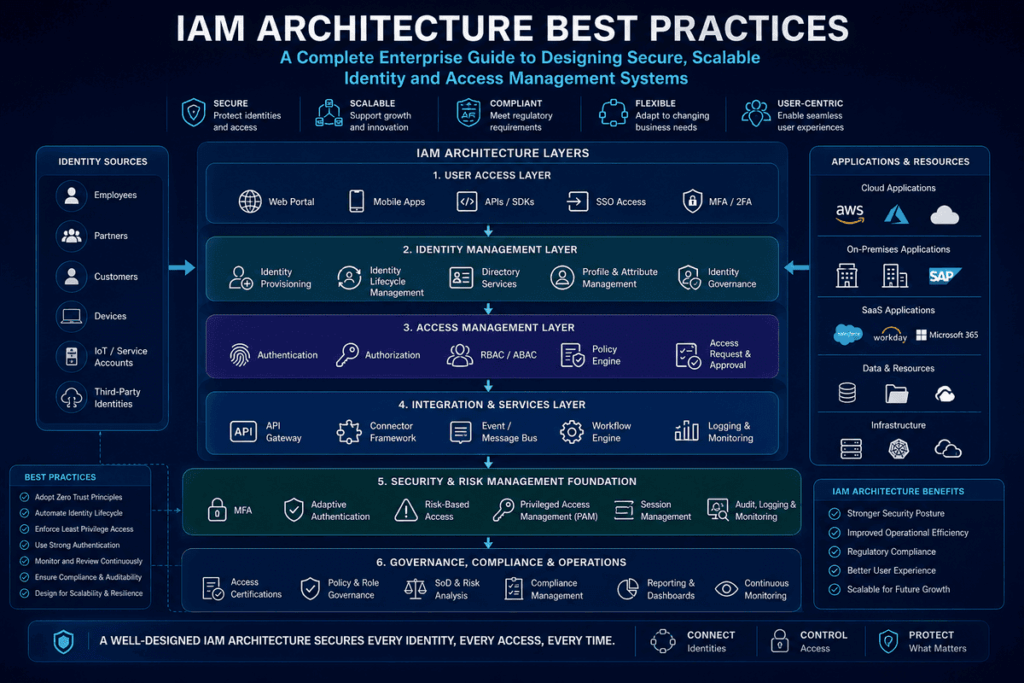
IAM Architecture Layers Explained
A mature IAM architecture can be understood as a stack of distinct functional layers, each serving a specific purpose:
| Layer | Function | Example Technologies |
|---|---|---|
| Presentation Layer | User portals, self-service, dashboards | Okta Dashboard, SailPoint UI |
| Identity Layer | Identity storage, profile management | Active Directory, Entra ID, LDAP |
| Authentication Layer | Login, MFA, SSO, federation | Ping Identity, Okta, ForgeRock |
| Authorization Layer | Access policy enforcement, RBAC/ABAC | OPA, AWS IAM, Azure RBAC |
| Provisioning Layer | Joiner/mover/leaver automation | SailPoint, One Identity |
| Governance Layer | Access certification, SoD, IGA | SailPoint IIQ, Saviynt, Omada |
| Directory Layer | Directory services and synchronization | AD, Entra ID, LDAP |
| Integration Layer | APIs, connectors, federation | MuleSoft, middleware, SCIM |
| Audit Layer | Logging, monitoring, forensics | SIEM, Splunk, Microsoft Sentinel |
| Analytics Layer | Risk scoring, anomaly detection, ITDR | Varonis, IBM Verify, Securonix |
Each layer must be designed with security, availability, and scalability in mind. Weak links at any layer can undermine the entire architecture.
IAM Architecture Models: On-Premise, Cloud, Hybrid, and IDaaS

On-Premise IAM
Traditional on-premise IAM deployments give organizations maximum control over their identity infrastructure. All components, directories, authentication services, provisioning engines, and governance tools, run within the organization’s own data centers. This model suits regulated industries with strict data residency requirements but requires significant investment in infrastructure maintenance and upgrades.
Advantages: Full control, no dependency on external services, suits air-gapped environments Disadvantages: High infrastructure cost, limited scalability, slower innovation cycle
Cloud IAM
Cloud IAM solutions are delivered as fully managed services. Microsoft Entra ID, Okta, and Google Cloud Identity are examples of identity platforms that handle infrastructure management, availability, and updates. Organizations consume identity services through APIs and prebuilt connectors.
Advantages: Rapid deployment, automatic updates, built-in scalability, lower infrastructure overhead Disadvantages: Data residency concerns, dependency on vendor availability, potential integration complexity with legacy systems
Hybrid IAM
Most enterprises operate in a hybrid model, where some applications and directories remain on-premise while others move to the cloud. Hybrid IAM architecture synchronizes and federates identities across both environments, typically using directory synchronization tools (like Microsoft Entra Connect) and federation protocols (SAML, OIDC).
Advantages: Gradual migration path, supports both legacy and modern applications Disadvantages: Increased architectural complexity, requires careful synchronization management
Multi-Cloud IAM
Organizations operating across AWS, Azure, and Google Cloud need IAM architecture that spans multiple cloud platforms consistently. Multi-cloud IAM typically uses a central identity provider that federates to each cloud platform’s native IAM service.
Identity as a Service (IDaaS)
IDaaS delivers IAM capabilities through a SaaS model. Vendors like Okta, Ping Identity, and Microsoft Entra provide SSO, MFA, lifecycle management, and access governance as fully managed cloud services. IDaaS has become the dominant deployment model for new IAM initiatives due to its speed of deployment and lower operational overhead.
IAM Architecture in Zero Trust Security
Zero Trust is not a product or a platform. It is a security philosophy and architecture model that treats every access request as potentially hostile until verified. IAM is the engine that powers Zero Trust.
Identity First: Zero Trust starts with identity. Every user, device, application, and service must have a verified identity before any access is granted.
Never Trust, Always Verify: Access decisions are made on every request, not just at initial login. Location, device health, time of access, and behavioral signals all contribute to the trust score.
Continuous Verification: Sessions are not statically trusted. Continuous authentication monitors for risk signals and re-challenges users when context changes.
Least Privilege Enforcement: Zero Trust architecture enforces minimal access rights, granting only what is necessary for the specific task at hand, and revoking it automatically when the task is complete.
Adaptive Authentication: Risk-based policies adjust authentication requirements dynamically. A user logging in from a recognized device at a normal time gets a seamless experience. The same user logging in from an unknown location at 3 a.m. gets stepped-up authentication.
Micro-Segmentation of Access: Rather than broad network access, Zero Trust IAM grants application-level and resource-level access, limiting the blast radius of any compromised identity.
IAM Architecture Across Industries
Different industries have different IAM requirements shaped by regulation, risk profile, and operational complexity.
Healthcare: HIPAA compliance demands strict access controls around electronic protected health information (ePHI). IAM architecture must support role-based access for clinical staff, privileged access for system administrators, and audit trails for every record access. Integration with EHR systems and clinical applications is critical.
Banking and Financial Services: GLBA, SOX, and PCI DSS impose rigorous access governance requirements. Financial institutions need strong PAM controls, SoD enforcement, real-time transaction monitoring, and identity analytics to detect insider threats and fraud.
Insurance: Similar to banking, insurance organizations need access governance, claims system integration, and compliance reporting. Broker and agent identity management adds complexity with large external user populations.
Government: Federal agencies follow NIST SP 800-63 digital identity guidelines and FedRAMP requirements. PIV/CAC card authentication, identity proofing, and rigorous audit capabilities are standard requirements.
Retail: High customer identity volumes, seasonal workforce spikes, and point-of-sale system integration shape retail IAM architecture. CIAM platforms handle customer registration, authentication, and consent management at scale.

Manufacturing: Operational technology (OT) environments, supplier identity management, and remote access for maintenance contractors create unique IAM challenges in manufacturing.
Education: Large, diverse user populations including students, faculty, staff, and alumni, combined with federated identity requirements for research collaboration, make higher education IAM architectures particularly complex.
Energy and Utilities: Critical infrastructure protection requirements under NERC CIP and ICS security frameworks demand rigorous identity controls for both IT and OT environments.
Technology: Fast-growing technology companies need IAM architectures that scale rapidly, support DevOps workflows, and secure machine identities and API access across complex microservices environments.
Common IAM Architecture Mistakes to Avoid
1. No Governance Layer: Building authentication and provisioning without IGA leaves access unchecked. Entitlement accumulation becomes a compliance liability.
2. Manual Provisioning Processes: Relying on manual access request approvals and ticket-based provisioning creates delays, inconsistencies, and audit gaps.
3. No Role Management Strategy: Deploying RBAC without a role lifecycle management process leads to role explosion. Hundreds of unmanaged roles become harder to govern than the individual entitlements they replaced.
4. Poor Documentation: Undocumented IAM architectures make troubleshooting, audits, and change management extremely difficult.
5. Weak Integrations: IAM platforms that aren’t fully integrated with HR systems, cloud platforms, and business applications operate in partial coverage mode. Access granted outside the IAM platform can’t be governed.
6. No MFA for Privileged Accounts: Skipping MFA for service accounts and administrator accounts is one of the highest-risk gaps in enterprise IAM.
7. Ignoring PAM: Treating privileged access like regular user access leaves the most sensitive credentials unprotected.
8. Legacy Directory Sprawl: Multiple unsynchronized directories create orphaned accounts, access inconsistencies, and governance blind spots.
9. No Automation in Deprovisioning: Delayed deprovisioning of terminated employees is consistently one of the most common audit findings and a frequent attack vector.
10. Identity as an Afterthought in Application Development: Applications that don’t integrate with the enterprise IAM platform create shadow identity systems that are difficult to govern and audit.
Enterprise IAM Architecture Implementation Roadmap
Building or modernizing an enterprise IAM architecture is a multi-phase initiative. Here is a practical roadmap:
Phase 1: Assessment Inventory all identity repositories, applications, and access management tools. Identify coverage gaps, orphaned accounts, and compliance risks. Define the current-state architecture map.
Phase 2: Planning and Strategy Define target-state architecture. Select deployment model (cloud, hybrid, on-premise). Choose technology platforms. Build the business case and secure executive sponsorship.
Phase 3: Architecture Design Design the identity fabric, including directory consolidation strategy, federation model, provisioning workflows, and governance processes. Define integration patterns for cloud and on-premise applications.
Phase 4: Pilot Deployment Deploy core components (SSO, MFA, provisioning) for a pilot user population and a representative set of applications. Validate integration patterns and user experience.
Phase 5: Production Deployment Expand deployment across the full user population and application catalog. Prioritize high-risk applications and privileged access environments in early waves.
Phase 6: Data Migration Migrate identity data from legacy systems. Synchronize directories. Clean up orphaned accounts and stale entitlements.
Phase 7: Governance Activation Launch access certification campaigns. Implement role management. Activate SoD policies and access request workflows.
Phase 8: Optimization Tune adaptive authentication policies. Implement identity analytics. Expand PAM coverage. Automate lifecycle workflows.
Phase 9: Continuous Monitoring Establish ongoing identity monitoring, threat detection, and compliance reporting. Schedule regular access reviews and architecture reviews.
IAM Architecture Technology Stack
Selecting the right technology components is critical to a successful IAM architecture. Here is an overview of the major platforms:
Directory Services:
- Microsoft Active Directory (on-premise standard)
- Microsoft Entra ID (formerly Azure AD, cloud identity platform)
- LDAP directories (OpenLDAP, Oracle Directory Server)
Identity and Access Management Platforms:
- Okta (leading cloud IAM/IDaaS platform)
- Ping Identity (enterprise identity platform with strong federation capabilities)
- ForgeRock (now part of Ping Identity, strong in CIAM and API security)
- Microsoft Entra ID (integrated with Microsoft 365 and Azure ecosystem)
- IBM Security Verify (enterprise IAM with AI-driven analytics)
Identity Governance and Administration:
- SailPoint (market-leading IGA platform with AI-powered access governance)
- Saviynt (cloud-native IGA with strong cloud access governance)
- One Identity (comprehensive IGA and PAM platform)
- Omada (European-focused IGA)
Privileged Access Management:
- CyberArk (market-leading PAM platform)
- BeyondTrust (PAM and remote access)
- Delinea (formerly Thycotic/Centrify)
Cloud IAM:
- AWS IAM and AWS Identity Center
- Azure RBAC and Microsoft Entra ID
- Google Cloud Identity and Access Management
Container and DevOps Identity:
- HashiCorp Vault (secrets management)
- Kubernetes RBAC
- Spiffe/Spire (workload identity)
SIEM and Identity Analytics:
- Microsoft Sentinel
- Splunk
- IBM QRadar
- Securonix
Future Trends in IAM Architecture
AI-Driven Identity Governance: Artificial intelligence is transforming how access decisions are made and reviewed. AI-powered IGA platforms can automatically detect access anomalies, recommend role assignments, and automate certification decisions based on peer group analysis and behavioral baselines.
Passwordless Authentication and Passkeys: The adoption of FIDO2/WebAuthn passkeys is accelerating. Passkeys replace passwords with cryptographic keys bound to devices and biometrics, eliminating phishing risk and improving user experience simultaneously.
Identity Fabric: The identity fabric concept describes a unified architecture that connects all identity services, cloud, on-premise, and hybrid, into a single, coherent policy enforcement framework. Gartner has identified identity fabric as a strategic architecture pattern for enterprise IAM.
Identity Security Posture Management (ISPM): ISPM tools continuously assess the security posture of identity infrastructure, identifying misconfigurations, excessive privileges, and identity risks before attackers can exploit them.

Identity Threat Detection and Response (ITDR): As attackers focus increasingly on identity systems, ITDR capabilities detect and respond to identity-based threats in real time. This emerging category combines identity analytics, behavioral monitoring, and automated response.
Decentralized Identity and Verifiable Credentials: Blockchain-based decentralized identity frameworks allow users to control their own identity credentials without relying on a central authority. W3C Verifiable Credentials and Decentralized Identifiers (DIDs) are the underlying standards.
Agentic AI Security: As AI agents and autonomous systems operate within enterprise environments, they require identity management capabilities. Governing AI agent access, monitoring AI-initiated transactions, and enforcing least privilege for machine agents is an emerging IAM challenge.
Continuous Access Evaluation Protocol (CAEP): CAEP enables real-time sharing of security events between identity providers and relying parties, enabling near-instant access revocation when risk signals change.
Behavior Analytics and User Entity Behavior Analytics (UEBA): Behavioral biometrics and UEBA tools continuously analyze how users interact with systems, flagging deviations that may indicate account compromise or insider threat.
How Avancer Corporation Helps Organizations Build Modern IAM Architecture
Designing and implementing an enterprise IAM architecture is a complex undertaking. The technology decisions alone can take months, and that’s before addressing the organizational change management, integration complexity, and governance process design that determine whether an IAM program actually delivers its intended outcomes.
Avancer Corporation has spent years helping organizations across healthcare, financial services, government, manufacturing, and technology sectors build, modernize, and optimize their IAM architectures. The team brings deep technical expertise in identity governance, privileged access management, cloud identity management, and Zero Trust implementation, paired with the practical knowledge of what works in real enterprise environments.
Avancer’s IAM services span the full identity lifecycle:
Identity Governance and Administration (IGA): Avancer helps organizations implement SailPoint, Saviynt, and other leading IGA platforms to automate access governance, run certification campaigns, enforce SoD policies, and manage role lifecycle.
Privileged Access Management: From CyberArk implementations to just-in-time privilege frameworks, Avancer’s PAM practice helps organizations secure their most sensitive accounts and reduce the attack surface for credential-based threats.
Cloud IAM and Hybrid Identity: Whether you’re migrating to Microsoft Entra ID, deploying Okta as your enterprise identity provider, or building a hybrid identity architecture that bridges on-premise directories and multi-cloud environments, Avancer brings the architecture expertise to do it right.
Single Sign-On and MFA: Avancer designs and deploys SSO and MFA solutions that improve the user experience while significantly strengthening authentication security across the application portfolio.
Identity Lifecycle Management and Provisioning: Automating joiner-mover-leaver workflows with reliable HR integrations reduces IT overhead, eliminates access accumulation, and ensures deprovisioning happens on time, every time.
Directory Services and Consolidation: Avancer helps organizations rationalize complex directory environments, clean up legacy identity data, and build reliable synchronization architectures.
IAM Consulting and Roadmap Development: For organizations at the beginning of their IAM modernization journey, Avancer provides assessment, architecture design, and roadmap services that translate business requirements into a practical, phased implementation plan.
IAM Managed Services: For organizations that need ongoing IAM operational support, Avancer provides managed identity services that keep IAM systems running, optimized, and aligned with evolving security and compliance requirements.
Zero Trust and Compliance: Avancer’s identity architects help organizations align IAM architecture with Zero Trust frameworks and regulatory compliance requirements, including HIPAA, SOX, CMMC, and others.
The goal isn’t to sell technology. It’s to help organizations build identity programs that actually work, that reduce risk, improve operational efficiency, support compliance, and scale as the business evolves.
Conclusion: Identity Architecture Is the Strategic Foundation of Enterprise Security
IAM architecture best practices are no longer a technical concern reserved for IT security teams. They are a business imperative that touches every employee, every application, every cloud platform, and every regulatory requirement the organization faces.
The organizations that invest in building a well-designed identity and access management architecture gain more than security. They gain operational efficiency through automation, competitive advantage through secure digital experiences, and regulatory confidence through audit-ready governance.
The direction of enterprise security is clear. Identity is the new perimeter. Zero Trust is the operating model. Cloud and hybrid environments are the norm. And the threats targeting identity systems are growing more sophisticated every year.
Whether you are designing an IAM architecture from scratch, modernizing a legacy identity infrastructure, or extending coverage to new cloud environments, the principles remain consistent: centralize identity, enforce least privilege, automate the lifecycle, implement governance, protect privileged access, and build for continuous verification.
The organizations that get this right will be better positioned to defend against credential-based attacks, pass compliance audits, support digital transformation initiatives, and scale securely as their business grows.
Avancer Corporation works with enterprises across industries to design, implement, and optimize IAM architectures that align with business strategy, security requirements, and compliance obligations. From identity governance and privileged access management to cloud identity migration, Zero Trust enablement, and IAM managed services, Avancer brings the technical depth and real-world experience to help organizations build modern identity programs that deliver lasting results.
Frequently Asked Questions About IAM Architecture:
What is IAM architecture?
IAM architecture is the structured framework of technologies, policies, and processes that an organization uses to manage digital identities and control access to systems, applications, and data. It includes authentication, authorization, identity governance, provisioning, directory services, and audit capabilities.
Why is IAM architecture important?
IAM architecture is important because identity is now the primary target in cyberattacks. Over 80% of data breaches involve compromised credentials. A well-designed IAM architecture controls who can access what, detects anomalies, enforces compliance, and reduces the risk of unauthorized access across the enterprise.
What are the core components of IAM architecture?
The core components include an identity repository (directory services), authentication layer (MFA, SSO, passwordless), authorization layer (RBAC, ABAC), provisioning engine, identity governance and administration (IGA), privileged access management (PAM), identity federation, session management, identity analytics, and audit and compliance capabilities.
What is SOA security in the context of IAM?
SOA security refers to the identity controls applied to service-oriented architectures and microservices environments. It covers securing service-to-service communication using OAuth 2.0, OIDC, SAML, and security tokens. Machine identities, API security, and service accounts all fall under SOA security in enterprise IAM architecture.
What is Zero Trust architecture and how does IAM fit in?
Zero Trust is a security model based on the principle of “never trust, always verify.” IAM is the foundational layer of Zero Trust, providing identity verification, continuous authentication, least privilege enforcement, and adaptive access controls. Without a mature IAM architecture, Zero Trust cannot be effectively implemented.
What is Identity Governance and Administration (IGA)?
IGA is the discipline of managing and governing access rights across the enterprise. It includes access request workflows, access certification campaigns, role lifecycle management, separation of duties (SoD) enforcement, and compliance reporting. IGA platforms like SailPoint and Saviynt automate these processes at enterprise scale.
What is provisioning in IAM?
Provisioning is the process of creating, modifying, and removing user accounts and access rights across connected systems. Automated provisioning ties identity lifecycle events (hiring, role changes, terminations) to access changes in real time, reducing manual overhead and eliminating orphaned accounts.
What is RBAC?
Role-Based Access Control (RBAC) is an authorization model that assigns permissions to users based on their job role rather than individually. A user inherits access rights from the roles assigned to them. RBAC simplifies access management and supports least privilege when roles are well-defined and regularly reviewed.
What is ABAC?
Attribute-Based Access Control (ABAC) is an authorization model that makes access decisions based on attributes of the user, the resource, and the environment. For example, a policy might grant access only if a user’s department is “Finance,” their clearance level is “Confidential,” and the access request originates from a corporate-managed device. ABAC provides more granular control than RBAC and handles complex, dynamic access scenarios more effectively.
