
What is a security token? It sounds like a straightforward question, but the answer sits at the crossroads of traditional finance, blockchain technology, and securities law.
Put simply, a security token is a digital token issued on a blockchain that represents a real-world financial asset. Think of it as a stock certificate or bond document, except it lives on a distributed ledger and can be traded, transferred, or managed using smart contracts. These tokens are not like Bitcoin or Ethereum. They are explicitly designed to comply with securities regulations, and they grant holders tangible rights such as dividends, profit sharing, or equity ownership.
The concept has gained significant momentum over the last several years. Institutions like BlackRock, Nasdaq, and major global banks are actively exploring tokenized securities. Regulatory frameworks in the U.S. and Europe are catching up. And the market infrastructure to support these instruments is quietly being built out.
This guide covers everything you need to know: what security tokens are, how they work, the different types, the regulatory landscape, real-world examples, and why identity security is a critical but often overlooked piece of the puzzle.
Background & Evolution of Security Tokens
To understand where security tokens are today, it helps to know where they came from.
The story starts with the Initial Coin Offering (ICO) boom of 2017. That year, blockchain startups raised billions of dollars by issuing digital tokens to the public, often with very little regulatory oversight. Many of these tokens promised future utility on platforms that did not yet exist. The market was speculative, largely unregulated, and attracted enormous attention from both investors and fraudsters.
By 2018, regulators had seen enough. The U.S. Securities and Exchange Commission (SEC) began cracking down, issuing guidance that many ICO tokens were likely securities under the Howey test and therefore subject to existing securities laws. Suddenly, the industry needed a compliant alternative.
That alternative was the Security Token Offering, or STO. Unlike ICOs, STOs were designed from the ground up to comply with securities regulations. They required proper registration or exemptions, rigorous KYC and AML checks, and formal investor disclosures.
Key milestones since then include:
- 2018: First notable STOs launch in the U.S. and Europe. The SEC publishes detailed guidance on when crypto tokens qualify as securities.
- 2020: The World Bank issues Bond-i, a tokenized bond on a public blockchain, demonstrating institutional viability.
- 2021-2022: Major financial institutions begin piloting tokenized funds and bonds. HSBC launches a tokenized gold product.
- 2023: The European Union formally adopts the Markets in Crypto-Assets (MiCA) regulation, creating one of the world’s first comprehensive crypto-asset frameworks.
- 2024: BlackRock launches its BUIDL fund as a tokenized money market fund on the Ethereum blockchain, drawing over $500 million in assets.
- 2025: Nasdaq files a proposal with the SEC to allow trading of tokenized securities on traditional exchange infrastructure. The U.S. GENIUS Act is introduced, carving out stablecoins from securities law while leaving tokenized securities firmly under SEC jurisdiction.
The trajectory is clear. Security tokens have moved from fringe experimentation to institutional adoption.
What Is a Security Token?
Definition Box: A security token is a blockchain-based digital asset that represents a stake in a real-world asset or enterprise, such as equity, debt, or property. It is regulated as a security and grants holders economic or governance rights, including dividends, profit sharing, or voting.
According to the SEC, a tokenized security is “a financial instrument represented by a crypto asset, where the record of ownership is maintained on a crypto network.” This is not a new asset class. It is the same class of financial instruments that has always existed, expressed in a new technological form.
Binance Academy describes it well: a security token is “a token representing a stake in an external asset or enterprise, serving the same purpose as stocks, bonds, and other equities.”
What sets security tokens apart from other blockchain assets is intent and regulation. A security token is designed to be an investment instrument. It passes the Howey test, which asks whether an instrument involves an investment of money in a common enterprise with an expectation of profit from the efforts of others. If it does, it is a security, and the issuer must comply with securities laws.
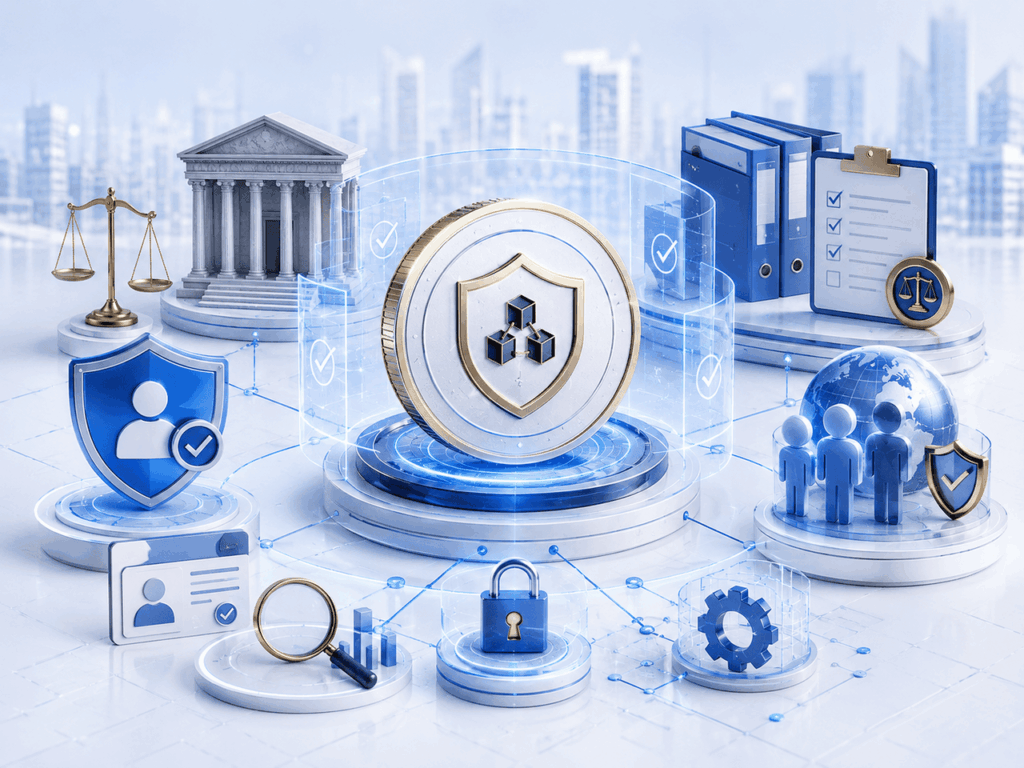
Key Features of Security Tokens
- Programmable compliance: Transfer restrictions, investor eligibility checks, and reporting obligations are embedded directly into the token’s smart contract.
- On-chain ownership records: Every transaction is permanently recorded on a distributed ledger, creating a tamper-resistant audit trail.
- Fractionalization: A $5 million commercial property can be divided into thousands of tokens, each worth a fraction of the total, allowing smaller investors to participate.
- Automated distributions: Dividends, interest payments, or profit shares can be distributed automatically via smart contracts without requiring manual processing.
- Voting rights: Governance mechanisms can be built directly into the token, allowing holders to vote on corporate decisions on-chain.
These features make security tokens significantly more flexible and efficient than traditional securities, without sacrificing the legal protections investors expect.
How Security Tokens Work
Security tokens rely on two foundational technologies: blockchain networks and smart contracts.
A blockchain provides the underlying distributed ledger. All token ownership records are stored across thousands of nodes simultaneously, making the data highly resistant to tampering or manipulation. When a token changes hands, the transaction is validated by the network and permanently recorded.
Smart contracts are self-executing programs stored on the blockchain. For security tokens, smart contracts do much of the heavy lifting. They enforce who can hold the token, automatically distribute income, and ensure that transfers only occur when all regulatory conditions are met.
Here is how a typical security token transaction works in practice:
- An investor completes identity verification and KYC/AML checks on the issuer’s platform.
- Once approved, the investor purchases tokens during the issuance phase.
- The smart contract mints the tokens and records the investor’s wallet address as the owner.
- If the investor later wants to sell, the smart contract checks whether the buyer is also verified and eligible.
- If conditions are met, the transfer is executed on-chain. If not, it is automatically rejected.
- Distributions, such as quarterly dividends, are sent directly to token holders’ wallets by the smart contract.
This process removes layers of intermediaries, including transfer agents, clearing houses, and custodians, though regulated custodial arrangements are still typically required for institutional-grade tokens.
The Tokenization Process & Lifecycle
The life of a security token follows a defined arc from creation to potential redemption.
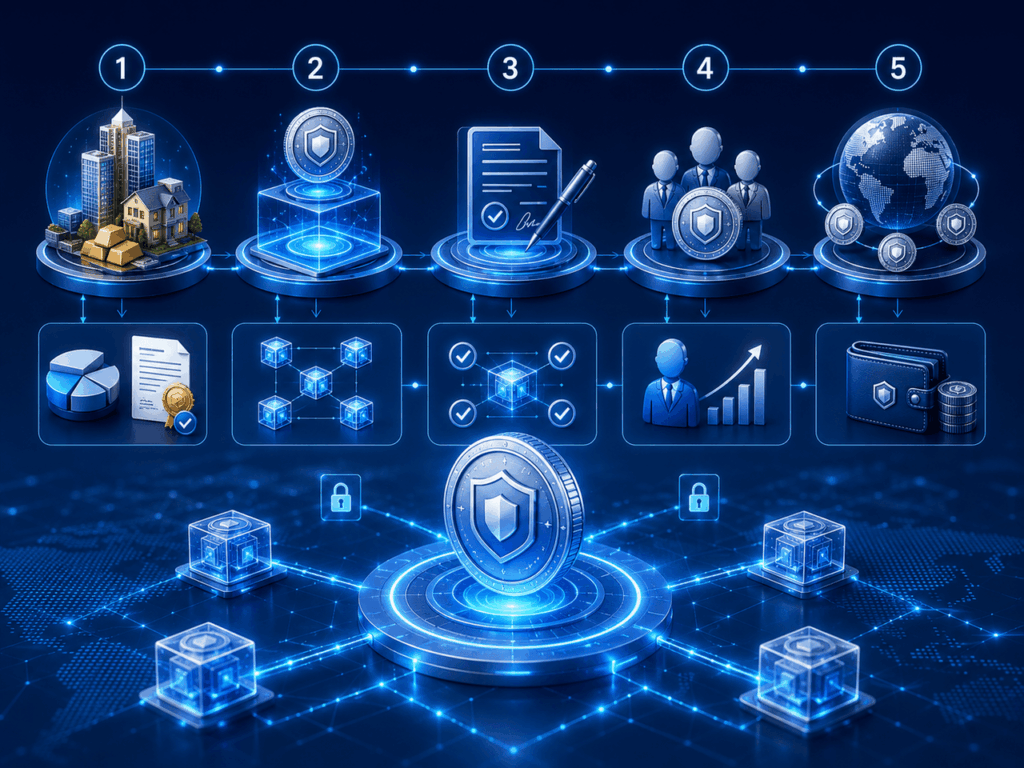
Stage 1 – Asset and Legal Structuring: Before any code is written, legal and financial groundwork must be laid. The issuer defines what asset is being tokenized, how ownership rights are structured, and which regulatory exemptions or registrations apply.
Stage 2 – Token Design and Smart Contract Deployment: Developers build the token’s smart contract using standards like ERC-1400 (for Ethereum-based security tokens) or the T-REX protocol (Token for Regulated EXchanges, also known as ERC-3643). These standards include built-in compliance modules.
Stage 3 – Primary Issuance (STO): The issuer conducts an STO, selling tokens to approved investors through a regulated platform. KYC, AML, and accreditation checks are completed at this stage.
Stage 4 – Secondary Market Trading: After the lockup period (if any), tokens may be tradeable on regulated alternative trading systems (ATS) or digital asset exchanges that support tokenized securities.
Stage 5 – Ongoing Management: Smart contracts automatically handle distributions, corporate actions, and record updates throughout the token’s life.
Stage 6 – Redemption or Expiry: When the underlying asset is sold or the token’s term ends, the smart contract may automatically burn the tokens and return capital to holders.
[Asset Structuring] --> [Smart Contract Deployment] --> [STO / Primary Issuance]
        |                                                        |
[Secondary Trading] <-- [On-Chain Record Keeping] <-- [Investor KYC Approval]
        |
[Dividend/Income Distribution] --> [Token Redemption / Burn]
Security Token Offerings (STOs)
An STO is the compliant mechanism through which security tokens are sold to investors. Think of it as the blockchain equivalent of an IPO or a private placement, but with the token infrastructure built in from the start.
Unlike ICOs, which operated largely outside regulatory frameworks, STOs require issuers to either register the offering with the SEC or qualify for an exemption. Common exemptions used include:
- Regulation D (Rule 506(b) or 506(c)): Allows issuances to accredited investors without SEC registration.
- Regulation A+: Allows public offerings of up to $75 million per year with lighter registration requirements.
- Regulation S: Covers offerings made exclusively to non-U.S. investors.
- Regulation CF (Crowdfunding): Allows limited crowdfunded offerings to both accredited and non-accredited investors.
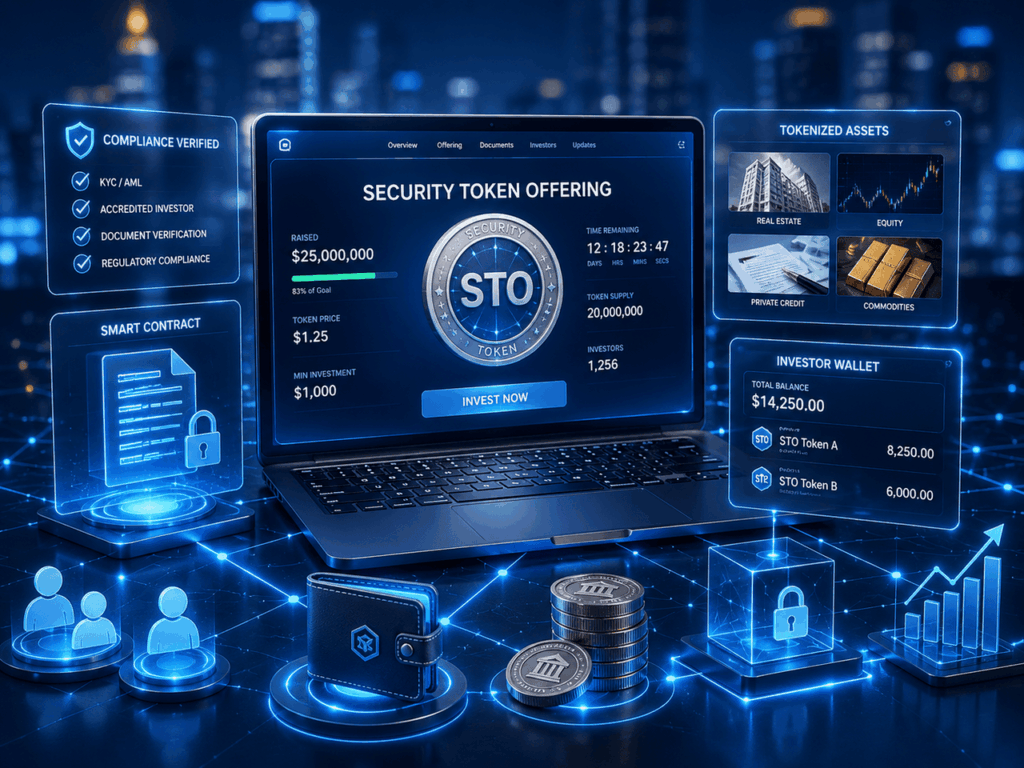
A notable early example was the 2020 World Bank Bond-i, the first bond to be both created and managed on a blockchain. The project ran on a private Ethereum network and demonstrated that regulated institutions could successfully issue tokenized debt instruments.
More recently, platforms like Securitize and tZERO have facilitated dozens of STO issuances, covering everything from real estate funds to venture capital portfolios.
Types of Security Tokens
Not all security tokens represent the same type of asset. The category is broad and includes several distinct subcategories.
Equity Tokens
These represent ownership shares in a company or fund. Holding an equity token is functionally similar to holding stock. The token may confer voting rights, dividend entitlements, and liquidation preferences, all enforced by smart contract.
Debt Tokens
Debt tokens represent bonds, loans, or other fixed-income instruments. They carry a face value, interest rate, and maturity date. Interest payments are distributed automatically on-chain. Tokenized government bonds and corporate bonds fall into this category.
Real Estate Tokens
One of the most discussed applications of security tokens. A commercial building worth $20 million could be divided into 20 million tokens at $1 each. Investors can buy fractional interests, receive rental income proportionally, and trade their tokens on secondary markets without waiting for a traditional property sale.
Asset-Backed Tokens
These are backed by tangible physical assets, such as gold, commodities, or fine art. HSBC’s tokenized gold product is an example. The token represents a fractional claim on actual physical gold held in custody.
Revenue and Profit-Sharing Tokens
These tokens grant holders a share of a company’s or project’s revenue stream without necessarily conferring formal equity ownership. They are common in entertainment, intellectual property, and startup financing contexts.
Security Tokens vs Other Tokens
Understanding what a security token is also means understanding what it is not.
| Feature | Security Token | Utility Token | Stablecoin | RWA Token |
|---|---|---|---|---|
| Represents | Financial asset/ownership | Platform access/service | Pegged currency value | Broad real-world asset |
| Regulated as | Security | Often unregulated | Currency/payment (varies) | Varies by asset type |
| Returns | Dividends, equity gains | None (service access) | Price stability | Varies |
| Howey Test | Passes | Typically does not pass | Typically does not pass | May pass |
| Examples | Tokenized stocks, bonds | Filecoin, Basic Attention Token | USDC, Tether | Tokenized real estate, carbon credits |
Utility tokens grant access to a product or service on a platform. Ethereum’s native gas payments and in-app credits are utility functions. They are not designed as investment instruments.
Stablecoins are pegged to a fiat currency and primarily serve as a medium of exchange or store of value. Under the U.S. GENIUS Act of 2025, approved stablecoins are explicitly carved out from securities regulation.
RWA tokens (Real-World Asset tokens) is a broader industry term that sometimes overlaps with security tokens but can also include non-security assets like carbon credits or commodities.
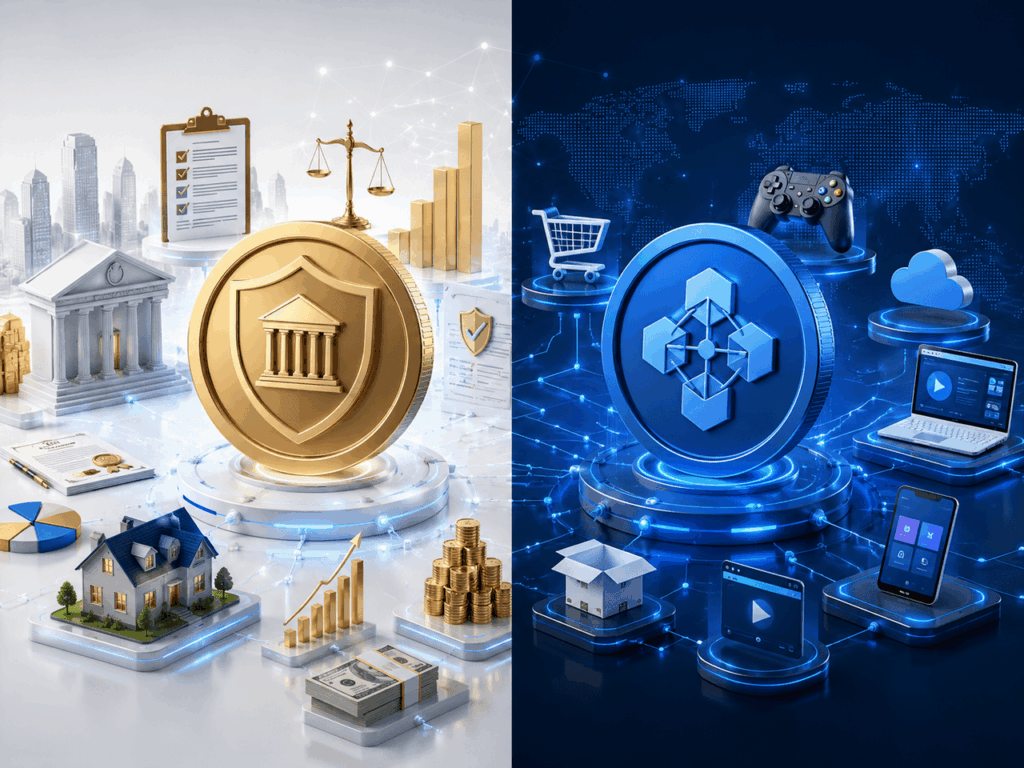
The critical distinction is this: if a token represents an investment in a common enterprise with an expectation of profit driven by others’ efforts, it is likely a security under U.S. law.
Benefits and Use Cases
The case for security tokens comes down to efficiency, access, and transparency.
Increased Liquidity Many high-value assets, particularly real estate, private equity, and fine art, are traditionally very illiquid. Selling a $10 million office building takes months and requires expensive intermediaries. Tokenization allows fractional ownership, opening these assets to a much wider investor base and creating secondary market tradability that simply did not exist before.
Faster and Cheaper Settlement Traditional securities settlement in the U.S. operates on a T+1 basis following the recent SEC rule change. Blockchain-based settlement can happen in minutes, with lower counterparty risk and reduced need for clearing intermediaries.
Global Accessibility Security tokens can be offered to qualified investors anywhere in the world. A German investor can hold a fractional share of a Dallas office tower. A Brazilian pension fund can invest in a U.S. infrastructure bond. Geography becomes far less of a constraint.
Transparency and Audit Trail Every transaction is permanently recorded on the blockchain. Regulators, auditors, and investors can verify ownership records and transaction histories without relying on third-party record-keepers.
Automated Compliance Smart contracts enforce who can buy, sell, and hold tokens. This removes entire categories of compliance risk that currently require human oversight, manual checks, and paper trails.
Portfolio Diversification Tokenization opens up asset classes that were previously accessible only to institutional investors or high-net-worth individuals. Retail investors can now build diversified portfolios including tokenized real estate, private credit, and infrastructure assets.
Regulatory Framework
Regulation is the defining challenge and the defining opportunity for security tokens. Here is where the major jurisdictions currently stand.
United States
The SEC takes the position that tokenized securities are subject to the same laws as traditional securities. The form of the instrument does not change its legal character. This means issuers must register their offerings or qualify for an exemption, disclose material information to investors, and use registered broker-dealers and transfer agents.
In January 2026, the SEC issued updated guidance categorizing types of tokenized securities and clarifying which exemptions apply in various contexts. Commissioner Hester Peirce has been a prominent voice for providing regulatory clarity to enable compliant innovation.
The Howey test remains the primary analytical tool. Any token that (1) involves an investment of money, (2) in a common enterprise, (3) with an expectation of profits, (4) from the efforts of others, is a security.
European Union
Under MiFID II and the more recent MiCA regulation, investment-type crypto assets that qualify as financial instruments fall under existing EU securities law. Issuers must produce a prospectus, meet capital requirements, and register with relevant national competent authorities. ESMA provides ongoing technical guidance to national regulators on how to classify specific tokens.
The EU DLT Pilot Regime, which came into force in 2023, allows regulated exchanges to experiment with blockchain-based settlement for tokenized securities under a sandboxed regulatory environment.
Other Jurisdictions
Switzerland’s FINMA distinguishes clearly between payment tokens, utility tokens, and asset tokens (which are treated as securities). Singapore’s Monetary Authority of Singapore (MAS) regulates digital payment tokens and security tokens under different parts of the Securities and Futures Act. These jurisdictions have been generally more proactive about creating legal clarity, which has attracted significant STO activity.
The overarching principle is consistent across all major markets: security tokens must comply with the same securities laws as their traditional equivalents.
The Role of Identity Security in Security Token Ecosystems
Security tokens are, at their core, about ownership. And ownership claims are only as trustworthy as the identity verification processes behind them.
This is a critical, and frequently underestimated, challenge in the tokenized asset space.

Why Investor Identity Verification Matters
When a smart contract enforces that only accredited investors can hold a particular token, that enforcement is entirely dependent on the accuracy of the underlying identity data. If an investor’s verification record is compromised, stale, or inaccurate, the compliance layer fails. The token may end up in the hands of an ineligible holder, creating regulatory liability for the issuer.
KYC (Know Your Customer) and AML (Anti-Money Laundering) processes are not just regulatory checkboxes. They are foundational to the integrity of the entire tokenized securities infrastructure.
Access Management for Investors and Administrators
A tokenized asset platform typically involves multiple layers of access: investors accessing their portfolios, fund administrators managing distributions, compliance officers reviewing transaction records, and smart contract operators managing token parameters.
Each of these roles requires precise access controls. An investor should have read access to their own holdings but not to other investors’ data. A compliance officer needs audit visibility without the ability to modify records. An administrator needs operational access but with full audit logging.
This is where modern Identity and Access Management (IAM) principles become directly relevant. Role-based access control (RBAC), least-privilege policies, and just-in-time access provisioning are not just IT best practices. They are regulatory necessities in a securities environment.
Identity Governance in Tokenized Platforms
As tokenized asset platforms scale, managing who has access to what becomes increasingly complex. Employees move between roles. Investors change their accreditation status. Service providers gain and lose access. Without a structured identity governance program, these changes create access drift, where users accumulate permissions they no longer need or should not have.

Access certification processes, where administrators periodically review and certify that all access rights remain appropriate, are a key control in both traditional financial services and tokenized asset platforms.
Multi-Factor Authentication and Secure Access
For investors, securing a wallet or platform account is critical. A compromised account in a traditional brokerage means unauthorized trades. A compromised account in a tokenized platform could mean irreversible on-chain transfers. Multi-factor authentication (MFA) is not optional in this context.
Single Sign-On (SSO) solutions can provide investors with a seamless and secure access experience across multiple platforms while centralizing authentication controls for administrators.
Organizations building or operating tokenized asset platforms should treat identity security as a foundational architectural concern, not an afterthought. The firms that get this right will be positioned to meet regulatory expectations and win institutional trust.
Industry Examples and Platforms
The tokenized securities market, while still early-stage, already has a meaningful body of real-world activity.
BlackRock BUIDL Fund: Launched in March 2024, BlackRock’s tokenized money market fund on the Ethereum blockchain attracted over $500 million in assets in its first several months. It represents one of the most significant institutional endorsements of tokenized securities to date.
Nasdaq Tokenization Proposal: In 2025, Nasdaq filed a rule proposal with the SEC to allow trading of tokenized securities on its regulated exchange infrastructure. If approved, this would bring tokenized assets into the mainstream of U.S. equity markets.
Securitize: One of the leading platforms for digital securities issuance in the U.S. Securitize has facilitated tokenized offerings for real estate funds, venture capital funds, and private equity vehicles. It is also the transfer agent for the BlackRock BUIDL fund.
tZERO: A regulated alternative trading system specifically designed for security tokens. tZERO has listed tokenized equity and debt instruments and serves as secondary market infrastructure.
World Bank Bond-i: The first bond created, allocated, transferred, and managed using blockchain technology. Issued in 2018, it raised AUD 110 million and demonstrated that sovereign-grade institutions could execute tokenized debt.
HSBC Orion: HSBC’s tokenized asset platform, which has been used to issue tokenized gold and tokenized bonds for institutional clients.
These examples span asset classes, geographies, and institution types. The common thread is that regulatory compliance, not just technical capability, is the prerequisite for participation.
Challenges & Risks
Despite the momentum, security tokens face real obstacles that have slowed mass adoption.
Regulatory Complexity While frameworks are improving, issuers still face a patchwork of regulations across jurisdictions. A token offering that is compliant in the U.S. may require additional steps in the EU or Singapore. Cross-border issuance remains legally complicated.
Market Infrastructure Gaps The secondary market for security tokens remains thin. There are only a handful of regulated trading venues, and the number of active market participants is still small. Liquidity improvements are happening but are not yet comparable to traditional markets.
Custody Challenges Institutional investors require regulated custodians for their holdings. The ecosystem of qualified digital asset custodians is growing but still limited compared to traditional securities custody infrastructure.
Technical Risk Smart contract bugs are not theoretical. Errors in contract code can create vulnerabilities that malicious actors exploit, and unlike traditional securities transactions, on-chain transfers are generally irreversible.
Investor Education Many retail and even institutional investors remain unfamiliar with how security tokens work, how to hold them securely, and how their rights compare to traditional securities. Adoption requires education at scale.
Valuation and Reporting Marking tokenized assets to market and producing audit-ready financial reports remains more complex than for listed securities, creating operational overhead for fund administrators.
Future Outlook
The directional trend is clear, even if the timeline is uncertain.
Institutional adoption is the primary driver. When BlackRock tokenizes a fund, when Nasdaq proposes trading tokenized securities, and when major sovereign bond markets experiment with DLT settlement, the signal to the rest of the industry is unmistakable.
Standards development is also progressing. ERC-1400, ERC-3643 (T-REX), and similar protocols are establishing technical conventions that allow interoperability between platforms. As these standards mature, the cost and complexity of building compliant tokenized asset infrastructure will decrease.

Regulatory clarity is improving, if slowly. The EU’s MiCA framework, the U.S. GENIUS Act’s clear treatment of stablecoins (which, by clarifying what is not a security, implicitly clarifies what is), and ongoing SEC guidance are collectively building a more navigable legal environment.
Market size projections vary, but reports from Citi, McKinsey, and major asset managers consistently point to tokenized asset markets potentially reaching $10 trillion or more by 2030, spanning bonds, equities, real estate, and alternative assets.
The infrastructure layer, including exchanges, custodians, transfer agents, and identity verification providers, will mature in parallel. Companies that position themselves in these foundational roles today will have significant advantages as market volume grows.
Larry Fink of BlackRock has been direct about his view: the tokenization of financial assets is not a question of if but when, and the process is already underway.
Conclusion:
What is a security token? It is the natural evolution of financial instruments, adapted for a world where blockchain technology can deliver ownership records with more transparency, efficiency, and programmability than traditional paper-based or centralized ledger systems.
Security tokens are not a replacement for traditional securities law. They are traditional securities, issued and managed on a distributed ledger. The Howey test still applies. SEC registration requirements still apply. Investor disclosures still apply. What changes is the infrastructure through which these obligations are fulfilled and these rights are exercised.
For investors, the promise is fractional access to previously inaccessible assets, faster settlement, and 24/7 trading. For issuers, it is lower cost, broader investor reach, and automated compliance. For regulators, it is a more transparent and auditable market.
The technology is ready. The regulatory frameworks are taking shape. The institutional validation has arrived. What remains is the buildout of reliable, secure, and compliant infrastructure, and that includes, critically, the identity and access management systems that verify who investors are and govern what they can do.
Organizations navigating this space would benefit from partnering with firms that bring deep expertise in identity security, access governance, and compliance automation. Companies specializing in identity lifecycle management, access certification, and secure authentication are not peripheral to the tokenized asset story. They are central to making it work.
Frequently Asked Questions:
What is a security token?
A security token is a digital token issued on a blockchain that represents a real-world financial asset such as equity, debt, or property. It is regulated as a security and grants holders economic rights including dividends, ownership stakes, or profit sharing.
How is a security token different from a utility token?
A security token represents a financial investment and must comply with securities laws. A utility token grants access to a product or service on a platform and is not designed as an investment instrument. The key legal test in the U.S. is the Howey test.
What is a Security Token Offering (STO)?
An STO is a regulated fundraising event where security tokens are sold to investors. Unlike ICOs, STOs require regulatory compliance including investor accreditation checks, KYC/AML verification, and SEC registration or a qualifying exemption.
What assets can be tokenized as security tokens?
Almost any asset with defined ownership can be tokenized: company shares, bonds, real estate, fine art, commodities, private equity fund interests, and revenue streams. A $10 million real estate asset, for example, could be divided into thousands of tokens for fractional investor access.
Are security tokens legal in the United States?
Yes, when issued and managed in compliance with securities laws. Issuers must register with the SEC or qualify for an exemption such as Regulation D, Regulation A+, or Regulation S, and follow standard disclosure and investor protection requirements.
How do security tokens trade?
Security tokens trade on regulated alternative trading systems (ATS) or licensed digital asset exchanges. Settlement can occur on-chain, subject to applicable regulatory frameworks. Nasdaq has proposed extending its infrastructure to support tokenized securities trading.
What is the Howey test and why does it matter for security tokens?
The Howey test is the U.S. Supreme Court’s framework for determining whether an instrument qualifies as a security. It asks whether there is an investment of money in a common enterprise with an expectation of profit from others’ efforts. Most security tokens are deliberately structured to comply with this standard.
What role do smart contracts play in security tokens?
Smart contracts automate and enforce the rules governing a security token. They control who can hold the token, distribute income automatically, enforce transfer restrictions, and maintain compliance without requiring manual intervention for each transaction.
What are the main risks of investing in security tokens?
Key risks include thin secondary market liquidity, technical risks from smart contract vulnerabilities, regulatory uncertainty across jurisdictions, custody complexity, and the possibility of fraud or misrepresentation in the underlying asset. Due diligence remains essential.
What is the future of security tokens?
Institutional adoption is growing. BlackRock, Nasdaq, and major sovereign issuers are all exploring or actively using tokenized securities. Regulatory frameworks are maturing in the U.S. and EU. Market forecasts project the tokenized asset market could reach trillions in value over the next decade as infrastructure, standards, and investor education improve.
